Why Wool Fiber Holds Pet Hair Better Than Synthetic Fiber
Wool fiber is not smooth. Under magnification, each individual wool strand is covered in tiny overlapping scales along the length of the fiber, similar in concept to the scales on a fish or the barbs on a feather. These scales are what give wool its natural felting capacity, its warmth retention, and its ability to crimp and hold a pile structure. They are also exactly what makes pet hair so difficult to remove from wool pile once it gets past the surface layer.
Pet hair, particularly from dogs with coarser coat types, also has a scale structure along the shaft. When a hair falls into wool pile and works its way down through mechanical contact from foot traffic or from the pet itself moving across the rug, the scales on the hair shaft and the scales on the wool fiber interlock in a ratcheting action. The hair can move inward easily because the scales align in the direction of travel. Pulling it back out goes against the grain of both scale structures, which is why you can run a lint roller across the surface of a wool rug and pull off the loose surface hair but leave the embedded hair almost entirely untouched.
Synthetic fibers like nylon and polyester have smooth or lightly textured surfaces compared to wool. Hair that falls onto a synthetic pile rug tends to sit at the surface or in the upper portion of the pile, where suction from a good vacuum can reach it. It does not interlock with the fiber the same way because there is no scale structure to catch on. This is why the same pet, on the same two rugs side by side, will leave the wool rug looking significantly more embedded with hair over time while the synthetic rug vacuums up relatively clean.
The dander situation compounds this. Pet dander is fine, dry, and light. It settles into wool pile and catches on the same fiber scales that catch the hair, working its way to the lower pile layers over time. In a home where a pet spends significant time on or near a wool rug, the dander accumulation at the base of the pile can be substantial after a year or two, and it carries allergen load even after the visible hair on the surface has been vacuumed off.
The Difference Between Surface Hair and Embedded Hair
Not all pet hair in a wool rug is equally difficult to remove, and knowing the difference between surface hair and embedded hair is important before any cleaning process starts. Surface hair is in the top quarter of the pile depth. It has not worked its way down to the point where the fiber scale interlocking becomes the dominant retention force. A good quality vacuum with a strong suction head, used in multiple directions across the rug, removes a meaningful percentage of this material. Rubber-bristle tools also help because the rubber creates static attraction that pulls hair up and out of the pile more effectively than a standard vacuum brush head.
Embedded hair is in the lower half of the pile or at the base. At this depth, the scale interlocking is the main thing holding it in place and suction alone is not strong enough to overcome it. You can feel the difference by pressing your palm flat against the rug surface and dragging it firmly against the pile direction. Surface hair comes up and follows the hand. Embedded hair does not move. If you do this test in several directions on a rug that a dog has been using regularly for a year or more, you will often feel and see the embedded layer staying put while the surface layer moves.
This distinction matters for cleaning because embedded hair in wool pile requires specific mechanical pre-treatment before any liquid chemistry goes down. If you apply moisture to a wool rug with heavily embedded hair without loosening it first, the moisture swells the wool fiber slightly, which tightens the scale structure around the embedded material and makes it harder to remove. Getting the mechanical step right before the wet step is the sequence that determines whether the cleaning gets the hair out or locks it in further.
The Palm-Drag Test: Do This Before Calling Anyone
This takes about thirty seconds and tells you whether you have a surface hair situation or an embedded hair situation:
- Press your palm flat against the rug and drag it firmly against the pile direction
- If hair comes up easily and follows your hand: surface hair is the primary issue, maintenance vacuuming with a rubber brush tool is managing it reasonably
- If your hand comes away with little hair despite the rug looking like it has hair in it: the hair is embedded and suction is not reaching it
- Repeat in several directions across the rug, particularly in the zones where the pet rests most often
- A flat, slightly gritty feel in those zones, even without visible hair on the surface, indicates compacted dander accumulation at the pile base
Embedded hair and deep dander accumulation require professional mechanical pre-treatment to address. Surface hair requires better ongoing maintenance technique.
The Cleaning Process for Pet Hair in Wool Pile
The cleaning process for a wool rug with embedded pet hair starts dry and stays dry for longer than most people expect. The first step is a thorough dry extraction pass to pull out everything loose from the surface layer before anything else happens. This is slow, deliberate passes in multiple directions with a proper suction tool that actually reaches into the pile, not just across the top of it. Taking the time to do this thoroughly removes the easy surface material so the subsequent steps are dealing only with what is actually embedded.
After the dry extraction pass, a rubber-bristle tool worked through the pile in short, firm strokes against the pile direction loosens embedded hair by working against the scale interlocking rather than with it. The goal is not to pull the hair out at this stage but to break the interlocking grip so the hair can be extracted rather than having to be pulled free against resistance. Going with the pile direction at this stage does nothing useful. The mechanical action has to work against the direction of scale overlap to disturb the interlocking.
After the mechanical pre-treatment, a second dry extraction pass with suction pulls out the loosened hair that the rubber tool brought up from the deeper pile layers. In a rug with significant embedding, the amount of material that comes out in this second dry pass compared to the first is a clear indicator of how deep the problem went. This is often the point where a homeowner who is watching says something like "I had no idea that much was in there."
The wet cleaning step comes after the hair situation has been addressed as thoroughly as possible in the dry phase. The citrus-based solution sits in a safe pH range for wool and addresses the organic soil component, including the dander and skin oil accumulation in the lower pile, without stressing the fiber chemistry. Low moisture is especially important with wool because wool absorbs water readily and takes longer to dry than synthetic fiber. An over-wet wool rug that is slow to dry at the pile base is a browning risk. The VLM process keeps moisture application controlled and targeted.
A Wool Rug With a Dog in the House: What Cleaning Actually Looks Like
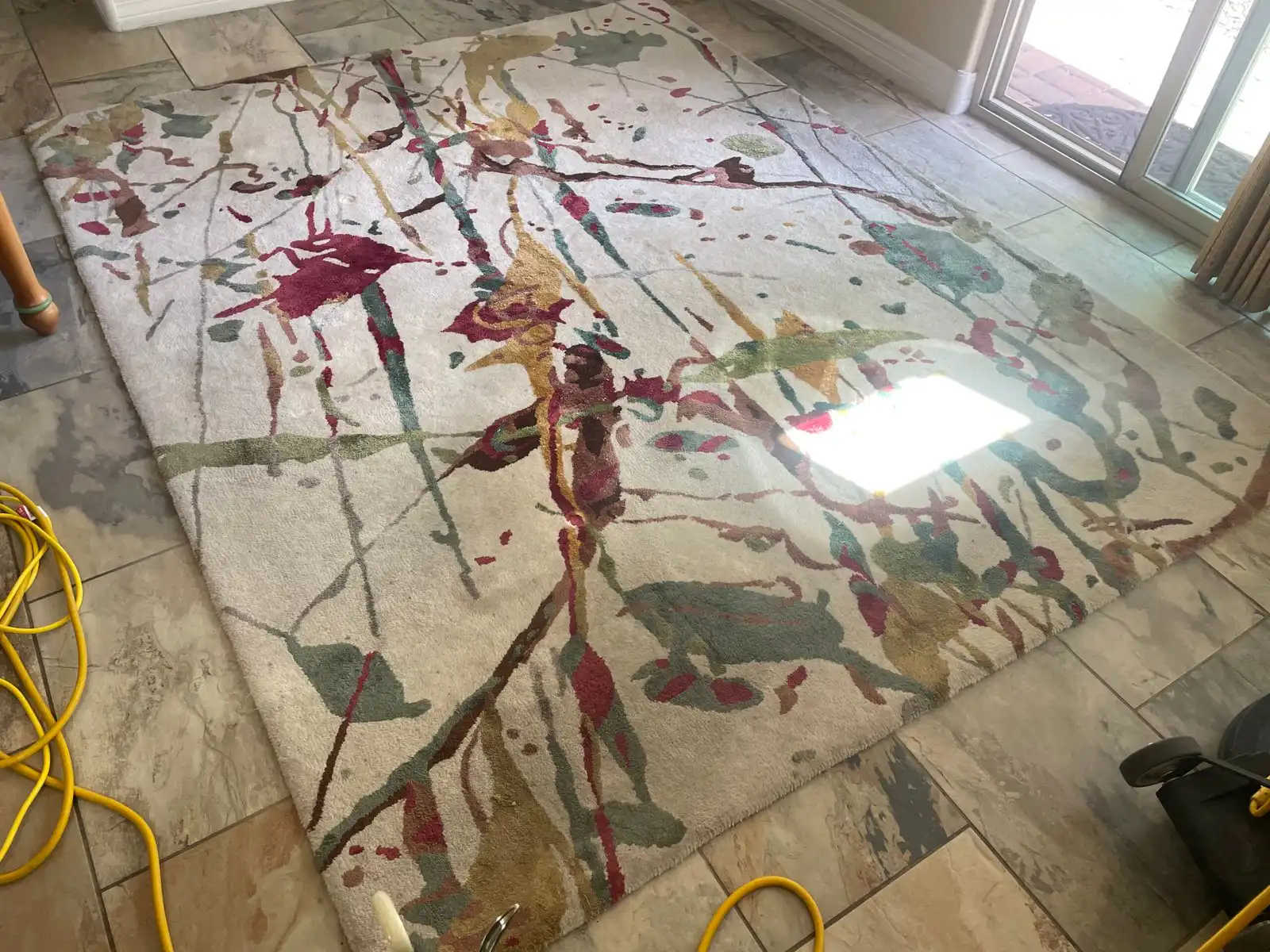
I cleaned a wool rug for a family in La Loma Village a while back. Medium-sized dog, a breed with a denser coat, and the rug was in the main sitting room where the dog spent most of its time. The homeowner had been vacuuming it weekly and thought the situation was reasonably under control. From a standing distance the rug looked okay, maybe a little flat and dull, but not dramatically dirty.
When I did the palm-drag test before starting, the embedded layer was significant. The surface vacuuming had been keeping the top layer clean, but the embedded material at the base of the pile had been accumulating for probably two years without being addressed. The dry extraction and the rubber tool pre-treatment pulled out a substantial amount of material that surprised the homeowner. She had not realized how much was in there because the surface looked managed.
After cleaning, the pile stood up noticeably better. The color saturation improved because the dander and embedded fine particulate that had been sitting around the base of the fiber and suppressing the visual depth of the color was gone. The rug did not smell like dog anymore, which had been a background issue the homeowner had noticed but attributed to needing a general clean. The dander accumulation at the pile base was a big contributor to that, and removing it made a clear difference. That result is realistic for a wool rug that has regular pet use but has been maintained reasonably at the surface level.
Honest Limitations: What Professional Cleaning Does and Does Not Fix
Embedded hair removal is thorough but not necessarily complete in a single cleaning. Hair that has been in a wool rug for two or three years and worked its way fully to the backing can be very resistant even with proper mechanical pre-treatment. Most of it comes out. In rugs with very long hair embedding history, a small amount may remain in the deepest pile layer. Successive cleanings at shorter intervals do progressively better because each visit addresses what the previous one left, and the overall embedding depth decreases over time.
Odor from dander and skin oil accumulation responds well to cleaning and usually resolves fully. Odor from urine contamination, if that is also a factor in the rug, is a different and more complex situation. Urine in wool pile penetrates to the backing and the foundation threads, and surface cleaning does not fully address deep urine contamination. If urine is part of the history of the rug, that needs to be assessed separately before the job starts because the treatment approach and the outcome expectations are different.
Fiber recovery from prolonged pet compression, where a dog has been lying in the same spot and the pile has developed a consistent lay in one direction, is partial. Cleaning and the moisture in the process help the pile stand up, and natural wool crimp assists recovery. But a spot that has had a large dog lying on it for two years will show some residual pile direction even after cleaning. It recovers better than synthetic fiber would in the same situation, but not always completely.
Wool Rug Construction in Litchfield Park Homes
The wool rugs in Litchfield Park homes are not all the same, and the cleaning approach should reflect that. A machine-made wool-blend rug from a mainstream retailer and a hand-knotted 100 percent wool rug from a specialty importer are both wool, but they behave differently in cleaning and they have different tolerances for moisture, agitation, and chemistry.
Hand-knotted wool rugs, which are common in the premium homes near The Wigwam and in established properties throughout the Village at Litchfield Park, have a pile structure where each tuft is individually knotted into the foundation. Afghan and Moroccan rugs tend to have coarser, more resilient wool that handles agitation reasonably well. Indian and Pakistani rugs with finer pile require more careful mechanical handling. Turkish and Persian rugs with natural dyes are the most pH-sensitive and require the most careful chemistry approach.
The assessment before any wool rug cleaning is where all of this gets sorted out. Construction, dye stability at multiple points across the rug, fiber condition, and the soil and hair embedding level are all assessed before deciding what approach is appropriate. A Litchfield Park homeowner with a quality piece deserves that level of attention before the cleaning starts, not a generic approach that treats every rug the same way.
Managing Pet Hair in a Wool Rug Between Professional Cleanings
The most effective tool for ongoing maintenance of a wool rug in a pet household is a rubber-bristle brush used before vacuuming, not instead of it. Run the rubber brush through the pile in short, firm strokes against the pile direction first. This brings embedded hair up toward the surface where the vacuum can reach it. Then vacuum with suction in multiple directions. Doing the rubber brush step after vacuuming misses most of what you were trying to accomplish.
Vacuuming direction matters more on wool than on synthetic pile. Wool pile has a direction to it from the way it is constructed, and vacuuming only with the pile direction skims the surface. Vacuuming against the pile direction and then across it in two additional passes reaches deeper into the pile and pulls out significantly more material per session. For a rug in a heavy pet household, this full multi-direction approach once a week is more effective than a quick single-direction pass every few days. Avoid beater bar vacuum attachments on quality wool rugs. The mechanical impact from a rotating brush bar can stress wool fiber over time, especially in a rug with naturally finer pile.
Professional cleaning every 12 months is the right interval for a wool rug in active use in a Litchfield Park pet household. If there is more than one dog, or a dog with a dense shedding coat, every 8 to 10 months gets better ongoing results because the embedding depth at each cleaning visit is shallower and the mechanical pre-treatment does not have to work as hard.
Learn more about our wool area rug cleaning, or explore other cleaning services we offer in Litchfield Park.

 (602) 429-9602