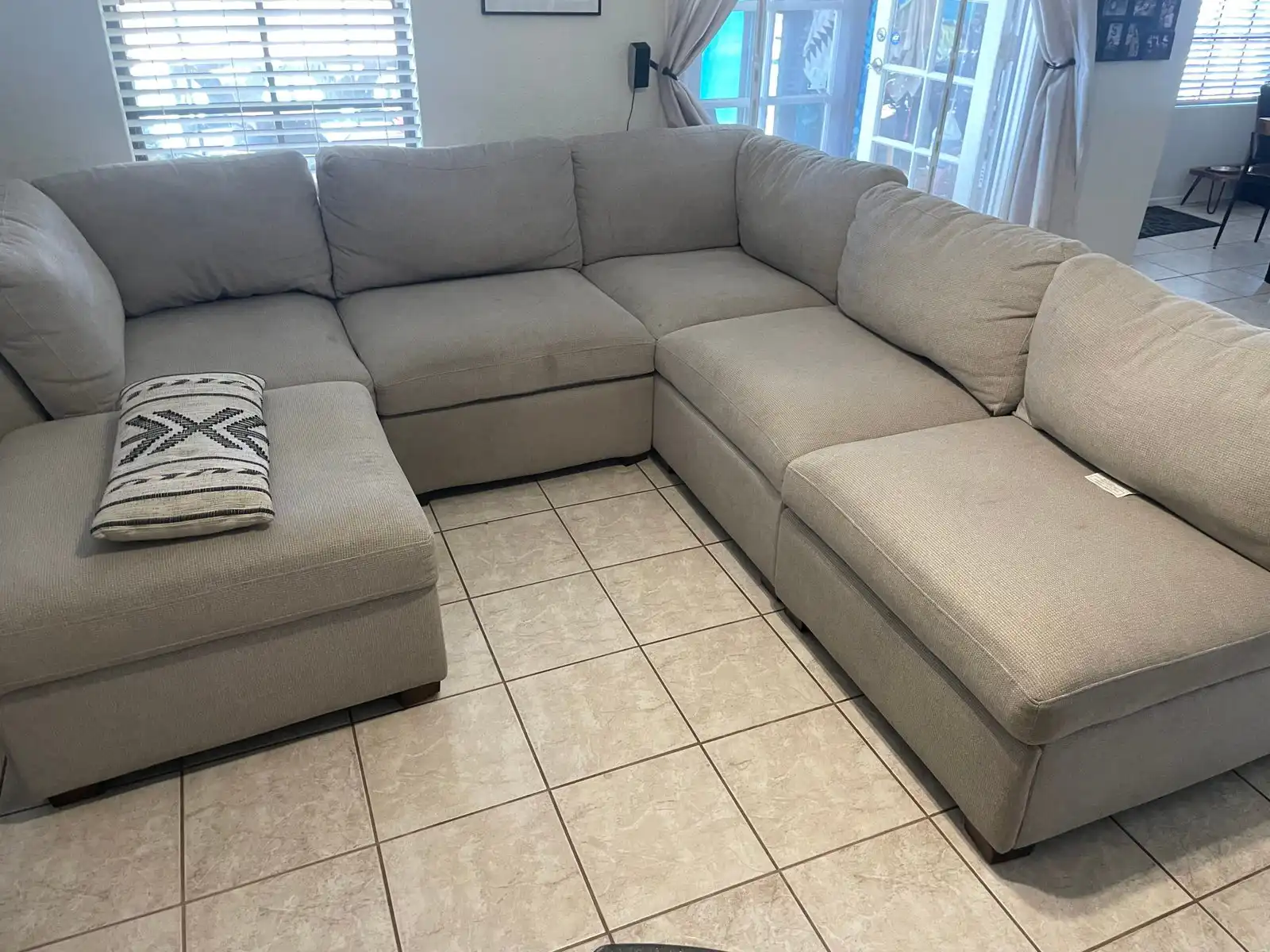
What Environmental Soil Is and Why It Builds in Unused Fabric
Upholstery fabric is a three-dimensional structure. The pile or weave creates depth from the surface of the cushion down to the base of the fiber, and that depth is what makes fabric feel soft and look rich. It also makes fabric an effective particulate collector. Fine dust and airborne material that settles onto a smooth hard surface can be wiped off because the surface does not provide the structural depth to hold it. The same material settling onto upholstery fabric gets caught in the fiber structure and progressively works its way deeper with air movement and the slight mechanical pressure of the fabric shifting during temperature changes and HVAC cycling.
In a formal great room in a Litchfield Park home near the Indian School Road area, the HVAC system runs continuously to maintain the indoor temperature against the Arizona exterior. Every cycle of conditioned air through the room carries whatever is in suspension in the household air across every surface in that room, including the modular sectional. Dust mite material, fine skin cell particulate from the occupied areas of the home, cooking particulate from the kitchen carried by air movement, and fine mineral dust from the desert environment all participate in this continuous deposition.
The fabric surface also develops an invisible film over time from volatile organic compounds that are present in every home environment. These come from furniture finishes, flooring materials, cleaning products, and the general chemistry of indoor air. They polymerize slowly on fabric surfaces, producing a thin coating that does not look like anything but that changes how the fabric reflects light and how it responds to soil. A fabric with this coating accumulates additional particulate faster than a clean fabric surface does because the coating has a slightly adhesive character relative to airborne material landing on it.
How a Premium Piece in a Formal Room Ages Differently from a Daily-Use Piece
The intuition that a piece that is not being used is not getting dirty is partly correct and partly wrong in a specific and important way. It is correct that the soil generated by direct human contact, body oil, skin cell material, food residue, and mechanical wear from use does not accumulate significantly on a rarely-used piece. A showpiece sectional in a formal room does not have the headrest oil darkening or the seat cushion compression from daily body contact that a daily-use piece accumulates. That is real.
What the low-use piece does accumulate is everything that does not require human contact to deposit. Environmental particulate, surface film from airborne compounds, and in the case of a formal great room with large windows, UV exposure to the fabric face on the side of the room closest to the glass. These accumulation mechanisms are independent of use. The piece being rarely sat on does not slow them down.
In the Sunset Terrace area and similar established Litchfield Park neighborhoods where formal great rooms are common in the larger custom home footprints, this type of piece comes up regularly. The homeowner has been protecting the sectional carefully, keeping it looking good, and has a sense that it probably should be cleaned professionally at some point but is not sure what the cleaning would actually accomplish on a piece that looks so clean already. The answer is that it accomplishes more than they expected, and the extraction result is usually what makes the case most clearly.
How to Read Whether a Showpiece Sectional Is Ready for Cleaning
A sectional in a formal great room rarely looks dramatically dirty even when it carries years of environmental accumulation. These are the signals worth checking:
- The fabric color looks slightly flatter or less saturated in strong light than it did when the piece was newer
- Running a white cloth across the cushion face in raking light picks up a visible gray or tan residue
- The module seam zones feel gritty when you press a finger into the gap
- The piece has been in the room for two or more years without professional cleaning
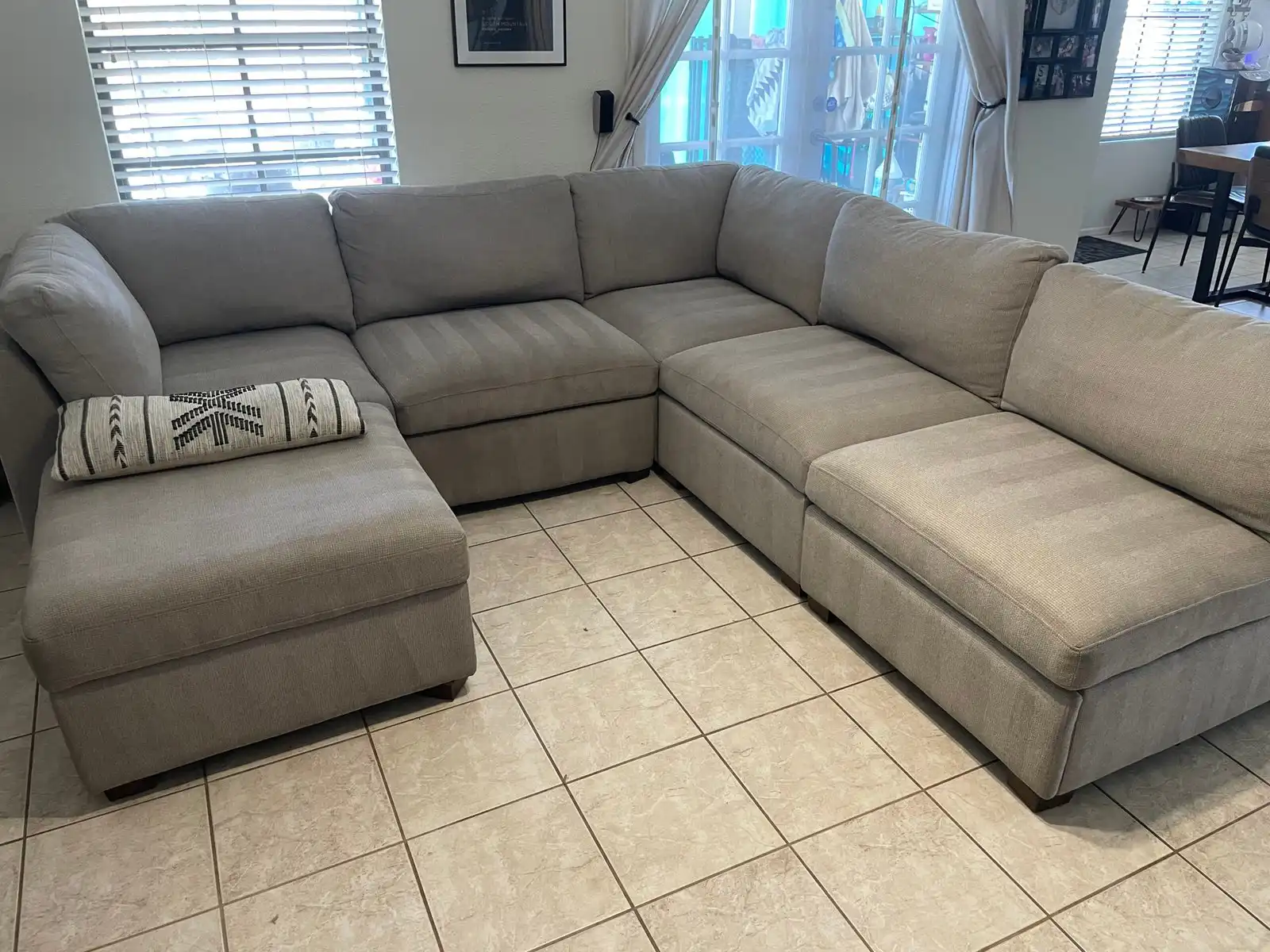
The extraction result tells the story most concretely. The fluid from a showpiece sectional that has been in a formal room for three years without cleaning is noticeably not clean, even when the piece appeared pristine before the cleaning started.
The Assessment of a Never-Cleaned Showpiece Sectional
The pre-cleaning assessment of a modular sectional that has been in a formal Litchfield Park great room for several years without professional cleaning covers ground that is different from the assessment of a daily-use piece, because the soil profile is different and the fabric condition has aged differently.
The UV inspection of a showpiece piece is particularly revealing. Under UV illumination, the environmental film accumulation on the fiber surface shows differently from clean fabric. Areas of the sectional that face a window or that are positioned to receive more ambient light show different accumulation profiles from sections positioned against a wall or in lower-light areas of the room. This mapping tells me how the environmental exposure has been distributed across the piece before I start, which affects whether the cleaning result will be fully uniform or whether some sections will show more improvement than others.
The modular configuration adds a specific assessment dimension. Individual modules can be separated, which allows the assessment to include the seam zones between modules where particulate has been falling through the gaps and accumulating in the module interface areas. This material does not vacuum out through the cushion face. It sits in the gap geometry between modules and in the seam channel where the modules connect, and it is one of the more concentrated soil zones in any modular sectional including a rarely-used showpiece.
The Cleaning Approach for Environmental Rather Than Use-Generated Soil
The cleaning approach for a showpiece sectional in a formal Litchfield Park great room is calibrated differently from the approach for a piece with heavy organic soil from daily use. The soil profile here is primarily environmental rather than contact-generated, and that difference affects the chemistry selection, the pre-treatment, and the extraction approach.
The dry extraction step is more significant on a showpiece piece than on a heavily used piece, because the ambient particulate accumulation in the fiber body is the primary soil and it needs to be mechanically loosened before wet chemistry goes down. A thorough dry extraction pass in multiple directions across each cushion face, working through the pile depth rather than skimming the surface, removes the upper layers of settled particulate and loosens the material in the mid-pile layers so the wet step can reach what is deeper.
The module seam zones get specific dry attention before the cushion faces are cleaned. Particulate that has been falling through the module gaps for months or years sits in the seam channel and in the base of the module edges at a concentration that is typically higher than anywhere on the cushion face itself. A crevice tool extraction in these zones before the main cleaning removes the concentrated soil that would otherwise be redistributed during the wet cleaning step.
The cleaning chemistry for a piece with primarily environmental soil uses a slightly lower concentration than would be appropriate for heavy organic soil from body contact. The environmental film on the fiber surface does not require the same degreasing intensity that years of scalp oil and skin oil accumulation would need. Extraction is thorough and complete across every module, including the back cushions and side panels, because environmental accumulation is distributed across the full exposed surface of the piece, not concentrated at the contact zones the way use-generated soil is.
Why the Premium Character of This Piece Changes the Cleaning Approach
The modular sectionals in Litchfield Park formal great rooms are not the mass-market modular configuration available at furniture chains. They are often custom or semi-custom pieces with performance or premium fabric, down-blend cushion fills, and construction quality that justifies the price point and the care with which the household treats them.
Premium fabric on a rarely-used showpiece piece has characteristics that affect the cleaning approach. High thread count woven fabrics and performance fabric with tight weave structures accumulate environmental film differently from looser weave fabrics, and they require the cleaning chemistry to penetrate the tighter weave structure rather than working on a more open fabric face. The agitation approach needs to work with the weave structure rather than against it to avoid pile disruption in directional fabrics.
Down-blend cushion fills in a premium modular sectional require low-moisture cleaning because down absorbs moisture readily and a cushion fill that gets wet takes far longer to dry than a standard foam cushion. Over-wetting a down or down-blend cushion with any cleaning method is a risk because moisture that reaches the fill can produce odor from the natural protein material in the down. The VLM low-moisture approach delivers the cleaning chemistry and extraction at the surface and upper pile without driving significant moisture through to the fill below, which is specifically why it is the right method for premium modular sectionals with down-blend fills.
In homes throughout the Indian School Road corridor and the larger custom footprints in the Litchfield Park Greens area, the formal great room with a premium modular sectional is a consistent configuration. The piece is the focal point of the room. The cleaning approach has to treat it as such, with the care and attention to the specific material that a focal-point piece in a premium home deserves.
Protecting a Showpiece Modular Sectional Between Professional Cleanings
Light covers or fitted throws on the cushion faces during the extended periods when the room is not in use reduce the rate of environmental particulate accumulation in the fabric. The covers intercept the settling dust and can be removed before any occasion when the room is being used. Linen or tightly woven cotton covers work better than loose throws because they do not add fiber to the fabric surface when they are removed. Launder them periodically.
Monthly vacuuming of the cushion faces, including a light pass at the module seam zones with a crevice attachment, removes the loose surface layer of settled particulate before it works its way into the pile body. Use suction without a beater bar on premium fabric, and move slowly enough for the suction to actually pull material out of the pile rather than skating across the surface. Quarterly separation of the modules to vacuum the seam channels and the side surfaces of each module is the maintenance step that most homeowners skip and that makes the most difference in the seam zone soil accumulation.
UV protection for the sections closest to large windows reduces the rate of dye change in the most exposed fabric surfaces. Window film rated for UV rejection, or window treatments that close during the hours of peak afternoon sun, protects the fabric from the accumulation of UV exposure that eventually creates a visible difference between the most-exposed and most-protected sections of the piece. Professional cleaning every 18 to 24 months is appropriate for a showpiece modular sectional in a formal room with light use.
Learn more about our modular sectional cleaning, or explore other cleaning services we offer in Litchfield Park.

 (602) 429-9602