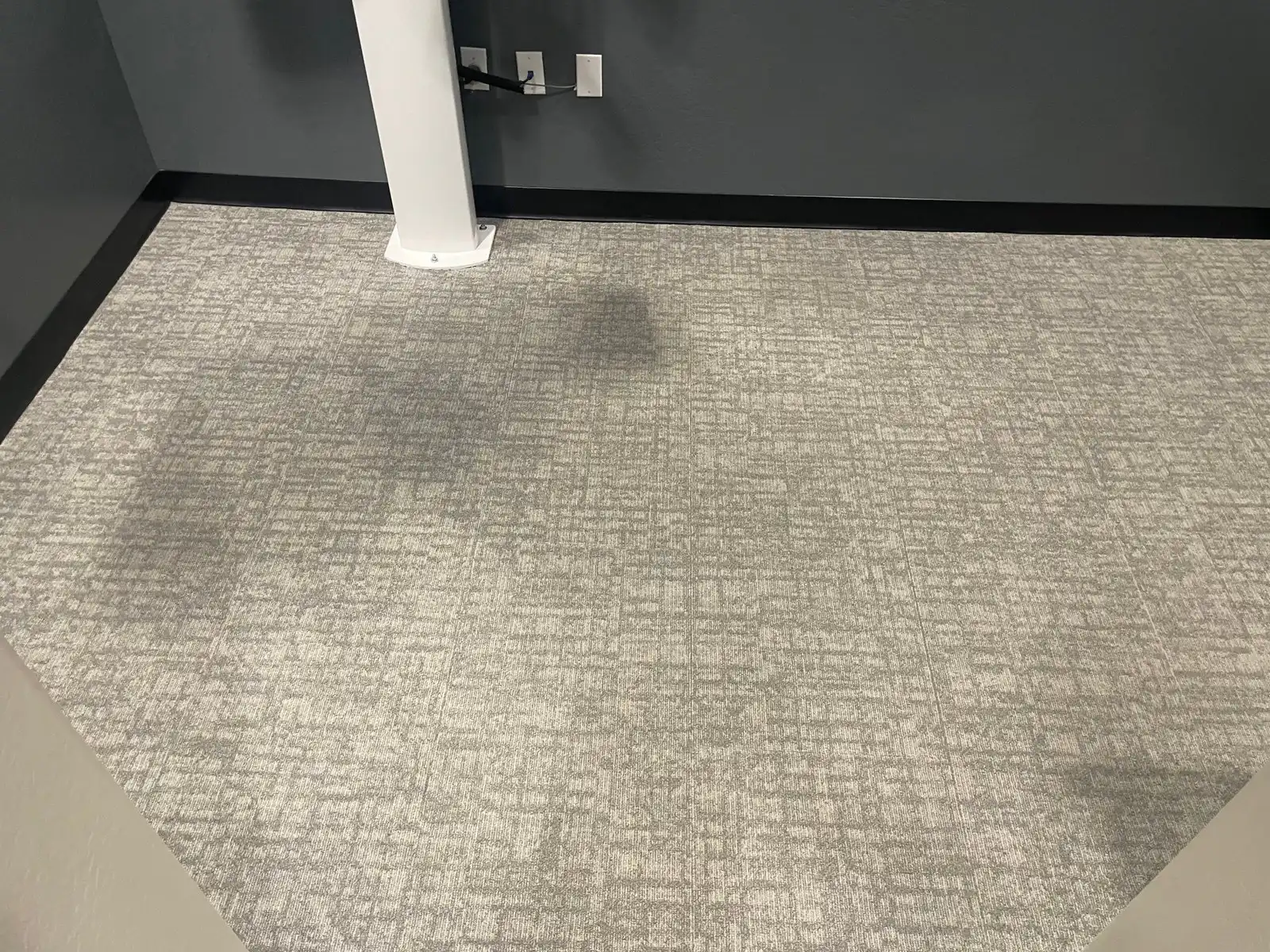
The Boutique Commercial Soil Profile: Low Volume, Long Exposure
In a high-volume commercial space like a large office building or a retail chain with hundreds of daily entries, soil accumulation is rapid, visible, and driven primarily by the volume of foot contact. The carpet dulls quickly and the frequency program is driven by how fast the visual threshold of acceptable appearance is reached.
In a boutique commercial space with thirty to sixty daily entries, the soil accumulation rate is much lower in volume terms. But lower volume does not mean lower impact, because the same environmental accumulation mechanisms that affect residential carpet operate in a commercial space regardless of foot traffic volume. Ambient dust settles continuously. West Valley desert particulate enters with every door opening. Airborne compounds from the business environment, product displays, finishing materials, candles in a boutique, coffee from a cafe, deposit on carpet fiber over time.
The critical difference in a boutique commercial space is the appearance standard relative to the accumulation rate. In a high-volume commercial space, the carpet is expected to show some accumulation between professional cleanings. In a boutique on Wigwam Boulevard serving clients with high aesthetic standards, the carpet needs to look clean at all times, not just at the beginning of a cleaning cycle. The accumulated environmental film that is nearly invisible in a busy office becomes noticeable to an observant client in a quiet boutique where they have time to look at the space. A three-year-old boutique that has not had professional carpet cleaning may not look dramatically dirty, but the color is slightly flatter and the texture of the fiber is subtly different from clean fiber in a way that a careful eye picks up.
What Kyle Knows About the Wigwam Boulevard Strip
The businesses along Wigwam Boulevard operate in a community with a specific character. Litchfield Park residents know each other. They walk the strip regularly. They go to the same cafe on weekday mornings and the same restaurant before a community event at the Litchfield Park Recreation Center. The relationship between a business on that strip and its regular customers is closer than the relationship between a chain store and its transaction-based customer base. That relationship is partly built on the physical quality of the space.
I have been in those spaces as a customer. I know what the Wigwam Boulevard strip feels like on a Saturday evening when people are out. I know the sidewalk cafe situation and the easy pedestrian movement between the shops. I know the kind of space that the boutiques and professional offices there are trying to maintain. That firsthand familiarity is different from a commercial cleaning company that shows up to quote a job without any specific understanding of what the business is trying to present to its clients.
The cleaning frequency and approach I recommend for a business on Wigwam Boulevard is based on what that specific business needs to look like to the clients it serves, not on a generic commercial square footage calculation. A professional financial advisory office on the strip has different appearance standards and a different soil profile from a boutique clothing store or a wine and dessert cafe. The right cleaning program for each of those is different, and figuring out what that is starts with understanding the space.
How to Read Whether Your Space Is Ready for Cleaning
In a low-traffic boutique the carpet rarely looks dramatically dirty. These are the subtler signals that the interval has arrived:
- Color saturation looks slightly flatter than it did after the last cleaning
- Fiber texture in the main traffic path is less crisp than a low-traffic corner or area under furniture
- The pile feels subtly different underfoot compared to a freshly cleaned section
- The entry zone looks noticeably different from the main floor even though neither looks "dirty"
If a protected section under a display case or furniture looks noticeably better than the main floor, the cleaning interval has arrived regardless of what the calendar says.
The Entry Zone in a Low-Traffic Commercial Space
In any commercial space, the entry zone takes the heaviest soil load because it is where every customer transitions from the outside environment to the interior. In a high-volume commercial space, the entry zone darkens quickly. In a low-volume boutique on Wigwam Boulevard, the entry zone darkening happens more slowly but it happens at the same relative concentration compared to the rest of the space.
The entry zone soil in a Litchfield Park commercial space has a specific composition that reflects the city's environment. The West Valley desert particulate that settles on parking surfaces and walks carries into every interior with every entry. In Litchfield Park, cart path grit is also part of the picture for businesses near the golf course community where some customers arrive by golf cart or have recently driven their cart through the area. The mineral grit component of commercial entry zone soil in Litchfield Park is higher than in comparable commercial spaces in cities without the golf cart culture.
The contrast between a clean entry zone and a soiled entry zone is more visible in a boutique than in a high-volume commercial space because there is less visual competition. In a busy retail chain with music, merchandise on every surface, and constant customer movement, a slightly soiled carpet entry is part of the visual noise. In a quiet boutique where the space design is intentional and the presentation is curated, the entry zone carpet is part of the first impression that every client receives. Managing the entry zone at a shorter interval than the main floor, and keeping quality entry matting maintained, is the most cost-effective way to keep that impression consistent.
Scheduling Around a Small Business Operating Day
Standard hot water extraction cleaning saturates carpet and requires four to eight hours of drying time, which means a commercial space needs to be closed for a significant portion of a business day. For a boutique shop or a small professional office on Wigwam Boulevard with limited hours and a client-appointment schedule, closing for that long is a meaningful disruption and a real cost.
The VLM process produces carpet that is dry and walkable within approximately 30 to 45 minutes of cleaning completion. For a boutique that opens at 10 AM, a cleaning that starts at 8 AM and finishes by 9 AM leaves comfortable time for any remaining drying and room preparation before the first customer arrives. For a professional office with morning appointments, a cleaning that runs from 6 or 7 AM fits within the pre-opening window without reducing operating hours at all.
This scheduling flexibility affects how often a business can realistically clean. A cleaning method that requires extended closure has a higher effective cost per cleaning in terms of lost revenue or appointment rescheduling than the cleaning invoice reflects. If a boutique owner knows that a cleaning means losing half a business day, the cleaning interval gets pushed out longer than it should. The practical result is a space that goes longer between cleanings than the appearance standard warrants. Removing that barrier means the right interval is the one that the space actually needs, not the one the schedule can accommodate.
Different Businesses, Different Soil Profiles on the Same Strip
The businesses along the Wigwam Boulevard strip are not all the same type, and their carpet cleaning situations reflect those differences. A coffee and dessert cafe, a professional financial advisory office, a boutique clothing shop, and a personal care studio all operate in the same downtown strip context but with different soil sources, different client expectations, and different operational constraints for scheduling.
A cafe or restaurant space with indoor seating has the standard food service soil profile: beverage spills, food residue, foot traffic from a dining customer base. The sugar and tannin staining from coffee and dessert service is a specific soil chemistry that requires enzyme pre-treatment and is not addressed by standard encapsulation chemistry alone. A cafe on the strip needs a cleaning approach calibrated to that soil profile, including targeted pre-treatment for the seating areas where beverage contact is concentrated, and a frequency program that accounts for the higher soil load relative to a professional office in the same strip.
A professional financial advisory or legal office has a completely different soil profile. The primary soil is standard foot traffic from clients who arrived by car, plus ambient environmental accumulation. There is no food contact soil, and the client base tends to be in business attire that carries less outdoor soil than casual footwear. This is the lowest-soil-load commercial context on the strip, and the cleaning program reflects that with a longer interval.
A boutique retail shop sits somewhere in between. The foot traffic varies by season, with the Litchfield Park Art and Wine Festival in spring and the Christmas in the Park season creating higher-volume entry periods that deposit more soil in a short time than the typical daily traffic pattern. Planning a cleaning visit after those high-traffic events rather than on a fixed calendar interval is a smarter program for a boutique that experiences those seasonal spikes.
What a Business Can Do Between Professional Cleanings
Entry matting is the most significant ongoing protection for commercial carpet in a boutique space. A quality entry mat at the exterior door intercepts the majority of the outdoor particulate that would otherwise be tracked directly onto the interior carpet. The mat needs to be large enough that a customer takes at least two full steps on it before reaching the interior carpet, because the first step off the exterior surface carries the most material and the mat has to be long enough to extract it from the shoe before the next step reaches the carpet.
Both mats, exterior and interior threshold, need to be cleaned regularly to remain effective. A saturated mat that is full of the material it has been collecting stops intercepting new material and starts redistributing what it has already absorbed. For a business open six days per week, shaking or vacuuming the entry mat daily and professionally cleaning it monthly keeps it functioning as the first line of soil defense. A dirty entry mat presents worse than no entry mat to an arriving client.
Daily vacuuming of the entry zone and the main traffic paths through the space removes the loose surface layer of particulate before it works its way into the pile. This is the maintenance step with the highest return in a low-traffic boutique because the soil volume per day is low enough that daily vacuuming keeps it at a truly surface level where it has not yet compacted into the fiber body. A ten-minute vacuum at opening or closing prevents the slow descent into the fiber that makes the next professional cleaning have more work to do.
Spot treatment of any spill or stain immediately after it occurs prevents the setting that makes stain removal progressively more difficult with time. Treat immediately, blot rather than rub, use as little moisture as possible, and let it dry before vacuuming the area. The difference between a fresh spill treated within minutes and the same spill treated the next morning is often the difference between full removal and a permanent residue.
Learn more about our commercial carpet cleaning, or explore other cleaning services we offer in Litchfield Park.

 (602) 429-9602