All Ways Organic Citrus Carpet & Upholstery Cleaning - Home
🇺🇸 Made in USA
🍋 Citrus Based
🌵 Eco-Friendly
Hours
Mon – Sat
7AM – 7PM
Book Online
Book
Online
📍 Serving the Greater Phoenix Valley
🕐 Mon – Sat  7AM – 7PM
👨‍👩‍👧‍👦 Family Owned & Operated
🇺🇸 Made in USA
🍋 Citrus Based
🌵 Eco-Friendly
Book Online
Sectional Cleaning in Goodyear Arizona - All Ways Organic
Goodyear, Arizona

Goodyear AZ
Sectional Cleaning

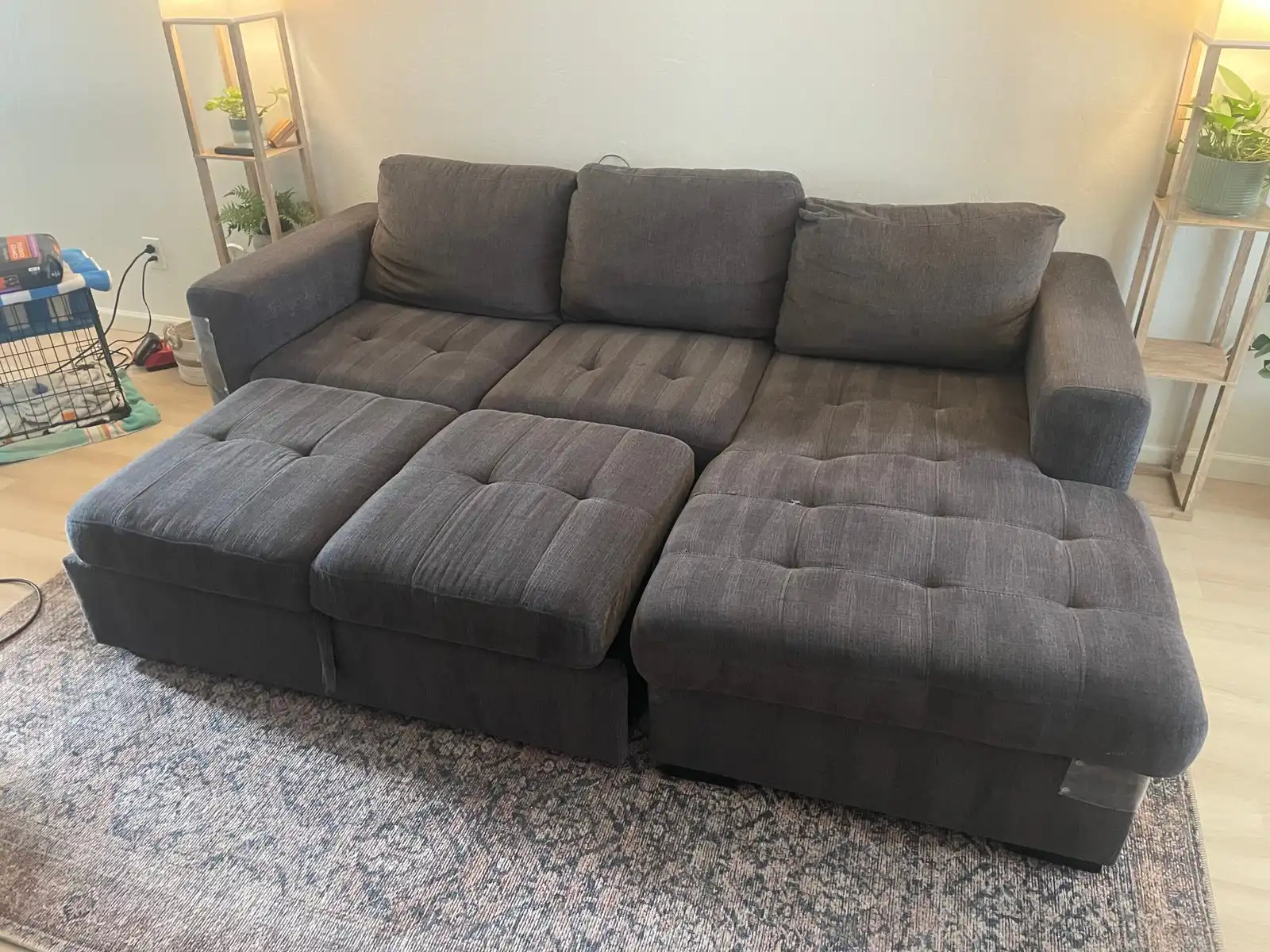
If your Goodyear sectional was marketed as stain-resistant or performance fabric, you may have been waiting years for a professional cleaning you assumed it did not need. Performance fabric treatments address one specific scenario: a liquid spill that is blotted immediately. They do not address body oil, pet dander, or the fine desert dust that settles from the Estrella Mountain area. This page covers what the treatments actually do and what they do not.

Google
5.0 / 5.0
Google Reviews
Organic
100% Organic
Citrus-based products
Owner operated
Owner-Operated
Kyle shows up every time
Quick dry
〜1 Hour Dry Time
Low-moisture process
No hidden fees
No Hidden Fees
Price quoted = price paid
Schedule Your Cleaning
Book Your Goodyear Sectional Cleaning
Pick a date, build your clean, and confirm - takes about 60 seconds
1Date
/
2Build
/
3Book
Your Clean
$0

When works for you?

Pick a day and time. We'll handle the rest.

Build your clean

Tap a category, then add what you need.

Need commercial cleaning? Call (602) 429-9602 for a custom quote.

Confirm your cleaning

Almost there. Fill in your details and lock in your spot.

📅
Driveway parking available?
Tap any item above to adjust add-ons or remove it.

You're All Set!

Booking #

Confirmation sent to your email.

What to expect: I'm Kyle, the owner, and I'll be the one showing up. Carpets dry in about 1 hour. Your home will smell like fresh citrus. Safe for kids and pets immediately after cleaning.

Questions? Call or text (602) 429-9602

Need help?(602) 429-9602
SMS Consent: By providing your phone number when booking, you consent to receive appointment reminders and follow-up messages via SMS from All Ways Organic. Msg frequency varies. Msg & data rates may apply. Reply STOP to opt out at any time. Privacy Policy · Terms
Transparent Pricing

No Hidden Fees. No Surprises.

The price you see is the price you pay. Performance fabric identification, cleaning code confirmation, and chemistry calibrated to your specific fabric treatment are included at every appointment.

3 Seat Sofa
3 Seat Sofa
Standard sofa, all surfaces cleaned
$125
per sofa
Book Now >
Sectional
Sectional
Standard sectional configuration
$225
per sectional
Book Now >
Modular Sectional
Modular Sectional
Multi-module configuration, full piece
$295
per modular
Book Now >
Optional Upgrade Treatments
Available at checkout to customize your cleaning
Deodorizer
Deodorizer
Extra odor elimination for a deeper fresh
High Traffic
High Traffic
Targeted treatment for heavy-wear zones
Pet Treatment
Pet Treatment
Neutralizes pet odors at the source
What Our Customers Say

Real Reviews, Real Results

"Stain-resistant fabric repels liquid penetration from spills you blot immediately. It has no effect on body oil from skin contact, pet dander, or the desert particulate that settles on every surface in Goodyear."

About This Service

What Performance Fabric Claims Actually Mean and What Professional Cleaning Still Addresses

If you bought a sectional in the last ten years in Goodyear, throughout Canyon Trails, Cottonflower, Estrella Mountain Ranch, or any of the newer communities near Estrella Foothills High School, there is a reasonable chance it was marketed with some version of a performance fabric claim. Stain-resistant. Easy-clean. Crypton. Sunbrella. Solution-dyed. Pet-friendly fabric. These are real technologies with real properties, and they do what they claim within their specific and limited scope.

The problem is that the marketing framing around these claims creates expectations that go well beyond what the fabric technology actually delivers. A Goodyear homeowner who bought a sectional marketed as stain-resistant may have been waiting years for the professional cleaning they assumed their high-performance fabric did not need, while body oil, pet dander, fine desert dust from the Estrella Mountain area, and general household soil have been accumulating in ways the stain-resistant treatment does not address at all.

I'm Kyle, and this page is specifically about what performance fabric claims mean technically, what they address and what they do not, and why sectionals with performance fabric need professional cleaning on the same schedule as any other sectional.

The Honest Framework
What Performance Treatments Address and What They Leave Completely Unchanged
What it does
What Fluoropolymer Treatment Actually Does
Fluoropolymer treatments coat individual fabric fiber surfaces with a compound that has very low surface energy, causing liquids to bead rather than absorb into the fiber. This addresses one specific stain scenario effectively: a liquid spill that is blotted immediately after contact. The treatment gives the liquid nowhere to go, so prompt blotting removes it completely. For the household accident where juice is spilled, noticed immediately, and blotted within seconds, the fluoropolymer treatment delivers on its promise.
What it misses
What Liquid Repellency Does Not Address
Body oil transferred by sitting, pet dander deposited by animal contact, and fine desert particulate from Goodyear's Estrella Mountain environment are not liquid penetration events. They are contact and deposition processes that occur regardless of whether the fiber surface has a liquid-repellent coating. The fluoropolymer treatment does not make the fiber surface non-stick to solids, non-stick to oils, or non-attractive to particulate. It repels liquid penetration only. Spills not immediately blotted, and any volume accident from a dog, can overwhelm the treatment entirely.
Crypton and solution-dyed
Crypton and Solution-Dyed: Better Technology, Same Gap
Crypton integrates a moisture barrier throughout the fabric structure rather than applying a surface coating, making it more durable and more resistant to spills that are not immediately blotted. Solution-dyed fabric has color embedded in the fiber core rather than applied to the surface, making it bleach-resistant and UV-resistant. Both are genuine improvements over standard fabric for their specific properties. Neither addresses body oil adhesion from skin contact. Body oil attaches to fiber surfaces through molecular forces rather than liquid absorption, which means every performance barrier treats it the same: as soil that accumulates and requires professional cleaning to remove.
Treatment degrades
Surface Treatments Degrade Over Time
Fluoropolymer treatments applied at purchase degrade over time from cleaning, UV exposure, and general use. A sectional that was treated at purchase has progressively less repellency protection over its first few years. A soiled fiber surface also makes the existing treatment less effective: the oil and particulate layer between the fiber surface and the liquid being repelled reduces the treatment's effective repellency. Professional cleaning that removes the soil accumulation and is followed by treatment reapplication restores both fabric appearance and treatment effectiveness simultaneously.

What Actually Accumulates in a Performance Fabric Sectional

The soil that accumulates in a performance fabric sectional in a Goodyear family home with children and dogs is the same soil that accumulates in any sectional. It just arrives and sits at the fiber surface rather than penetrating deeply into the fiber. Body oil from skin contact is the primary accumulation in any sectional used by a household. Every time a family member sits on the sectional, their skin transfers a microscopic amount of sebaceous oil to the fabric contact zones: head and neck against the back cushion, arms against the armrests, legs against the seat cushion surfaces.

This oil accumulates over months and years, producing the characteristic darkening at primary contact zones that every upholstered piece in regular use develops. Performance fabric treatments that repel liquid penetration do not prevent lipid oil from adhering to the fiber surface. The oil contacts the fiber surface and transfers through van der Waals molecular forces rather than through liquid absorption. The repellency mechanism that stops juice from penetrating does not stop oil from adhering.

Pet dander and pet hair from dogs in Goodyear households accumulates on performance fabric sectionals at the same rate as on untreated fabric. Dander settles on all fabric surfaces and works into the fabric structure by gravity and air movement. Performance treatments do not give the fabric any property that reduces dander adhesion or makes dander easier to remove by vacuuming. Fine desert particulate from Goodyear's Estrella Mountain environment settles on all surfaces continuously. It is a dry solid deposit, not a liquid, and liquid repellency treatments have no effect on its adhesion.

The Cleaning Approach for Performance Fabric Sectionals

Professional cleaning of a performance fabric sectional requires understanding the specific treatment type present and adapting the chemistry and technique to the fabric's properties. The care tag's cleaning code is particularly important: W-code fabrics can be cleaned with water-based chemistry, S-code fabrics require solvent-based chemistry only, and WS-code fabrics can use either. Some performance fabrics have specific care instructions from the manufacturer that override general cleaning approaches.

Pre-cleaning dry extraction is especially critical for performance fabric sectionals because the surface-accumulation character of performance fabric soil means more total soil is accessible to dry extraction than would be in a fabric that absorbs some soil into the fiber depth. Thorough vacuuming of all cushion surfaces, seams, and gap zones before any chemistry is applied removes the dry particulate and loose surface soil that makes up a significant fraction of the total soil load on a performance fabric sectional.

Chemistry selection uses pH-neutral to mildly alkaline chemistry rather than more aggressively alkaline chemistry that can degrade fluoropolymer and polymer-based performance treatments. Alkaline chemistry above pH 10 can disrupt fluoropolymer treatments, reducing their remaining repellency effectiveness. For Crypton fabric, the manufacturer's specific chemistry recommendations are followed rather than general upholstery chemistry to preserve the Crypton barrier properties. Light moisture approach with low-moisture encapsulation chemistry works well on performance fabric: the chemistry contacts the surface soil, encapsulates it as it dries, and the dried crystals are vacuumed away without needing deep moisture penetration that performance fabrics may resist anyway.

Treatment Reapplication After Cleaning Restores What Cleaning Reduces

Professional-grade fabric protection chemistry applied after cleaning recoats the fiber surfaces and restores liquid repellency to a level closer to the original treatment. This is a meaningful benefit in Goodyear's active family household context: the restored repellency gives the next liquid spill the brief blotting window that a partially degraded treatment no longer provides. The cycle of annual cleaning followed by treatment reapplication maintains the performance fabric's actual protective properties at their most effective level throughout the sectional's service life. Cleaning and reapplication together maintain the fabric at its best condition both in terms of soil removal and treatment effectiveness.

Questions to Ask Before Purchasing a Performance Fabric Sectional

The blotting window question is the most practically useful: how long does the treatment give you to blot a liquid spill before it penetrates? A treatment that gives you 30 seconds produces meaningfully different practical protection than one that gives you 5 minutes. Marketing language rarely specifies this, but checking the manufacturer's technical documentation reveals the practical limitation of the repellency claim.

The oil and contact soil question is equally important: does the performance treatment address body oil accumulation from normal seated contact? For most performance fabric treatments, the honest answer is no. A treatment that does not address body oil accumulation still requires professional cleaning on the same schedule as untreated fabric, which means the cleaning cost differential over the life of the sectional is zero regardless of the premium paid for the performance fabric. The treatment durability question addresses longevity: how long does the treatment remain effective under normal use and cleaning? The chemistry restriction question matters for professional cleaning: does the performance treatment require specific cleaning chemistry that limits what a professional cleaner can use?

Learn more about our sectional cleaning services, or explore other cleaning services we offer in Goodyear.
Common Questions

FAQs About Goodyear Sectional Cleaning

Yes. Stain-resistant treatments address one specific scenario effectively: a liquid spill that is immediately blotted. They do not address body oil from skin contact, pet dander and hair from dog and cat use, fine desert particulate from Goodyear's environment, or the compound soil accumulation of normal household use over time. These soil types accumulate in performance fabric sectionals at essentially the same rate as in untreated fabric. The stain-resistant treatment reduces the urgency of immediate response to liquid spills but does not reduce the need for periodic professional cleaning of the compound contact and surface soil that develops regardless of liquid repellency.

The darkening at primary contact zones is body oil accumulation: a lipid contact deposit rather than a liquid penetration stain. Stain-resistant treatments work by preventing liquid absorption into the fiber. They do not prevent lipid oil from adhering to the fiber surface through molecular contact forces. The mechanism of oil adhesion is different from liquid absorption and is unaffected by liquid-repellency treatments. The gradual darkening at seat and armrest contact zones is the same oil accumulation that develops in untreated fabric, just sitting on the surface rather than being absorbed into the fiber depth. Professional cleaning with appropriate chemistry removes this surface oil accumulation and restores the fabric appearance.

Crypton integrates a polymer moisture and stain barrier throughout the fabric structure rather than applying a surface treatment to the finished fabric. The treatment is in the fiber and in the backing rather than on the fiber surface, which makes it more durable than surface fluoropolymer treatments and more resistant to liquid penetration for spills that are not immediately blotted. Crypton also includes an antimicrobial component that inhibits bacterial growth in the fabric, reducing odor from biological soil. What Crypton shares with surface treatments is the same limitation: it does not address body oil contact accumulation, pet dander, or fine particulate from normal household use. The fabric still needs professional cleaning on a regular schedule.

Solution-dyed fabric has excellent resistance to one specific type of staining: color damage from bleach, harsh chemicals, and UV exposure. The dye is in the fiber core rather than on the fiber surface, so bleach and strong cleaners cannot remove color embedded in the fiber rather than applied to the surface. In this technical sense, solution-dyed fabric is genuinely stain-resistant. It does not mean the fabric surface does not accumulate dirt, body oil, pet deposits, and household soil. The color stays vibrant indefinitely but the fabric still gets dirty and still needs cleaning. The practical benefit is that professional cleaning can use a wider range of chemistry without color damage risk, which is a real advantage in terms of cleaning effectiveness.

For a small volume accident discovered and blotted immediately, possibly. The performance treatment's liquid repellency would have slowed the initial penetration and a prompt blotting response may have removed most of the urine before it fully penetrated. For a full volume dog accident that was not immediately discovered, no. The volume of a typical dog urination event overwhelms any performance treatment's repellency, and urine that has had time to penetrate through the treatment has reached the fabric fiber and potentially the cushion foam beneath. The contamination in this case needs professional treatment with enzyme chemistry regardless of what performance treatment the fabric has.

The care tag attached to the sectional, typically under a seat cushion or on the frame, has the manufacturer's cleaning code and sometimes the fabric treatment name. The original purchase documentation, brand name, or manufacturer website often provides specific fabric treatment details. If neither is available, the practical approach is to describe the sectional to a professional cleaner: the general performance properties can be assessed from the fabric's behavior, whether water beads, whether it feels treated, and what the cleaning code states. The cleaning code on the care tag is the most important piece of information for determining what chemistry is safe to use.

Professional cleaning reduces the effectiveness of surface-applied fluoropolymer treatments to some degree: each cleaning removes some of the surface treatment along with the soil. This reduction in treatment effectiveness is manageable and is addressed by reapplying professional-grade fabric protection after cleaning. Integrated treatments like Crypton are more cleaning-durable and lose less effectiveness per cleaning cycle. The key for preserving performance treatments during cleaning is using pH-appropriate chemistry: strongly alkaline chemistry above approximately pH 10 degrades fluoropolymer treatments more significantly than pH-neutral or mildly alkaline chemistry.

Every 12 months for active Goodyear family households with children and dogs: the same interval as a non-performance fabric sectional in the same household. The performance fabric slows certain specific stain events but does not meaningfully reduce the body oil, pet dander, and fine particulate accumulation that drives the annual cleaning need. For lower-activity households with adults only and no pets, 18 months is appropriate because the performance treatment does produce some practical reduction in soil accumulation rate in lower-intensity use environments. The professional cleaning appointment is also the right time to reapply performance treatment: cleaning and reapplication together maintain the fabric at its best condition both in terms of soil removal and treatment effectiveness.

Performance Fabric Still Gets Dirty. Here Is What Gets It Clean.
Performance fabric identification, chemistry calibrated to your treatment type, and treatment reapplication available at every appointment
What Our Customers Say

Real Reviews, Real Results

All Goodyear Services
What We Clean in Goodyear
All 14
Carpet
Upholstery
Area Rugs
Tile & Commercial
Decorative desert cactus illustration growing from the desert floor