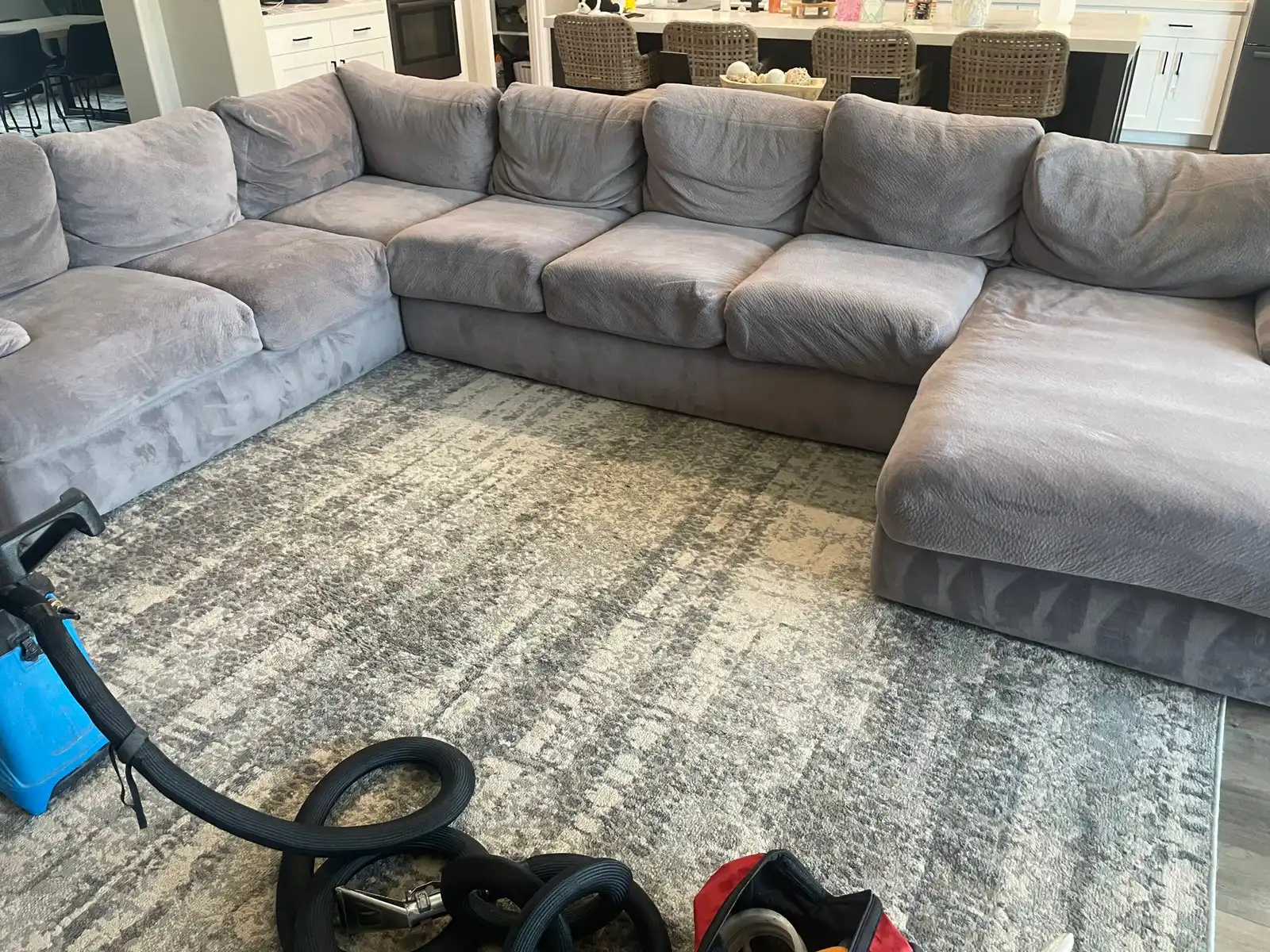
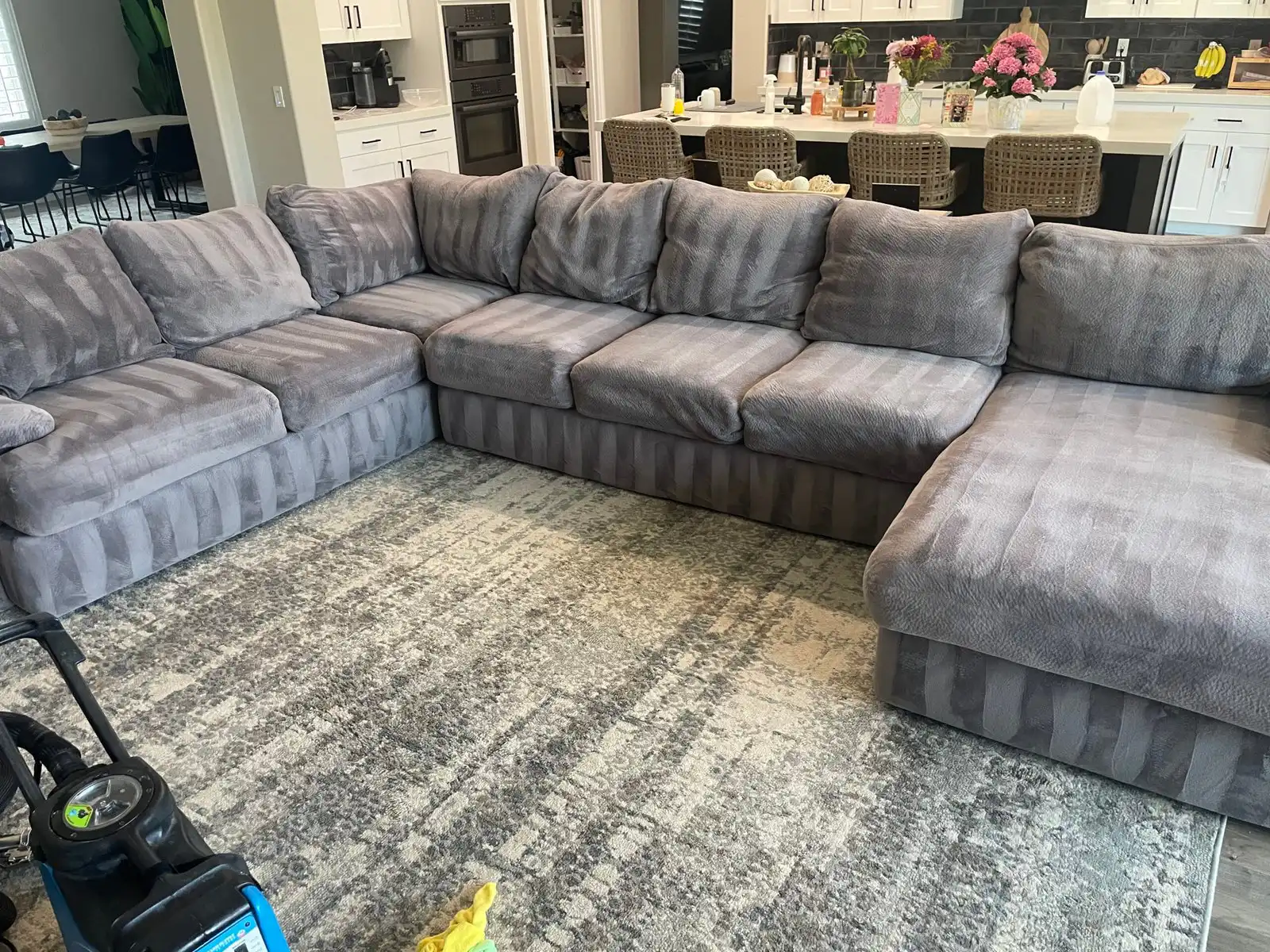
What Accumulates in Ten Years of Daily Family Use
A modular sectional that has been in active daily family use for ten years without professional cleaning does not simply have ten times the soil of a one-year-old sectional. The soil accumulation is a layered compound that has changed in character over time. Early deposits have been progressively buried by later deposits. Early stains were treated with home products whose residues have become part of the compound. And the sheer time in the fabric fiber means that what was once removable surface deposit has become more deeply bonded material.
Body oil is the most pervasive long-term accumulation. The sebaceous oil transferred through skin contact deposits with every contact event: every hour of sitting, every arm resting on the armrest, every leaned-back evening. In a family with multiple household members using the sectional daily over ten years, the body oil in the primary contact zones has built to a depth that standard cleaning is not designed to address in a single pass. The oil in the outermost fiber layer is relatively fresh and responds well to degreaser chemistry. The oil in deeper fiber layers has had years to bond to the fiber surface through progressive oxidation and chemical attachment.
Dog contact soil in Goodyear households where dogs have used the sectional for years follows the same accumulated profile: interdigital oil, paw pad organic compounds, and dog dander concentrating in the primary dog resting zones over years of daily contact. Stain history compounds the long-term profile further. Over ten years, a sectional accumulates numerous staining events, some addressed at home with cleaning products that left surfactant residue in the fiber. Over years, these residue layers from multiple home treatment events become part of the compound soil.
The Pre-Cleaning Assessment for a Never-Cleaned Piece
The pre-cleaning assessment for a decade-old never-cleaned sectional is more extensive than the standard pre-cleaning check for a well-maintained piece. Fabric condition assessment checks whether the pile or weave has any wear damage, pilling, or fiber breakdown in the primary contact zones that would persist after cleaning regardless of soil removal. UV inspection of the full sectional surface is the most important single step: the UV light reveals the complete urine contamination history from ten years of family and pet use. The foam condition assessment where accessible identifies whether any foam has developed structural degradation or biological contamination from urine events that reached the fill.
The home treatment history conversation is part of every first-cleaning assessment: asking what products and treatments have been applied to the sectional over its life. A household that regularly used alkaline spray cleaners has alkaline residue in the fiber. A household that used enzyme cleaners for pet accidents has enzyme chemistry residue in those zones. Each of these residue types can affect how professional cleaning chemistry behaves and what results it produces. The honest outcome discussion that follows the assessment is the most important communication of the appointment: a specific, zone-by-zone picture of what the cleaning will achieve before it begins.
What the Cleaning Process Looks Like for a Decade-Old Piece
A first professional cleaning of a decade-old family modular sectional requires more time, more chemistry, and more assessment than standard maintenance cleaning. Dry pre-extraction of the full sectional surface, all cushion faces, seam channels, deck fabric beneath cushions, and crevice zones between sections removes the accessible dry soil load before moisture is introduced. For a decade-old piece, this step removes a substantially larger total dry soil volume than the same step on a well-maintained sectional.
Zone-specific pre-treatment chemistry is selected based on the assessment: enzyme pre-treatment for identified dog contact zones and any urine-mapped areas, degreaser pre-treatment for primary body-oil contact zones, standard pre-treatment for lower-contact sections. Extended dwell times throughout: 20 to 30 minutes for the enzyme zones and 15 to 20 minutes for the degreaser zones. The extended dwell is the critical difference between a first-time deep clean and standard maintenance cleaning. Multiple extraction passes at all primary contact zones, two to three passes rather than the single pass appropriate for a recently cleaned piece, remove what each previous pass has loosened and expose the next layer to the following chemistry application.
Three Annual Cleanings to Reach Stable Maintenance Condition
The first professional cleaning establishes the baseline at the sectional's best achievable current state. The second annual cleaning reaches soil that the first cleaning loosened but could not fully extract: the deeper bonded oil layers, the residue from old home treatment chemistry, the biological compounds the first enzyme treatment began addressing. By the third annual cleaning, the sectional is approaching the condition it would have been in throughout its life if cleaned annually. The compound soil accumulation of the never-cleaned years is progressively addressed over three cycles, not corrected in one visit.
After the First Cleaning: Establishing the Maintenance Schedule
The homeowner who has just experienced the first professional cleaning of a long-term sectional and seen what that cleaning achieved has the clearest possible motivation for establishing the annual maintenance schedule that prevents needing another decade-deep baseline cleaning. Annual professional cleaning after the first baseline maintains the sectional at the clean state the baseline established. The 12-month interval prevents the re-accumulation of the multi-year soil load that the first cleaning addressed.
Specific habits that protect the first-cleaning baseline include throw covers on the primary dog contact zones, immediate blotting response to spills and pet accidents before they penetrate and set, and the pool-household protection practices described in the Goodyear dining chair page for households where pool contact soil reaches the sectional. These practices applied consistently after the first professional cleaning maintain the sectional at a condition level that annual cleaning sustains effectively rather than allowing the decade-deep accumulation to recur.
Learn more about our modular sectional cleaning services, or explore other cleaning services we offer in Goodyear.

 (602) 429-9602