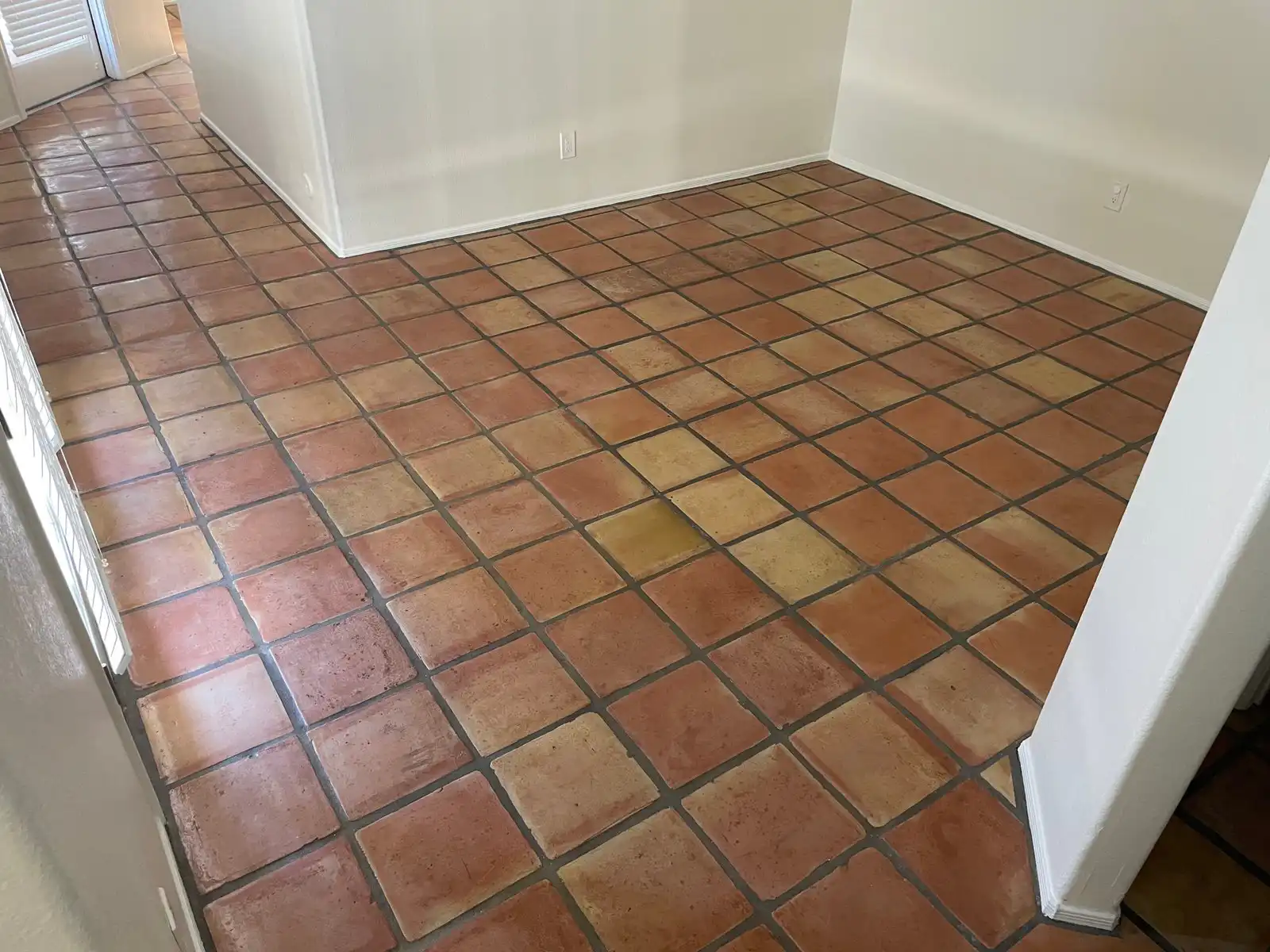
How Rubber Compound Bonds to Grout
Rubber compound contains several components that contribute to grout staining. Carbon black is the primary colorant - extremely fine-grained particles that penetrate into grout porosity readily under the pressure of a loaded wheel rolling over the surface.
Rubber also contains plasticizers - petroleum-derived compounds that keep the rubber flexible. These plasticizers transfer to the grout surface and act as a binding agent, helping the carbon black adhere rather than sitting as a loose deposit that could be mopped away.
The result is a stain that is chemically bonded through both mechanical penetration into the porosity and chemical adhesion from the plasticizer component. Standard neutral-pH floor cleaners don't have the chemistry to break this bond. Alkaline degreasers specifically formulated to release petroleum-based compounds work on the plasticizer component and allow the carbon black to be lifted from the grout profile.
Dwell time matters significantly. The alkaline chemistry needs time to penetrate and break the plasticizer bond before mechanical action begins. Rushing this step produces partial results. Allowing full dwell time - typically 15 to 20 minutes for established rubber staining - produces dramatically better carbon black removal.
Identifying Rubber Wheel Staining vs. Other Grout Darkening
Rubber wheel staining has a specific pattern: it follows distinct linear paths through the home corresponding to regular mobility device routes. The darkening is most pronounced in the grout lines directly in the wheel tracks - typically two parallel lines corresponding to the wheel spacing - and it's consistent along the entire path.
Foot traffic darkening is more diffuse. It accumulates in heavily traveled areas - doorways, main corridors - but without the linear two-track pattern. It's a general graying rather than a concentrated dark line.
Mold and mildew darkening tends to appear in moisture-prone areas, has a biological distribution pattern, and often has a slightly fuzzy or irregular texture rather than the sharp linear profile of rubber staining.
Grout that has simply aged and absorbed general soil over years shows a uniform general darkening throughout the floor rather than path-specific or moisture-specific patterns.
Shower Grout Mildew: Why It Keeps Coming Back
The recurrence problem has a specific cause: mildew that appears on the grout surface is the visible evidence of a colony that has established itself in the grout structure below the surface. Cleaning the visible staining removes what you can see, but the colony in the grout substrate continues growing and produces new surface staining as it spreads back out.
Sun City shower conditions contribute in a specific way. The combination of Arizona's very dry ambient air and the humidity of a daily shower creates extreme humidity cycling. Rapid drying concentrates the mineral deposits from Sun City's hard water on grout surfaces, creating a mineral scaffold that provides a physical structure for mildew to colonize more effectively.
Addressing recurrent shower mildew requires penetrating treatment that reaches the colony in the grout structure, appropriate dwell time, mechanical agitation into the grout line profile, and thorough rinsing. Surface-only cleaning without penetrating chemistry leaves the colony intact and produces the recurrence pattern.
Hard Water's Role in Sun City Shower Grout Problems
Sun City's water supply carries significant dissolved mineral content. Hard water deposits calcium carbonate and magnesium compounds on every surface it contacts. In a shower, the mineral concentration at the grout surface is continuous and significant. Over time, calcium carbonate builds up in the grout surface porosity, creating a texture that traps soap scum and organic material and provides a colonization substrate for mildew.
Effective shower grout cleaning in Sun City homes needs to address the mineral deposit layer as well as the biological mildew staining. An acid-component pre-treatment dissolves calcium carbonate deposits, followed by alkaline treatment for biological material. This two-stage approach is more effective than either treatment alone.
After cleaning, applying a penetrating grout sealer to clean, mineral-free grout provides significantly better and longer-lasting protection than sealing over deposits. A properly sealed shower grout surface can maintain mildew resistance for 12 to 18 months with normal use.
The Full Tile and Grout Cleaning Process
For rubber wheel grout paths: Pre-inspection identifies the full extent and severity of staining. Alkaline degreaser pre-treatment is applied with 15 to 20 minutes of dwell time. Rotary grout brush agitation works specifically into the grout line profile. Extraction and rinse removes loosened rubber compound completely.
For shower grout with mildew recurrence: Two-stage pre-treatment - acid component first to dissolve mineral deposits, then penetrating biological treatment to reach the sub-surface colony. Grout brush agitation works the treatment into the recessed grout profile. Thorough rinse and dry before sealing. Penetrating grout sealer application closes the surface porosity.
Maintenance Schedule and Prevention
For mobility device grout staining, periodic professional cleaning annually combined with rubber-backed floor mats along primary mobility paths slows deposit accumulation. The mat receives the rubber transfer and can be cleaned far more easily than grout.
For shower grout, squeegee after each use to remove standing water. A daily or every-other-day light spray of a pH-neutral shower spray maintains the surface between professional cleanings. Resealing shower grout every 18 to 24 months after professional cleaning maintains mildew resistance.
For general floor grout, annual or bi-annual professional cleaning prevents the deep accumulation that becomes significantly harder to address. Older homes in Sun City West near Hillcrest and Briarwood, and the original Sun City neighborhoods around Heritage and Sun City Manor, often have grout that hasn't had professional cleaning attention in a long time - the improvement from a first professional cleaning is often dramatic.
Serving All Four Sun City Communities
Serving Sun City, Sun City West, Sun City Grand, and Sun City Festival including communities near RH Johnson Recreation Center, Hillcrest Golf Club, Briarwood Country Club, Corte Bella, Desert Springs, Trail Ridge Golf Course, Heritage, Sun City Manor, Festival Foothills, and throughout the West Valley active adult communities.
Learn more about our tile and grout cleaning services, or explore other cleaning services we offer in Sun City.

 (602) 429-9602