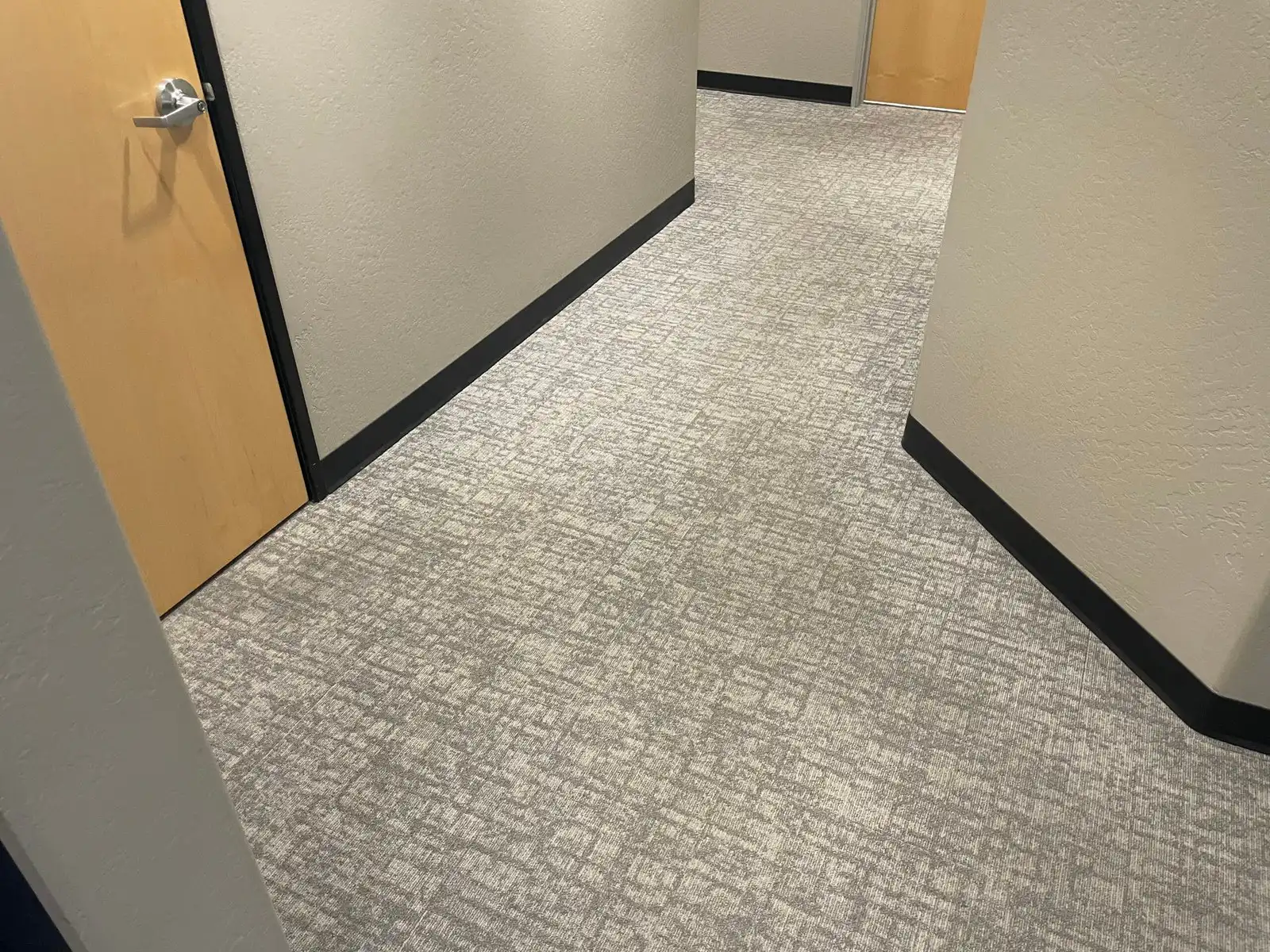
How Chronic Dulling Develops in Community Center Carpet
Chronic dulling in community center carpet is a specific maintenance failure mode that develops predictably when cleaning intervals are too long relative to the soil accumulation rate on the primary traffic paths.
Stage one is manageable accumulation. Carpet receives regular soil deposition along traffic paths. Each cleaning, done at appropriate intervals, removes the accumulated soil before significant bonding has occurred. The carpet responds fully to cleaning - the traffic paths lighten to match the surrounding less-used carpet, the facility looks clean after each service, and the clean appearance holds for the expected interval before the next scheduled cleaning.
Stage two is the early bonding threshold. Cleaning intervals have stretched slightly beyond what the soil accumulation rate warrants. Soil along primary traffic paths has had enough dwell time to begin bonding to fiber surfaces - the oil component of shoe sole soil, fine mineral particulate compressed into fiber by foot traffic, and the general organic accumulation of high-footfall use has started to set. Cleaning still produces improvement but the traffic paths don't fully return to the color of surrounding carpet. The facility looks clean after cleaning but not as clean as it used to look, and the clean appearance holds for a shorter period than previously.
Stage three is the chronic threshold crossed. Cleaning intervals have been long enough, consistently, that the primary traffic path soil has undergone significant bonding throughout the fiber depth. Cleaning removes surface soil and produces temporary improvement, but the bonded base layer remains and re-soils quickly. The facility starts looking dull within a short period of each cleaning. The maintenance coordinator schedules more frequent cleaning in response - but more frequent cleaning of a chronically bonded carpet produces diminishing returns because the bonded layer remains regardless of frequency. The facility now has chronic dulling: it never looks properly clean regardless of cleaning schedule.
Crossing the chronic threshold is the critical failure point because getting back from it requires a restoration cleaning significantly more intensive - and more expensive - than the maintenance cleaning program that would have prevented it. The economics of community center carpet maintenance favor prevention strongly over restoration.
In community facilities near Briarwood Country Club and throughout the Sun City Grand neighborhoods served by the Desert Springs clubhouse areas, I've seen both outcomes - facilities that have maintained their carpet in the manageable accumulation stage through good planning, and facilities that have crossed the chronic threshold and require restoration before a maintenance program can function effectively again.
Traffic Pattern Assessment: Mapping High, Medium, and Low Accumulation Zones
A maintenance program for a Sun City community center carpet that doesn't begin with an honest traffic pattern assessment isn't built on the right foundation. Treating all areas on the same schedule wastes cleaning budget on low-traffic zones that don't need frequent attention and under-serves the high-traffic paths that are the ones approaching the chronic threshold.
Primary traffic zones are the corridors and transition areas that receive footfall from essentially every person who enters the facility. The entry transition zone - where residents walk from the entry door to the main interior of the building - is typically the highest soil accumulation point in any Sun City community facility. Entry zones in Sun City community centers receive the full range of fine desert soil, and they receive it from every person who enters. These zones need the most frequent professional cleaning - in a high-use facility, monthly or every six weeks during peak activity season.
Secondary traffic zones are the primary corridors leading to activity rooms, fitness areas, and restrooms. These zones receive high footfall from most of the facility's daily visitors but not quite the full entry volume. Soil accumulation is significant and steady. These zones need professional cleaning every six to ten weeks in a well-designed maintenance program.
Activity room interiors are tertiary zones. The footfall is high during programming hours but the soil load per visit is lower than corridor traffic because activity room participants are typically seated for most of their time in the space. These zones can typically be maintained on a quarterly cleaning schedule.
Low-traffic zones - storage corridors, administrative offices, areas off the main circulation paths - accumulate soil slowly and need cleaning only as part of periodic facility-wide restoration cleaning or when a specific soil event requires attention.
The practical output of a traffic pattern assessment is a zone map with differentiated cleaning frequencies - more frequent attention for high-accumulation zones, less frequent for low-accumulation zones - that concentrates cleaning budget where it prevents the chronic threshold from being crossed.
The Specific Soil Profile of Sun City Community Facilities
The soil that accumulates in Sun City community center carpet has a specific composition that reflects both the desert environment and the resident population, and understanding this composition informs the appropriate cleaning chemistry.
Desert mineral particulate is the dominant soil source. Every resident arriving at a Sun City community facility has walked from their car or from nearby to the entrance, and Sun City's desert environment means that fine mineral dust - silica, calcium carbonate, iron oxide compounds from the desert soil - is on every shoe sole. This fine mineral particulate is the primary soil load in primary traffic corridors and entry zones. It's abrasive, fine-grained, and becomes progressively harder to extract as it works deeper into carpet pile fiber under foot traffic compression.
Rubber shoe sole transfer adds the carbon black and plasticizer component. Community center carpet traffic from thousands of residents over thousands of visits deposits rubber compound into the traffic path fibers in aggregate quantities that are significant - not from any single visitor's shoe but from the cumulative deposit of many.
Sun City's dry climate creates a low-humidity indoor environment in community facilities, particularly during the extended cooling season. Low-humidity conditions promote static charge on synthetic carpet fibers, which accelerates the attraction of fine particulate to fiber surfaces between cleaning events.
Seasonal soil variation is worth planning for in the maintenance schedule. Sun City community facilities see elevated desert soil loading after wind events and dust storms - the haboob activity that sweeps through the Phoenix metro can dramatically increase the fine particulate load entering community buildings in the days following a major event. Building a schedule with flexibility for post-event cleaning in the high-traffic zones accommodates this seasonal variation without disrupting the baseline maintenance cycle.
The absence of the highly varied commercial soil types found in other commercial environments - food service, retail, industrial - is worth noting. Sun City community center carpet doesn't face cooking grease, heavy outdoor mud, chemical spills, or the aggressive soil profiles of some commercial settings. The soil is predominantly mineral fine particulate and rubber compound - serious in aggregate but addressable with appropriate chemistry and frequency.
Building the Maintenance Cycle: Frequency, Chemistry, and Method
A commercial carpet maintenance program for a Sun City community facility has three technical dimensions: cleaning frequency by zone, chemistry selection for the dominant soil profile, and cleaning method chosen for the operational constraints of an active facility.
Cleaning frequency by zone follows the traffic pattern assessment. Entry zones cleaned every four to six weeks during active programming seasons. Primary corridors every six to ten weeks. Activity room interiors quarterly. Facility-wide periodic restoration cleaning annually or bi-annually to address any accumulation that's worked below the surface layer despite the maintenance program. The specific frequencies are calibrated to the facility's actual usage level - a facility with daily programming across multiple rooms needs tighter intervals than one with part-week programming.
Chemistry for Sun City community center carpet is calibrated for mineral particulate and rubber compound as the primary soil types. Alkaline pre-treatment addresses the rubber compound component. Appropriate pH-balanced chemistry for the carpet fiber type handles the mineral particulate. The chemistry program avoids leaving surfactant residue in the fiber that would accelerate re-soiling - a common problem in commercial cleaning where chemistry is applied at incorrect dilution or without thorough extraction, leaving a residue layer that attracts new soil faster than clean fiber would.
Low-moisture encapsulation cleaning is the most operationally compatible method for Sun City community facilities. Dry time of 20 to 30 minutes rather than the two to four hours of hot water extraction means activity rooms and corridors return to use quickly. Encapsulation chemistry's soil-encapsulating action continues working after the cleaner has left, capturing additional particulate as it dries and releasing it during the next vacuum - providing soil removal benefit between cleaning visits. Low-moisture methods also reduce the risk of over-wetting commercial carpet backing and subfloor.
For periodic restoration cleaning or for areas that have crossed the chronic threshold and need intensive treatment, truck-mounted hot water extraction produces more thorough deep extraction than low-moisture methods. The restoration cleaning is a different service from the maintenance program - done less frequently, with more aggressive chemistry and mechanical action, to address the soil that's accumulated below what routine maintenance reaches.
The Economics of Preventive vs. Reactive Commercial Carpet Maintenance
The economic case for a planned community center carpet maintenance program is straightforward and worth making explicitly, because maintenance budget decisions in community facilities often favor reactive approaches until the cost differential becomes undeniable.
Preventive maintenance cleaning - scheduled at intervals that prevent the chronic dulling threshold from being crossed - costs a predictable amount per year and produces consistent results. The carpet looks good throughout its designed service life. At the end of its service life, the carpet is replaced because it's aged, not because it looks bad.
Reactive cleaning - cleaning when the carpet looks dirty, on no fixed schedule - produces escalating costs and declining results. As the chronic threshold is approached, cleaning frequency increases without proportionate improvement in results. Eventually restoration cleaning is required before any maintenance cleaning can be effective - adding a significant one-time cost to the budget. When restoration cleaning also fails to return the carpet to acceptable appearance, premature replacement becomes necessary - replacing carpet that has functional life remaining but has been permanently damaged by inadequate maintenance. Commercial carpet replacement is a major capital expense. Premature replacement driven by maintenance failure is avoidable waste.
The crossover point - where planned preventive maintenance costs less in total than reactive maintenance plus premature replacement - arrives earlier than most facility managers expect. For a medium-sized Sun City community facility, the annual cost of a properly designed zone-based maintenance program is typically recovered in avoided restoration cleaning costs within two years, and in avoided premature carpet replacement costs within the first replacement cycle.
Sun City homeowner association and facilities managers who oversee the community buildings throughout these four communities are often working within constrained annual maintenance budgets. The argument for prioritizing carpet maintenance in those budgets is not about appearance for its own sake - it's about total cost of ownership over the carpet's designed service life.
Coordinating Commercial Cleaning With Facility Operations
The operational coordination of commercial carpet cleaning in an active Sun City community facility is a practical challenge that determines whether a good maintenance program actually gets executed as planned.
Sun City community facilities run programming throughout the week, often from early morning through evening. Finding cleaning windows that don't displace resident programming requires coordination with the facility's activity schedule. A maintenance program that's technically well-designed but practically incompatible with the facility's operational calendar won't get executed consistently - which means the maintenance intervals slip and the chronic threshold approaches.
Early morning cleaning before programming begins is the most compatible time window for most Sun City community facilities. First activities typically begin at 7 or 8am. Cleaning that starts at 5 or 6am and completes before first programming allows full dry time in the specific zones being cleaned before residents arrive. This requires a cleaning provider willing to work early morning commercial hours - which not all residential carpet cleaners are set up to do.
Zoned cleaning that cleans different areas on different days - entry zone Monday, primary corridors Wednesday, activity rooms on off-programming days - distributes the cleaning across the week rather than requiring a facility-wide closure for each cleaning event. This approach is operationally compatible with continuous facility operation and allows tight maintenance intervals on the highest-soil zones without disrupting the full programming calendar.
The post-event cleaning window after major community events - holiday parties, voting events that bring high resident turnout, special programming that draws attendance beyond the typical daily population - provides a natural additional cleaning opportunity for the primary traffic zones.
For facilities managers and homeowner association contacts throughout Sun City, Sun City West, Sun City Grand, and Sun City Festival who are evaluating their current carpet maintenance program, I offer a no-charge traffic pattern walkthrough assessment and maintenance program proposal - a practical starting point for building a plan that fits the facility's operational reality and budget.
Serving All Four Sun City Communities
Serving Sun City, Sun City West, Sun City Grand, and Sun City Festival community facilities including recreation centers, club buildings, HOA common areas, and activity facilities near RH Johnson Recreation Center, Desert Springs, Briarwood Country Club, Hillcrest Golf Club, Corte Bella, Trail Ridge Golf Course, Festival Foothills, and throughout the West Valley active adult communities.
Learn more about our commercial carpet cleaning services, or explore other cleaning services we offer in Sun City.

 (602) 429-9602