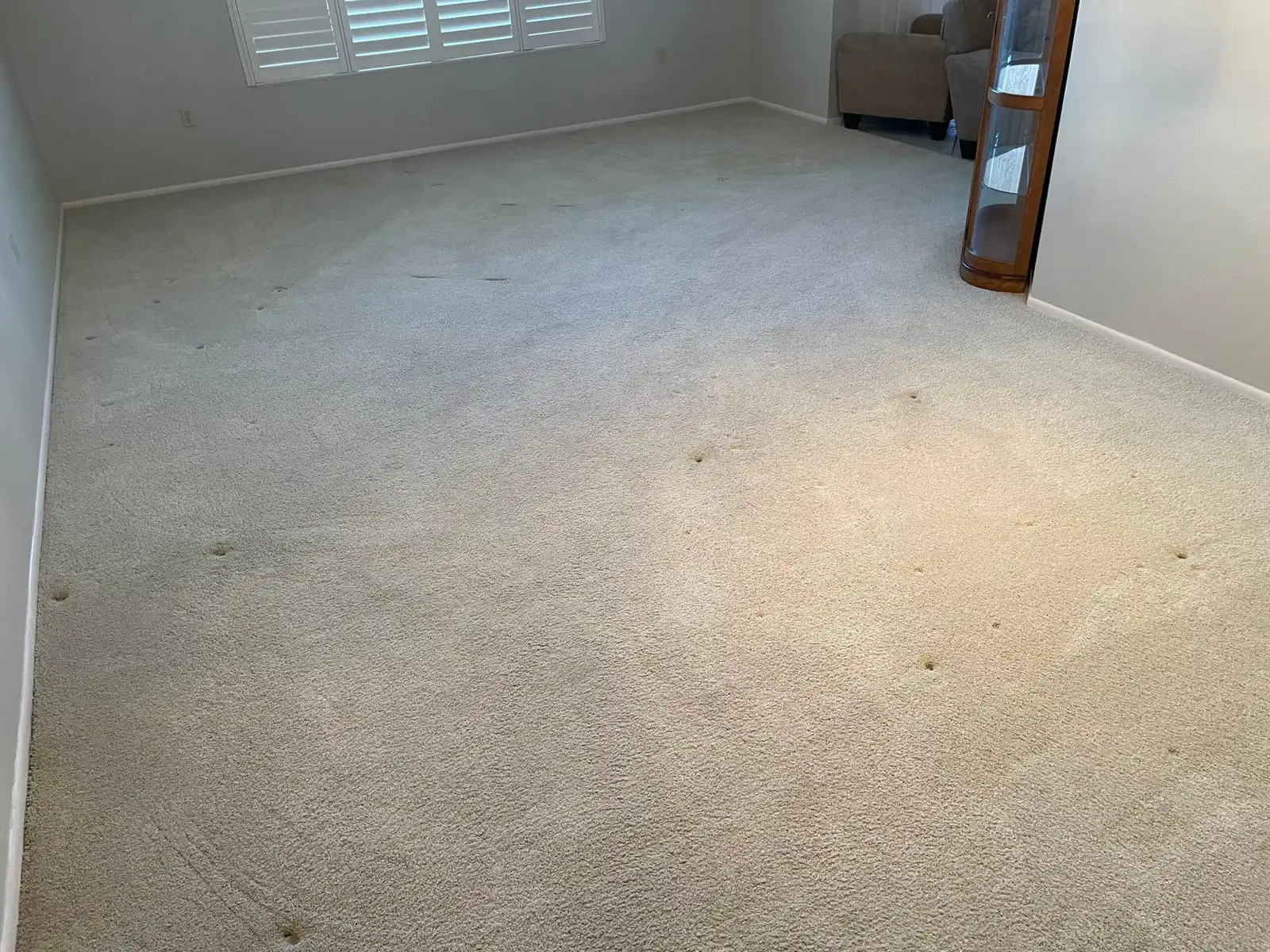
What Wheelchairs, Walkers, and Mobility Scooters Do to Carpet Fibers
This is the most specific carpet challenge I encounter in Sun City that I simply don't see at the same frequency anywhere else in the valley - and it's the one that requires the most direct conversation about realistic outcomes.
Rubber wheels on wheelchairs, walkers with wheels, and motorized mobility scooters do something to carpet that foot traffic doesn't. The rubber compound in wheels transfers to carpet fibers under the sustained pressure and friction of rolling contact. It's not a stain in the traditional sense - it's a physical and chemical deposit that bonds to fiber surfaces and darkens them. Over months and years of daily use along the same paths - bedroom to bathroom, bedroom to living room, living room to kitchen - those wheel paths develop a characteristic dark, matted appearance that looks distinctly different from regular foot traffic wear.
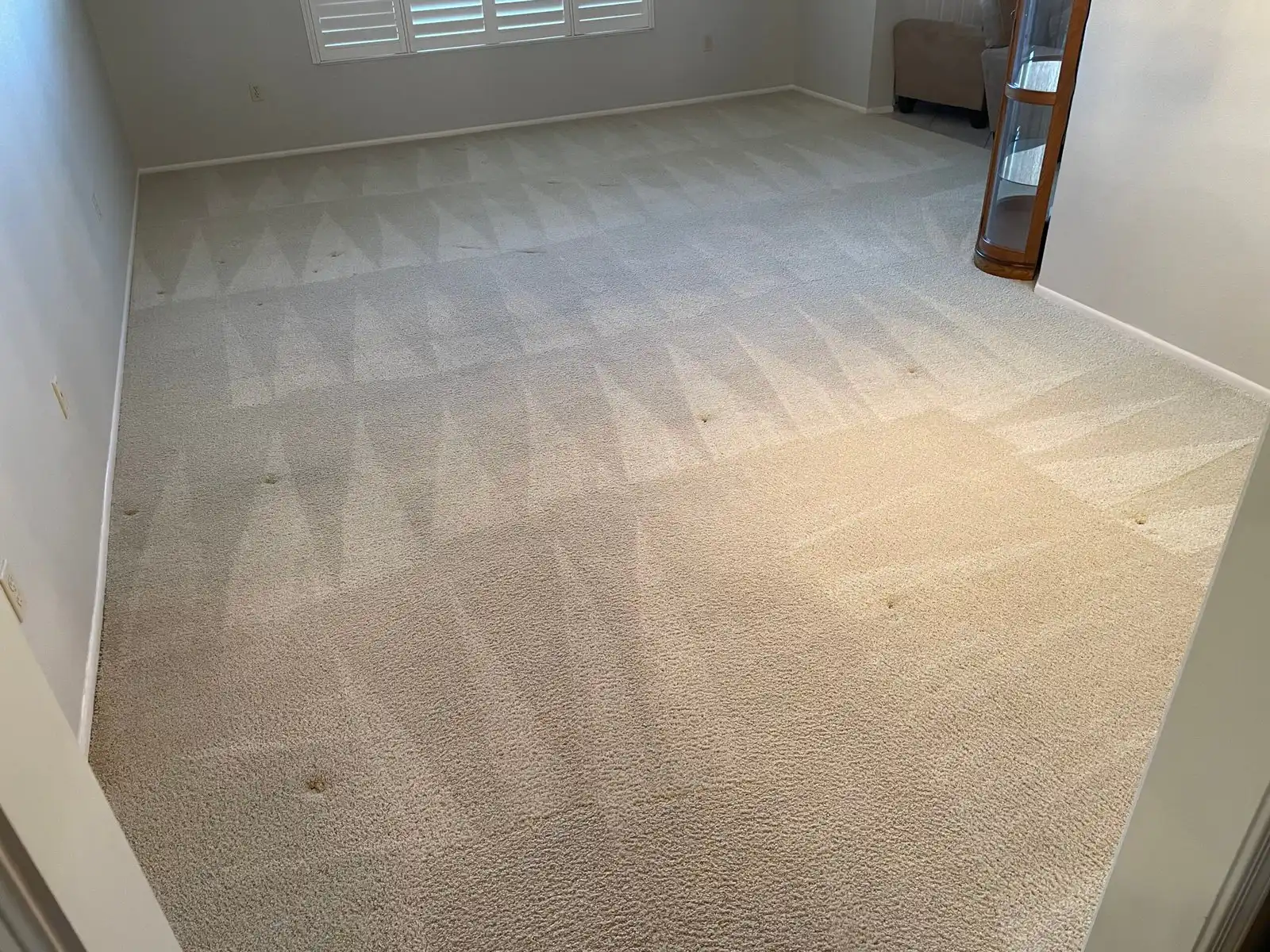
I cleaned a carpet in Sun City West, one of my early clients there, where the mobility paths through the main living area and bedroom were so compressed and rubber-darkened that the carpet looked almost brown in those zones while the areas under furniture still showed the original color. I worked on that carpet for hours - significantly more time than I'd budget for a standard cleaning - applying repeated treatment passes and targeted agitation. It improved. Noticeably. The rubber transfer lightened and the matting reduced. But the carpet was genuinely past the point where any cleaning was going to make it look like it had before the wheelchair use began. The fiber compression from years of rolling pressure had permanently altered the pile structure.
That's the honest version of what carpet cleaning can do with rubber wheel damage: it can remove the rubber transfer compound from fiber surfaces to a meaningful degree, it can reduce the matted appearance through agitation and extraction, and it can lighten the dark wheel paths. What it cannot do is reverse the physical compression that years of rolling pressure have created in the pile.
The rubber deposit itself has a specific chemistry - tire rubber contains carbon black, zinc compounds, and sulfur-based vulcanization agents that bond to synthetic carpet fibers. Addressing it requires pre-treatment with chemistry that specifically targets rubber compound rather than standard soil, plus mechanical agitation with enough tool pressure to break the deposit away from fiber surfaces. It's a different process than cleaning standard foot traffic carpet, it takes longer, and the results plateau at a point that's still better than before cleaning but isn't new-carpet quality.
How to Know Whether Cleaning or Replacing Makes Sense for Your Sun City Carpet
This is the conversation I have with a lot of Sun City homeowners before I start any work, and it's the one that most carpet cleaners skip because they'd rather just take the job. I'd rather tell you the truth.
Carpet that makes sense to clean: The pile is still present - fibers haven't been worn through to the backing. The color variation between trafficked and non-trafficked areas is noticeable but not dramatic. The rubber wheel paths, if present, are darkened but the fibers still have some resilience to them. There's visible dullness and graying from accumulated soil but the carpet's fundamental structure is intact. This carpet will show meaningful improvement with professional cleaning and it's worth the investment - especially for homeowners in Sun City Grand communities like Cimarron, Desert Springs, and Palm View who want to maintain their home's appearance without committing to replacement.
Carpet that's reached replacement threshold: The pile has been worn through in high-traffic paths - you can see or feel the backing. The fiber structure in wheel paths has been mechanically destroyed by years of rolling pressure and there's nothing to recover. The carpet is stiff, brittle, or separating from the backing. Staining has permanently altered the dye. In these cases, professional cleaning will still remove surface soil and make the carpet look somewhat better - but the structural damage is permanent and the visual improvement will be modest. For Sun City homeowners near Banner Boswell or over in Riverwalk Village considering whether to clean or replace, I'll tell you honestly which category your carpet is in when I do the walkthrough.
The in-between case: This is actually the most common situation in Sun City West and original Sun City - carpet that's past its prime but not catastrophically failed. The answer here is usually: clean it, set realistic expectations, and use the improved result to inform the replace timeline. A carpet that's been professionally cleaned and is holding up reasonably well can potentially go another year or two before replacement. A carpet cleaned specifically because the homeowner isn't ready to replace yet gets a functional extension of useful life. Both are valid reasons to clean.
I will never take your money for a cleaning that genuinely can't produce results worth the cost. If I walk through and the carpet is clearly past the point where cleaning makes financial sense, I'll tell you that directly.
Why Lightly-Used Carpet Gets Deeply Soiled Anyway
There's a misconception that carpet in homes with lighter traffic stays cleaner. It stays cleaner on the surface. The deep soil profile is often worse than people expect.
In an active adult home in Sun City where the primary residents are retired and largely at home throughout the day, the house is occupied more consistently than a working family's home. The HVAC runs continuously - the Arizona heat demands it. That continuous air circulation distributes fine particulate throughout the home and deposits it on every surface, including carpet. The carpet in a Sun City home near Stardust Golf Course or over in the Corte Bella community by Deer Valley Golf Course is receiving the same fine desert particulate, the same HVAC-distributed dust, and the same skin cell accumulation as any other Phoenix home - just without the heavy foot traffic to compress it visibly.
The result is carpet that has a significant deep soil load that isn't immediately apparent from the surface but becomes obvious during professional cleaning. The extraction water runs dark even on carpets that look relatively clean. The post-cleaning result is noticeably brighter and lighter because the deep fine soil is being removed for the first time in years.
This is why some Sun City homeowners are surprised when their carpet looks noticeably better after cleaning even though they thought it was "pretty clean already." The visual surface of the carpet can look acceptable while carrying years of deep-embedded fine particulate that's been dulling the color and fiber reflectivity without producing obvious visible staining.
The low-moisture VLM process works particularly well for this soil profile because fine particulate responds well to the encapsulation chemistry that surrounds and suspends particles for extraction, and the low moisture prevents over-saturating padding that may have aged and lost some of its resilience in older Sun City homes.
Mobility Device Paths Through Sun City Homes
The traffic patterns in Sun City homes with mobility devices are predictable and consistent across the community. Understanding them helps set expectations for which areas of the carpet will respond best to cleaning and which will show the most permanent wear.
The bedroom-to-bathroom path is almost always the most heavily impacted zone. This is the route that gets traveled multiple times daily, often with a wheelchair or scooter, and it's typically a narrow concentrated path that takes maximum wear from the rubber wheels. In homes where the bedroom carpet runs to a tile bathroom transition, this path frequently shows rubber darkening starting at the bedroom entry and running in two parallel wheel tracks to the bathroom doorway.
The living room sitting position is the second major pattern. A motorized scooter or wheelchair approached from a consistent direction to a consistent parking spot creates wear that's concentrated at the approach path and the turning radius. These areas show a different wear pattern from the straight hallway paths - more arc-shaped, sometimes with a heavier compression zone where the chair sat for long periods.
The kitchen approach, if carpeted, shows the third common pattern - a path from the seating area to the tile transition at the kitchen, usually with a distinctive worn threshold at the carpet-to-tile edge where the wheel transition happens repeatedly.
When I clean carpet in Sun City homes with this history, I assess each zone separately because the soil profile and damage level are genuinely different in each. The areas away from mobility paths - under furniture, along walls, in less-used rooms - often clean up very well and show significant improvement. The heavy mobility paths require more work, produce more modest results, and are the zones where I have the most direct conversation about what cleaning can realistically achieve.
In communities like Festival Foothills out near Sun Valley Parkway and N Canyon Springs Blvd, or in the established homes around the Sun City Country Club area, I see this pattern consistently in homes that have had a mobility device user for several years.
When to Clean and What Schedule Makes Sense
For carpet that's still in reasonable condition and worth maintaining, the cleaning schedule in Sun City homes is different from the advice I give in Surprise or Avondale family homes.
Without heavy foot traffic, without kids and pets generating concentrated soil, and with lighter daily use, Sun City carpet doesn't need cleaning as frequently as family home carpet. For carpet in good condition in a Sun City Grand or Sun City Festival home - newer communities where the carpet is more likely to be in genuinely good shape - every 18 to 24 months is a reasonable professional cleaning schedule for maintenance. The deep fine soil needs to be cleared periodically, but the accumulation rate is slower than in a family home.
For carpet in Sun City West and original Sun City homes that has a longer history and potentially some mobility device wear, the schedule depends more on current condition than on a fixed interval. If you're in the "clean it and use the result to inform the replacement decision" category, you'll know after the cleaning whether another year or two of maintenance cleaning makes sense or whether the result tells you it's time to replace.
What I don't recommend is waiting until carpet looks obviously bad before cleaning. By that point in a Sun City home, the fine particulate has been accumulating for so long that it has genuinely altered the fiber color and structure. Earlier cleaning - before the carpet looks like it urgently needs it - produces better results and maintains the carpet at a higher level throughout its remaining useful life.
I'm also happy to do a no-commitment walkthrough assessment for Sun City homeowners who aren't sure whether their carpet is worth cleaning or past the point. Looking at the pile condition, the rubber wheel damage if present, and the overall soil load takes about ten minutes and gives you the information you need to make a good decision. There's no charge for the assessment and no pressure to book if the honest answer is that replacement makes more sense.
What the Cleaning Process Looks Like for Sun City Carpet
When I clean carpet in Sun City homes, the process is adapted to the specific conditions - older carpet, fine soil load, and mobility device wear where present.
Pre-cleaning assessment comes first. I check pile condition in all zones, identify rubber wheel paths and assess their extent, check for any moisture issues in the padding that are common in older homes, and set expectations for each area before touching anything.
For standard fine-soil carpet without significant mobility device damage, I apply organic citrus pre-treatment and allow appropriate dwell time - longer than I would for a newer carpet with lighter soil, because the deep-embedded particulate needs more time to be fully suspended. The VLM cleaning process follows, with extraction pulling the suspended soil and pre-treatment completely out of the pile.
For rubber wheel paths specifically, I apply targeted pre-treatment formulated for rubber compound transfer before the main cleaning pass. This gets additional dwell time - typically 15 minutes or more - followed by mechanical agitation specifically in the affected zones, and thorough extraction. I'll do multiple passes on heavy wheel paths if the first pass shows significant improvement, because additional passes often produce continued improvement up to a point. I stop when additional passes are no longer producing meaningful results rather than continuing past the point of diminishing returns.
Grooming follows cleaning across all areas to reset fiber direction and even out the pile as much as the carpet's current condition allows. Older carpet doesn't respond to grooming the way newer carpet does, but partial recovery of fiber alignment is still possible in most cases.
Dry time in Sun City homes is typically 45 minutes to an hour for standard carpet, similar to other Phoenix-area homes in our dry climate. The low-moisture process means the carpet is usable quickly without extended waiting.
Serving All Four Sun City Communities
Serving Sun City, Sun City West, Sun City Grand, and Sun City Festival including communities near Hillcrest Golf Club, Briarwood Country Club, RH Johnson Recreation Center, Stardust Golf Course, Corte Bella, Trail Ridge Golf Course, Desert Springs, Cimarron, Willow Creek Golf Course, Heritage, Sun City Manor, Banner Boswell, Sun City Country Club, Riverwalk Village, Festival Foothills, and Sun Valley Parkway.
Learn more about our carpet cleaning services, or explore other cleaning services we offer in Sun City.

 (602) 429-9602