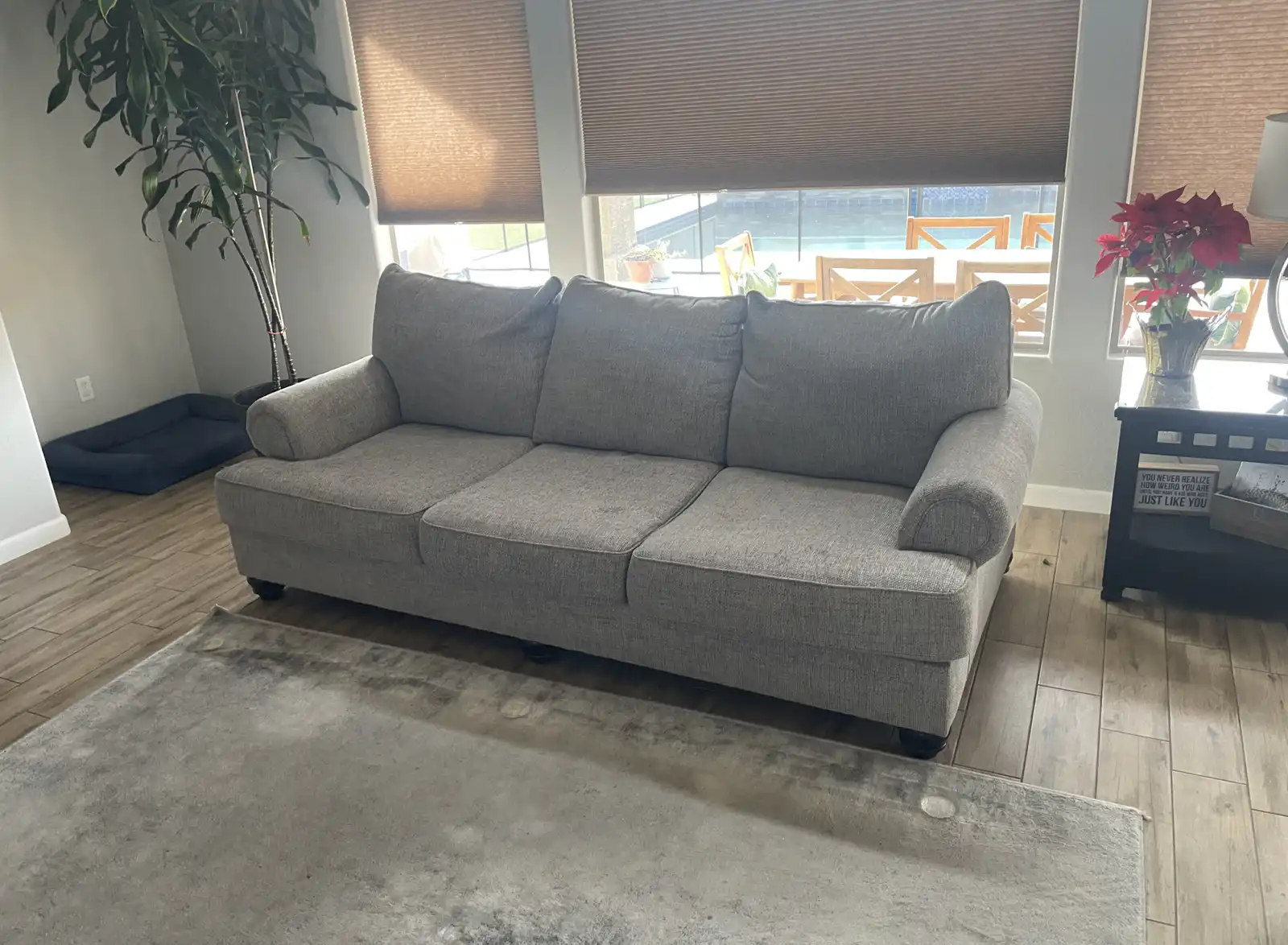
Why Fabric Dulling Looks Different From Staining
Clean upholstery fabric has a defined surface texture. The fibers have loft, a directional pile in many fabric types, and a surface quality that interacts with light in a specific way - reflecting some, scattering some, and giving the fabric its characteristic depth and color richness.
When a progressive film accumulates on the fiber surface, it changes this light interaction consistently: toward absorption and away from reflection and scatter. The combined effect of oil film absorbing light and fine dust particles scattering light is fabric that looks darker, flatter, and less dimensional than it did when clean.
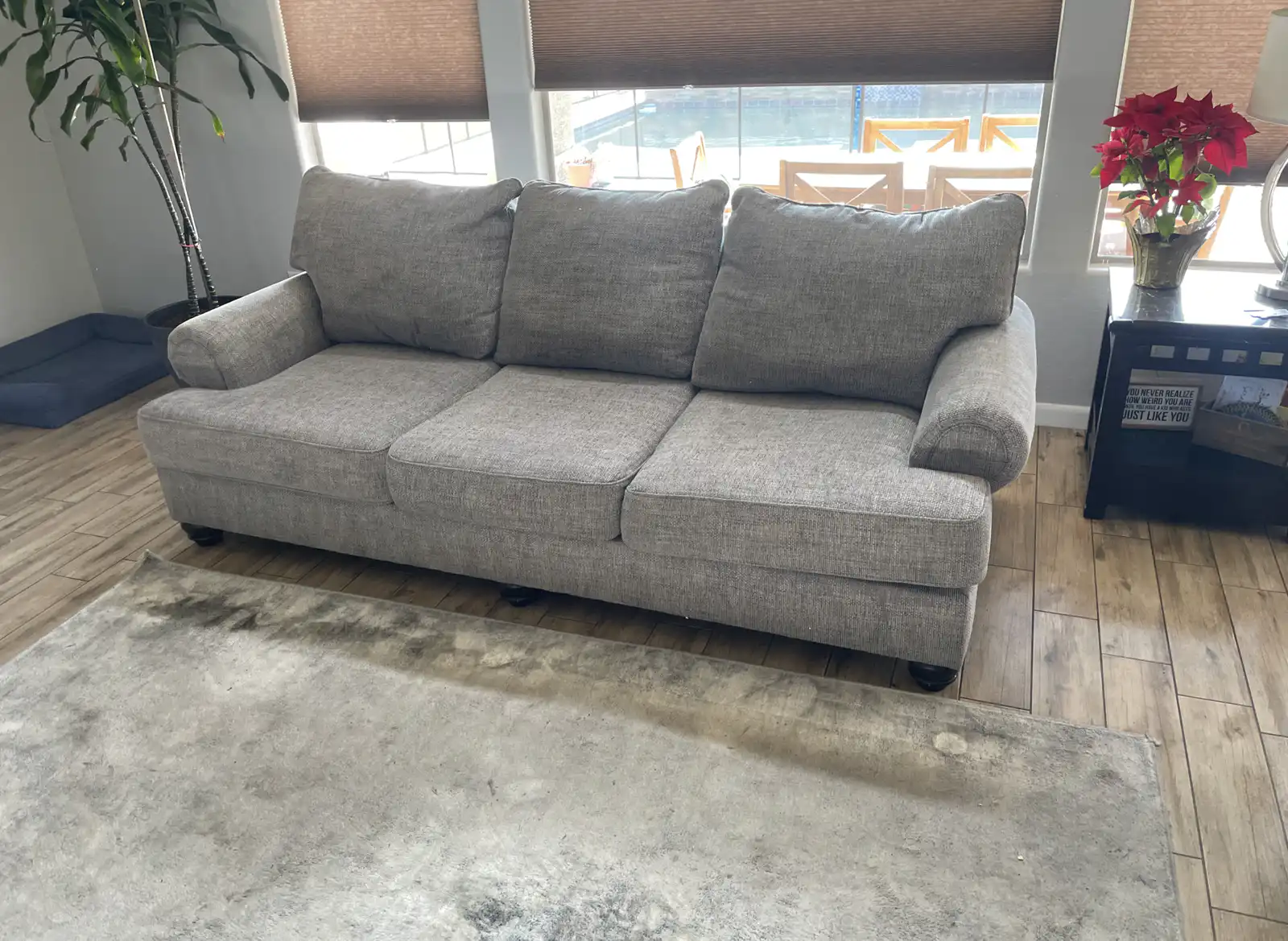
The evenness of the dulling is why it goes unnoticed for so long. A specific stain creates a contrast that draws attention immediately. Gradual uniform dulling across a surface changes the appearance so slowly that it's not noticed until compared to a photograph from when the sofa was newer, or until a cushion is moved and the uncontacted back face shows the original fabric color.
In Sun City Grand homes in the Cimarron and Desert Springs communities, and in the established Sun City neighborhoods around Willow Creek Golf Course and Sun City Lakes West, this cushion-back comparison is often the moment of recognition - lifting a sofa cushion and seeing that the back face is noticeably brighter than the sitting surface.
The Sun City Sofa Use Pattern and Why It Accelerates Dulling
Positional consistency is the key factor. In most Sun City homes, residents have established seating positions - the same person sits in the same location for the same daily activities. This consistency means the same fiber surfaces receive continuous deposit from the same source, building the film faster than varied use would.
Extended daily contact duration matters too. Retired residents spend more time on their sofa than working-age residents who are out of the home for most of the day. The Arizona climate amplifies this - the heat of Sun City summers keeps residents indoors for most of the day, with the sofa as the primary sedentary surface throughout.
Sun City's dry climate contributes its own factor. In low-humidity conditions, skin produces more oil as the body compensates for moisture lost to dry air. Residents apply more lotion and skin care products for the same reason. Both the elevated skin oil production and the increased lotion application mean higher transfer rates per contact hour than would occur in a more moderate climate.
How Fine Dust Contributes to the Dull Appearance
Fine airborne dust settles on every surface in a Sun City home continuously. The desert environment produces significant fine mineral particulate from undeveloped land, from golf course maintenance throughout all four Sun City communities, and from the general fine dust that circulates in Phoenix-area air year-round.
On clean upholstery fabric, settled dust sits loosely and is removed effectively by vacuuming. On fabric that has accumulated an oil and lotion film, settled dust behaves completely differently. The film provides an adhesive surface that captures dust particles on contact. Rather than resting loosely, the dust is held by the oil film's adhesion. Vacuuming removes the top layer of loosely settled dust but not the dust that's been captured and bonded to the film.
The combination of oil film absorption and dust-particle scattering produces the characteristic appearance that Sun City homeowners describe as their sofa looking "gray" or "washed out" - the underlying color is still there, but it's being both absorbed by the film and scattered by the dust layer above it.
Fabric Types Most Affected in Sun City Homes
Woven polyester and polyester blend fabrics show film dulling as a characteristic sheen change - the fabric takes on a slightly greasy or plastic-looking surface quality. The evenness of the coating on smooth polyester fibers makes the before-and-after of proper cleaning particularly dramatic.
Velvet and velvet-blend upholstery shows film dulling through pile flattening and direction disruption. The pile loses its upright orientation and the characteristic depth disappears. Cleaning that restores upright pile orientation alongside removing the film produces dramatic visual improvement on velvet.
Linen and linen-blend upholstery shows film dulling as color muting - the texture remains but the color looks washed out and tired. Linen responds well to cleaning because its natural fiber structure doesn't retain oil film as tenaciously as synthetic fibers do.
Chenille fabrics show film dulling as a loss of the characteristic soft, plush quality - the chenille loops accumulate film on their outer surface and begin to look matted and dull rather than plush and dimensional.
The Cleaning Process for Restoring Dulled Sun City Sofas
Pre-cleaning assessment identifies fabric type, film extent, and any specific zones needing more intensive treatment - typically primary seating positions, armrests, and areas of concentrated lotion contact.
Thorough dry pre-vacuuming with a soft brush attachment removes the loose surface dust layer before wet chemistry is applied. Multiple passes in both the pile direction and across it loosens more surface dust than a single directional pass.
Encapsulation pre-treatment applied across all contact surfaces with 10 to 15 minutes of dwell time. The film accumulation is diffuse and distributed, so the treatment needs to cover the full contact zone rather than being targeted only at obviously affected spots.
Gentle but thorough agitation works the chemistry into the fiber structure. For pile fabrics - velvet, chenille - the agitation direction matters for pile restoration as well as film removal.
Complete extraction removes the chemistry and encapsulated film material from all treated surfaces. Consistent extraction quality across the full sofa prevents residue from causing uneven re-soiling.
Pile grooming on velvet and chenille surfaces while slightly damp sets pile direction and restores the dimensional quality these fabrics depend on.
Maintaining a Restored Sofa in a Sun City Home
Weekly vacuuming with a soft brush attachment removes fine dust before it can bond to any newly accumulating film. This is the most important single maintenance habit.
Cushion rotation every two to three months distributes contact patterns more evenly and slows positional concentration of film accumulation. Most Sun City sofas have reversible seat cushions.
A light, dry microfiber cloth wipe of armrests weekly removes fresh skin oil and lotion trace before it builds up. The armrests are the highest-contact surface and the zone where film builds fastest.
Professional cleaning every 18 to 24 months maintains the sofa at a consistently good appearance level for Sun City two-person households with the maintenance habits in place. Without the maintenance habits, a 12-month interval may produce better results.
Serving All Four Sun City Communities
Serving Sun City, Sun City West, Sun City Grand, and Sun City Festival including communities near Trail Ridge Golf Course, Corte Bella, Desert Springs, Willow Creek Golf Course, Sun City Lakes West, Cimarron, Heritage, Sun City Manor, Festival Foothills, and throughout the West Valley active adult communities.
Learn more about our upholstery cleaning services, or explore other cleaning services we offer in Sun City.

 (602) 429-9602