All Ways Organic Citrus Carpet & Upholstery Cleaning - Home
🇺🇸 Made in USA
🍋 Citrus Based
🌵 Eco-Friendly
Hours
Mon – Sat
7AM – 7PM
Book Online
Book
Online
📍 Serving the Greater Phoenix Valley
🕐 Mon – Sat  7AM – 7PM
👨‍👩‍👧‍👦 Family Owned & Operated
🇺🇸 Made in USA
🍋 Citrus Based
🌵 Eco-Friendly
Book Online
Recliner Cleaning in Sun City Arizona - All Ways Organic
Sun City, Arizona

Sun City AZ
Recliner Cleaning

The recliner in many Sun City homes is not occasional seating - it is the primary chair, used for most of the resident's waking hours every day. A recliner used eight to ten hours daily by the same person for several years develops contact zone concentration that is categorically more severe than any other residential upholstery I clean. Cleaning these requires the right process for what's recoverable and the honesty to tell you when replacement makes more sense.

Google
5.0 / 5.0
Google Reviews
Organic
100% Organic
Citrus-based products
Owner operated
Owner-Operated
Kyle shows up every time
Quick dry
~1-Hr Dry Time
Low-moisture process
No hidden fees
No Hidden Fees
Price quoted = price paid
Schedule Your Cleaning
Book Your Sun City Recliner Cleaning
Pick a date, build your clean, and confirm - takes about 60 seconds
1Date
/
2Build
/
3Book
Your Clean
$0

When works for you?

Pick a day and time. We'll handle the rest.

Build your clean

Tap a category, then add what you need.

Need commercial cleaning? Call (602) 429-9602 for a custom quote.

Confirm your cleaning

Almost there. Fill in your details and lock in your spot.

📅
Driveway parking available?
Tap any item above to adjust add-ons or remove it.

You're All Set!

Booking #

Confirmation sent to your email.

What to expect: I'm Kyle, the owner, and I'll be the one showing up. Carpets dry in about 1 hour. Your home will smell like fresh citrus. Safe for kids and pets immediately after cleaning.

Questions? Call or text (602) 429-9602

Need help?(602) 429-9602
SMS Consent: By providing your phone number when booking, you consent to receive appointment reminders and follow-up messages via SMS from All Ways Organic. Msg frequency varies. Msg & data rates may apply. Reply STOP to opt out at any time. Privacy Policy · Terms
Transparent Pricing

No Hidden Fees. No Surprises.

The price you see is the price you pay. All surfaces cleaned, honest assessment included.

Recliner Cleaning
Recliner
Single recliner, all surfaces cleaned
$45
per recliner
Book Now >
Loveseat Cleaning
Loveseat
Standard 2-seat loveseat, all surfaces cleaned
$75
per loveseat
Book Now >
3-Seat Sofa Cleaning
3-Seat Sofa
Standard 3-cushion sofa, all surfaces cleaned
$125
per sofa
Book Now >
Optional Upgrade Treatments
Available at checkout to customize your cleaning
Deodorizer
Deodorizer
Extra odor elimination for a deeper fresh
High Traffic
High Traffic
Targeted treatment for heavy-wear areas
Pet Treatment
Pet Treatment
Neutralizes pet odors at the source
What Our Customers Say

Real Reviews, Real Results

"I'd rather help a Sun City homeowner make a well-informed replacement decision than clean a recliner repeatedly at diminishing returns."

About This Service

What Happens to a Recliner Used 8 to 10 Hours Daily

The distinction between a recliner as occasional seating and a recliner as a primary chair is not just a matter of degree - it's a fundamentally different use case with different accumulation rates, different damage patterns, and different realistic expectations for cleaning.

In a working-age household, a recliner might be used two to four hours in the evening. The upholstery has time between uses to recover. In a Sun City home where a resident spends most of their waking hours in the recliner - common across all four communities, and especially common for residents with mobility limitations that make the lift-recliner combination their most comfortable seating option - the recliner receives sustained contact for the equivalent of a full working day, every day.

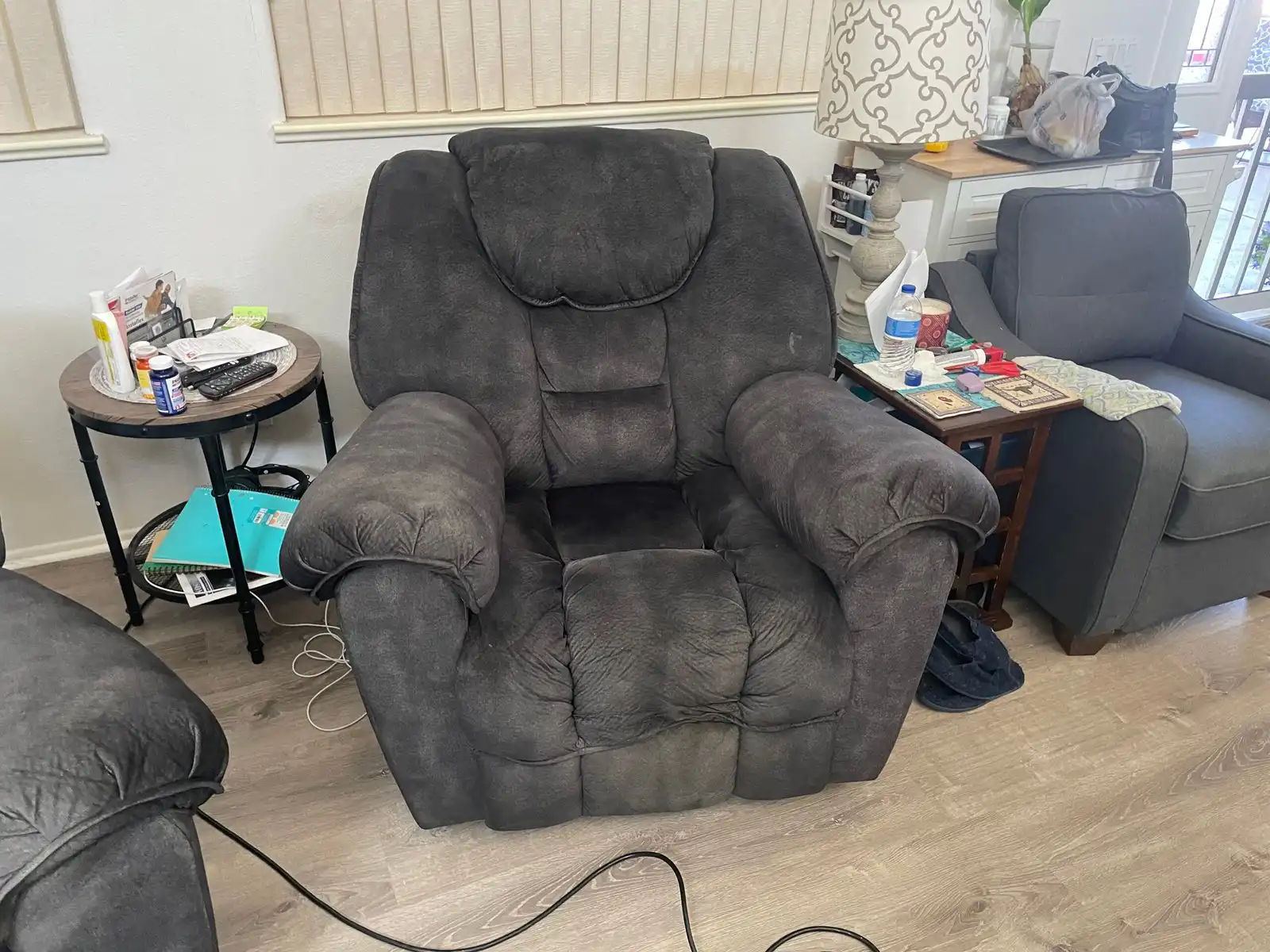
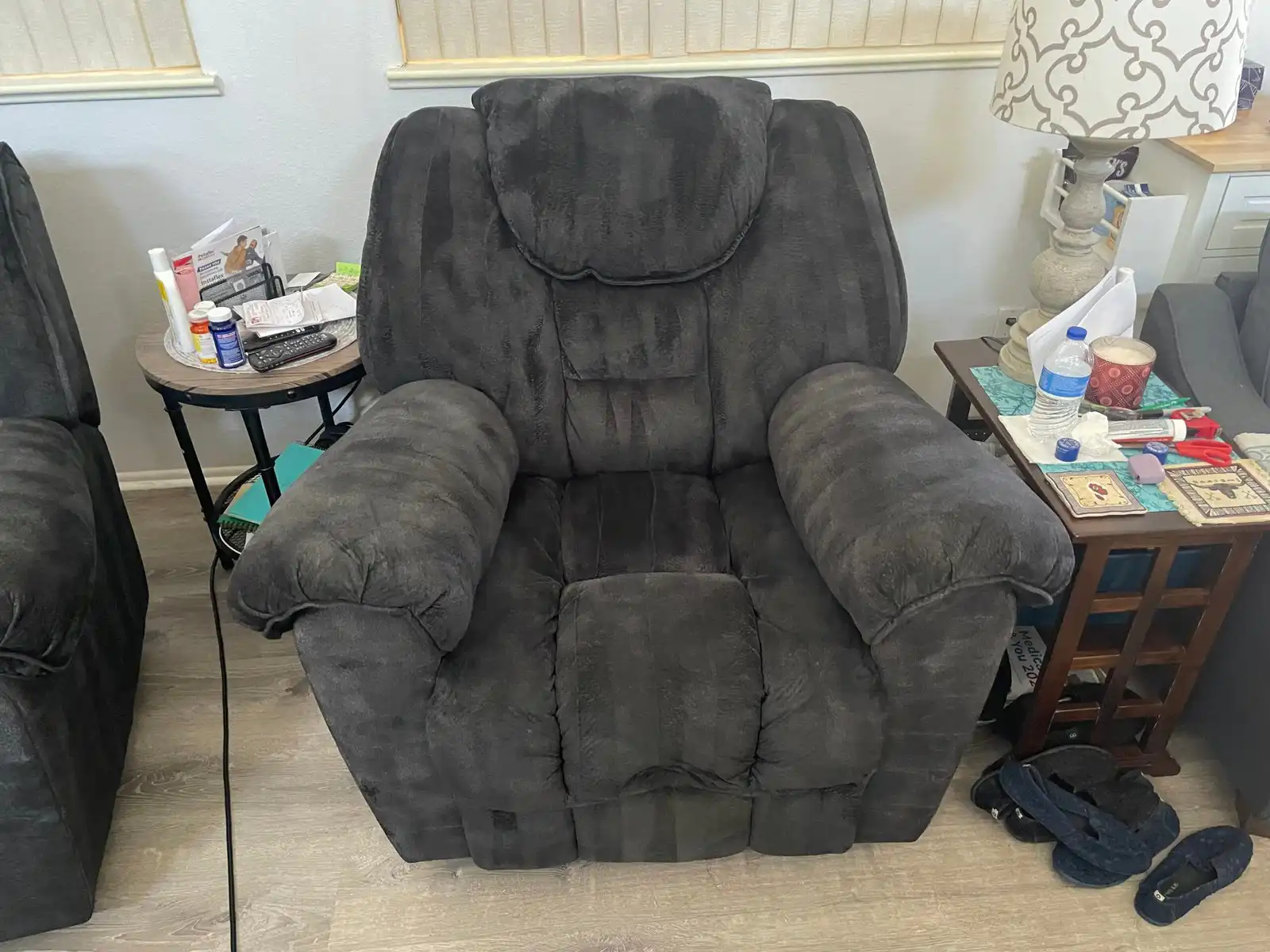
Over months of this use pattern, the contact zones accumulate material at a rate that's difficult to fully appreciate without seeing the results up close. I've cleaned recliners in Sun City West homes near RH Johnson Recreation Center and in Sun City Grand communities around Desert Springs where the headrest shows a defined, darkened contact area that mirrors the exact shape of where the resident's head rests. The armrests have a darkened band at the forearm contact zone that extends the precise length of a forearm.

These are not stains in the usual sense. They are the physical record of thousands of hours of contact from the same person in the same position, depositing skin oil, hair oil, scalp material at the headrest, and therapeutic lotion residue from arms and hands at the armrests, continuously, with no rest interval.

Why It Matters
Extreme Contact Zone Concentration
Headrest Zone
Headrest: Most Concentrated Zone
The scalp produces sebaceous oil continuously. When the same head position contacts the same surface for extended daily periods, sebum accumulates rapidly. Hair products and medicated shampoo residue add to the deposit. This zone shows the most dramatic darkening and often has an odor component.
Armrest Zone
Armrests: Extreme Lotion Loading
Forearms rest on armrests for hours at a time. Hands grip during standing and sitting transitions. Therapeutic cream for arthritis, hand moisturizer, and natural skin oil deposit with every contact. After several years, armrests carry the heaviest total lotion and oil accumulation.
Heat Bonding
Extended Heat Drives Deposits Deeper
Body heat during prolonged contact raises cushion temperature to 100-110 degrees. At these temperatures, oil compounds become more fluid and penetrate deeper into fiber structures. Each heat-cool cycle bonds more material at depth, making long-term deposits harder to extract than recent ones.
Honest Assessment
Honest Clean vs. Replace Framework
Contact zone darkening under two to three years of primary use is almost always recoverable. Very long-term accumulation with deep heat-cycle bonding improves but may not return to uniform. When fabric structure is physically altered, replacement becomes the honest recommendation.

The Specific Contact Zones and What Accumulates in Each

A primary-use recliner in a Sun City home has distinct accumulation profiles at each contact zone, and effective cleaning requires assessing and treating each zone according to what's actually there rather than applying a uniform approach.

The headrest is the most concentrated accumulation zone on most Sun City recliners. Sebum accumulates in the upholstery fiber at that exact contact location. Hair products, scalp treatments, and medicated shampoo residue add to the deposit. This zone also commonly shows fabric wear from the friction of repeated head repositioning - a different problem from soil accumulation that cleaning can address.

The armrests carry the therapeutic lotion and skin oil concentration in an extreme form. Forearms rest on armrests for hours at a time. Hands grip armrests during the standing and sitting transition multiple times daily. The armrest surface of a Sun City primary recliner after several years of this use is typically the most heavily loaded surface in terms of total lotion and oil accumulation.

The seat cushion receives the sustained compression of the resident's weight for most of the day, combined with whatever transfers from clothing. Sustained compression drives material deeper into the cushion fiber and the fill below, and extended heat from body contact accelerates the bonding of oils to fiber surfaces.

The footrest zone accumulates a different soil profile - contact from the backs of legs and feet, often including topical cream application to lower legs for circulation support, and occasionally contact from rubber-soled footwear residue.

How Extended Heat Contact Accelerates Soil Bonding

Human body temperature at the skin surface is approximately 93 to 98 degrees Fahrenheit. When a person sits in the same position for an extended period, the upholstery contact zones can reach 100 to 110 degrees Fahrenheit during prolonged contact in a Sun City home, where ambient temperatures already reduce the differential between body and air.

At these temperatures, oil compounds become more fluid and penetrate deeper into fabric fiber structures than they would at room temperature. Skin oil and lotion compounds that might sit primarily at the fiber surface during brief contact have hours of elevated temperature during primary recliner use to migrate progressively deeper into the fiber pile and toward the backing.

The repeated heat cycling - the contact zone warms during use and cools between uses - also promotes the bonding of oil compounds to fiber surfaces. Oils that migrate into fiber structures under heat can partially bond as they cool and re-solidify. Over years of daily primary use, the total bonded deposit at the headrest and armrests can be considerably deeper than anything I encounter in standard occasional-use upholstery.

Honest Assessment: What Cleaning Can and Cannot Recover

Contact zone darkening from skin oil, lotion, and scalp material that hasn't been building for more than two to three years of primary use is almost always recoverable to a significant degree. Pre-treatment with appropriate chemistry, adequate dwell time, mechanical agitation, and thorough extraction produces visible improvement. Not factory-new, but clean.

Headrest contact zones where the fabric has both deep oil accumulation and visible fiber wear from years of repeated head friction present a combined problem. Cleaning addresses the oil component but cannot reverse fiber wear. The result after cleaning is lighter and cleaner but not uniform with undamaged areas.

Very long-term armrest accumulation - five or more years of primary daily use - where oil compounds have had extensive heat-cycle bonding throughout the fiber depth. Cleaning produces improvement and the armrests feel less tacky, but complete color uniformity with less-used areas may not be achievable.

When the fabric structure at the primary contact zones has been physically altered - fibers are worn through, the fabric is separating from backing, or the fill material has compressed permanently beyond recovery - cleaning addresses surface contamination but can't restore the structural condition. I'll give a direct honest assessment at the walkthrough.

The Cleaning Process for Primary-Use Sun City Recliners

Pre-cleaning assessment and zone-by-zone evaluation comes first. I examine each contact zone separately - headrest, armrests, seat cushion, footrest - assessing the depth and extent of accumulation and identifying any fabric wear or structural issues.

Dry pre-treatment at the headrest zone specifically addresses the high proportion of dried, hardened scalp oil and hair product material that benefits from loosening before wet chemistry is applied.

Zone-specific wet pre-treatment calibrated to each zone's soil profile. The headrest gets chemistry formulated for sebum and hair product compounds. The armrests get encapsulation chemistry for lotion and therapeutic cream emollients. Each zone gets dwell time appropriate for its severity - typically 15 to 20 minutes for the most heavily loaded zones.

Multiple treatment passes on the primary contact zones as needed. For established deep accumulation, a single pass produces partial improvement. A second pass often produces significant additional improvement. I continue additional passes while meaningful improvement is occurring and stop when improvement plateaus.

The mechanical zones - areas where the frame and mechanism create fabric folds during operation - get specific attention because material compresses into fabric creases during folding and unfolding. These areas need the fabric positioned in different stages of recline during cleaning.

Fabric Types Common in Sun City Recliners

Bonded leather and faux leather are extremely common in Sun City recliners. They accumulate surface deposits rather than absorbing them into fiber structure. Bonded leather cleans more easily, but in primary daily use has a different vulnerability: the bonding layer degrades with sustained heat and flexing. Peeling and delamination is a wear issue, not a cleaning issue, and is common after five or more years of primary daily use.

Genuine leather develops the primary-use accumulation as a surface patina. Professional cleaning followed by conditioning is appropriate, and the cleaning outcome is generally better than for fabric because the material is inherently more cleanable at the surface level.

Performance fabric - tight-woven synthetic fabrics marketed as stain-resistant - resists initial accumulation but is not immune to deep bonding from years of primary daily use under heat. Earlier-stage accumulation is more responsive to cleaning. Later-stage accumulation that has worked through the weave is similar in difficulty to standard fabric.

Standard upholstery fabric - polyester, fabric blends, microfiber - shows the accumulation profile described throughout this page. Microfiber primary-use recliners show some of the most dramatic contact zone concentration because the fine fiber structure provides extensive surface area for oil film to coat.

After Cleaning: Extending the Life of a Sun City Primary Recliner

A headrest cover is the single most impactful maintenance addition. The headrest zone is the fastest-accumulating and hardest-to-clean zone on the recliner. A removable headrest cover intercepts the scalp oil and hair product transfer before it reaches the upholstery. The cover can be laundered weekly. This intervention alone extends the interval before the headrest needs professional attention from months to potentially years.

Armrest covers or a folded cloth at the primary forearm contact zone provide equivalent protection. The forearm resting position for extended periods is the armrest's most damaging use pattern, and a barrier cloth absorbs most of the transfer.

For bonded leather recliners, a protective conditioner applied every three to six months slows the degradation of the bonding layer that leads to peeling. For genuine leather, conditioning after each professional cleaning maintains suppleness and surface quality.

The honest end-of-life conversation: a recliner that has served as a primary chair for eight to ten years has provided a decade of several-thousand-hours-per-year use. Some degree of irreversible wear at the primary contact zones is the natural result. When cleaning improves it meaningfully but can't bring it to an acceptable appearance, or when structural wear is the dominant issue, replacement is the right decision, not a cleaning failure.

Serving All Four Sun City Communities

Serving Sun City, Sun City West, Sun City Grand, and Sun City Festival including communities near RH Johnson Recreation Center, Desert Springs, Hillcrest Golf Club, Briarwood Country Club, Corte Bella, Trail Ridge Golf Course, Heritage, Sun City Manor, Sun City Country Club, Festival Foothills, and throughout the West Valley active adult communities.

Learn more about our upholstery cleaning services, or explore other cleaning services we offer in Sun City.

Common Questions

FAQs About Sun City Recliner Cleaning

In most cases, significantly improved - yes. Completely uniform with the surrounding fabric - depends on how long it's been accumulating and whether there's fabric wear underneath the soil. With targeted pre-treatment chemistry, extended dwell time, and multiple treatment passes, the contact zones lighten noticeably in most situations I encounter in Sun City homes. The honest caveat: if the accumulation has been building for many years with deep heat-cycle bonding, the improvement will be real but the zone may not return to perfectly uniform color. I'll assess the condition before starting and tell you what's realistically achievable.

For primary daily use of eight or more hours, annually is the appropriate interval. At that use intensity, the contact zone accumulation reaches a level within a year where the headrest and armrests are visibly affected and where deeper bonding of oil compounds has begun. Annual cleaning keeps the accumulation from reaching the point where multiple treatment passes are needed and where some of the deposit has bonded beyond what cleaning can fully address.

Yes - armrest covers are the most effective intervention. A simple cloth cover over the armrests absorbs the therapeutic cream transfer before it reaches the upholstery. Launder the covers weekly. You can also apply cream and wait 15 to 20 minutes before sitting - lotion that has had time to absorb into the skin transfers significantly less to fabric. With both measures in place, the armrests accumulate much more slowly and annual professional cleaning maintains them in good condition.

Peeling bonded leather is a wear issue, not a cleaning issue - the adhesive bond between the polyurethane surface layer and the backing material is failing from repeated flexing and heat cycling of daily use. Cleaning removes surface contamination but doesn't repair the delamination. If the peeling is minor, targeted repair products can extend its life. If extensive, replacement is the honest recommendation.

Yes, in most cases. Headrest odor on a primary-use recliner comes from concentrated organic material - scalp sebum, hair products, skin cells - that produces odor as it breaks down. Professional cleaning with thorough extraction removes the material producing the odor. If the odor has penetrated through to the foam fill, a second pass after the first has dried often addresses residual odor. Very long-term accumulation may require an enzyme treatment specifically targeting the organic compounds at depth.

The difference is in scale and depth of accumulation. A primary-use recliner has contact zone accumulation that's five to ten times more severe than occasional-use seating. This requires longer dwell times, multiple treatment passes, zone-specific chemistry calibrated to each area's soil profile, and more thorough extraction. The honest assessment framework is also more important - for a recliner at the extreme end of primary use, communicating realistic expectations before starting is necessary.

Yes, and this is a situation I encounter in Sun City homes. Cleaning gives you an honest picture of what the recliner actually looks like at its current best, which is better information for the keep-or-replace decision than making that decision based on a heavily soiled piece. After cleaning, you'll know whether the result is one you're comfortable with or whether the years of primary use have left the piece past the point of acceptable appearance. I approach these situations with care and respect.

A headrest cover. The headrest zone is the fastest-accumulating and hardest-to-clean area on a primary-use recliner, and intercepting the scalp oil and hair product transfer with a removable washable cover makes more difference to long-term condition than any other single measure. Launder it weekly. Armrest covers are a close second. Together, these two barrier covers protect the two highest-accumulation zones and can meaningfully extend the interval between professional cleanings.

Is Your Primary Recliner Overdue for a Deep Clean?
Same-week availability - No hidden fees - Honest assessment included
What Our Customers Say

Real Reviews, Real Results

All Sun City Services
What We Clean in Sun City
All 14
Carpet
Upholstery
Area Rugs
Tile & Commercial
Decorative desert cactus illustration growing from the desert floor