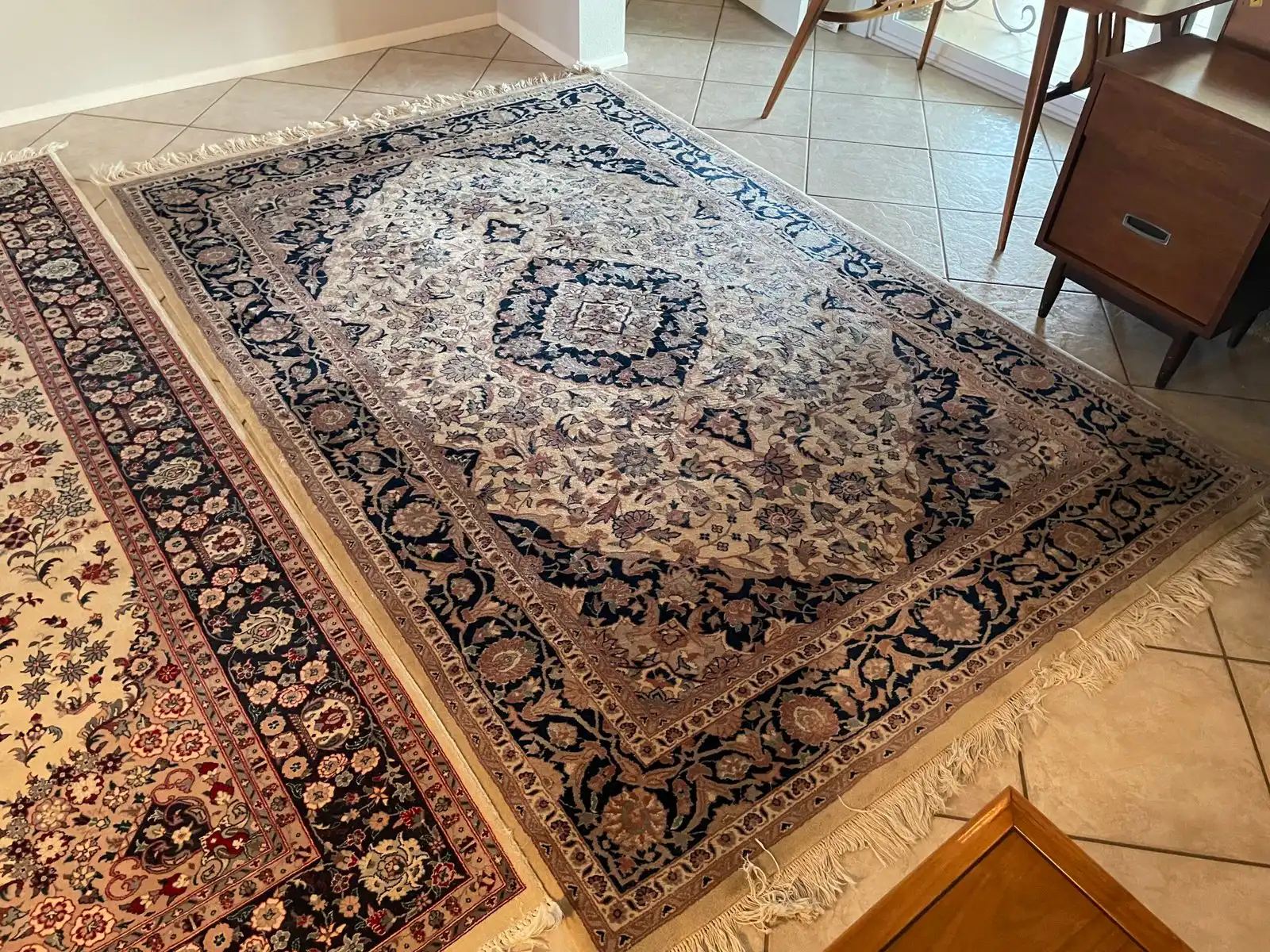
The Pre-Cleaning Assessment for Stored Oriental Rugs
A stored oriental rug requires a more thorough pre-cleaning assessment than a rug in active use, because the storage history has introduced potential issues that aren't visible from a quick surface inspection.
The full unrolling and flat examination comes first. A rug that's been rolled for an extended period needs to be fully unrolled and allowed to relax before meaningful assessment can happen. Pile that was compressed in the roll will partially recover within a few hours of being laid flat.
Pile condition assessment checks for pest damage, fiber loss, pile height consistency, and any areas where the foundation is exposed. Sun City garage storage creates favorable conditions for clothes moths, and wool pile is their primary food source. Even a few months in an unprotected warm garage can produce moth damage.
Dye stability testing is essential for any oriental rug before wet cleaning, and especially for older pieces or those of unknown history. Natural dyes in Persian and Turkish rugs - madder red, indigo blue, pomegranate yellow - have different stability characteristics from synthetic dyes. A brief moisture test in an inconspicuous area before full cleaning identifies any sensitivity.
Structural assessment checks the foundation - warp and weft threads - for brittleness or damage. The dry heat cycling in a Sun City garage, especially through multiple Arizona summers, removes moisture from the foundation fibers over time. Brittle foundation threads are a risk during cleaning because the mechanical stress of agitation can cause damage.
Moisture damage check involves examining the backing for any discoloration, odor, or texture change that indicates previous moisture exposure and potential mold in the foundation. If there is mold, treatment before cleaning is required.
Storage Odor: What It Is and How It Comes Out
Musty closed-air odor is the most common. This comes from the rug being in a low-airflow environment where the natural off-gassing of wool fiber builds up without dissipating. This odor responds well to cleaning and airing and typically resolves fully after professional cleaning.
Heat-cycled garage odor has a distinctive character that combines the musty component with notes of rubber, dust, and sometimes the off-gassing of nearby garage storage items. Oriental rugs stored in Sun City and Sun City West garages - where summer temperatures reach 140 to 160 degrees Fahrenheit inside an unventilated garage - have been through significant heat stress. This odor is more complex and requires cleaning that specifically addresses the heat-modified organic compounds.
Mothball or cedar odor is common in rugs stored with protective materials. Naphthalene from mothballs is a persistent volatile compound that impregnates wool fiber and doesn't simply air out. Removing mothball odor requires specific treatment beyond standard cleaning.
True mold odor is distinctive and requires identifying whether the mold is active or historical. Active mold in the foundation requires treatment before cleaning. Historical mold - where a previous moisture event caused growth that subsequently dried out - leaves a staining and odor pattern that professional cleaning can often significantly improve.
Pile Compression Recovery: What Cleaning Can and Can't Do
Cleaning helps with compression recovery in two ways. First, the moisture introduced during professional cleaning temporarily increases the elasticity of wool fiber. Wool in its natural humid state is more flexible and resilient than dry wool. A wool fiber that's been dry-compressed in a rolled rug will recover more of its original position when cleaned and returned to a more natural moisture state. Second, grooming the pile while the rug is slightly damp - using a pile brush to work against the compressed direction - physically assists fiber recovery during the window when moisture has maximized fiber flexibility.
What cleaning can't do is fully reverse severe long-term compression in fibers that have reached a permanent set. A rug rolled tightly for ten years in a hot garage will have areas of pile compression that are only partially recoverable regardless of cleaning. Setting realistic expectations about this before cleaning is part of the honest pre-cleaning conversation.
In most cases, a stored rug that has been cleaned and groomed properly shows substantial pile recovery within 24 to 48 hours as the fibers continue to recover after cleaning. Some areas may need a few days of use and foot traffic to fully settle.
Moth and Pest Damage in Stored Oriental Rugs
Clothes moths target wool pile specifically - the moth larvae feed on keratin, the protein that makes up wool fiber. Adult moths prefer dark, undisturbed environments, which describes a rolled rug in a garage storage area very accurately.
Damage assessment looks for irregular areas of pile loss - patches where the wool pile is noticeably shorter or absent, revealing the foundation warp and weft threads. Early-stage damage shows as minor thinning. More significant damage produces clearly visible bare patches. Severe damage can affect large areas and compromise the structural foundation itself.
Minor surface pile loss in inconspicuous areas may be cosmetically insignificant - the rug can be cleaned, placed, and used normally. More significant pile loss in visible central areas is a different situation. Structural damage that has compromised the foundation may require professional rug restoration beyond what cleaning can address.
Cleaning a moth-damaged rug requires confirming that the infestation is no longer active before any wet treatment. Active moth larvae in a wet rug will spread through the rug during cleaning.
Caring for Oriental Rugs in Active Use in Sun City Homes
Oriental rugs in active use benefit from regular vacuuming - but carefully. For hand-knotted oriental rugs with fringe, avoid vacuuming the fringe with a brush roll as this tangles and damages fringe fibers. Vacuum the pile with a suction head or low-setting brush attachment in the pile direction.
Rotation every six to twelve months distributes both foot traffic wear and the UV exposure from Sun City's significant sunlight. Oriental rugs in living rooms with golf course views - common in Sun City Grand communities overlooking Desert Springs Golf Course, or in Sun City West homes with views toward Briarwood Country Club - receive significant directional sunlight that can unevenly fade dyes over time.
Pad maintenance under the rug matters - for a valuable oriental rug specifically, a quality pad protects the rug's foundation from mechanical stress and hard tile contact. Inspect the pad at each professional cleaning.
Professional cleaning every two to three years is appropriate for an oriental rug in normal residential use. More frequent cleaning risks over-stressing the fiber structure. Less frequent cleaning allows fine particulate accumulation to reach the abrasion damage threshold. Two to three years hits the right balance.
Serving All Four Sun City Communities
Serving Sun City, Sun City West, Sun City Grand, and Sun City Festival including communities near Desert Springs Golf Course, Briarwood Country Club, Corte Bella, Hillcrest Golf Club, Willow Creek Golf Course, Sun City Country Club, Festival Foothills, and throughout the West Valley active adult communities.
Learn more about our area rug cleaning services, or explore other cleaning services we offer in Sun City.

 (602) 429-9602