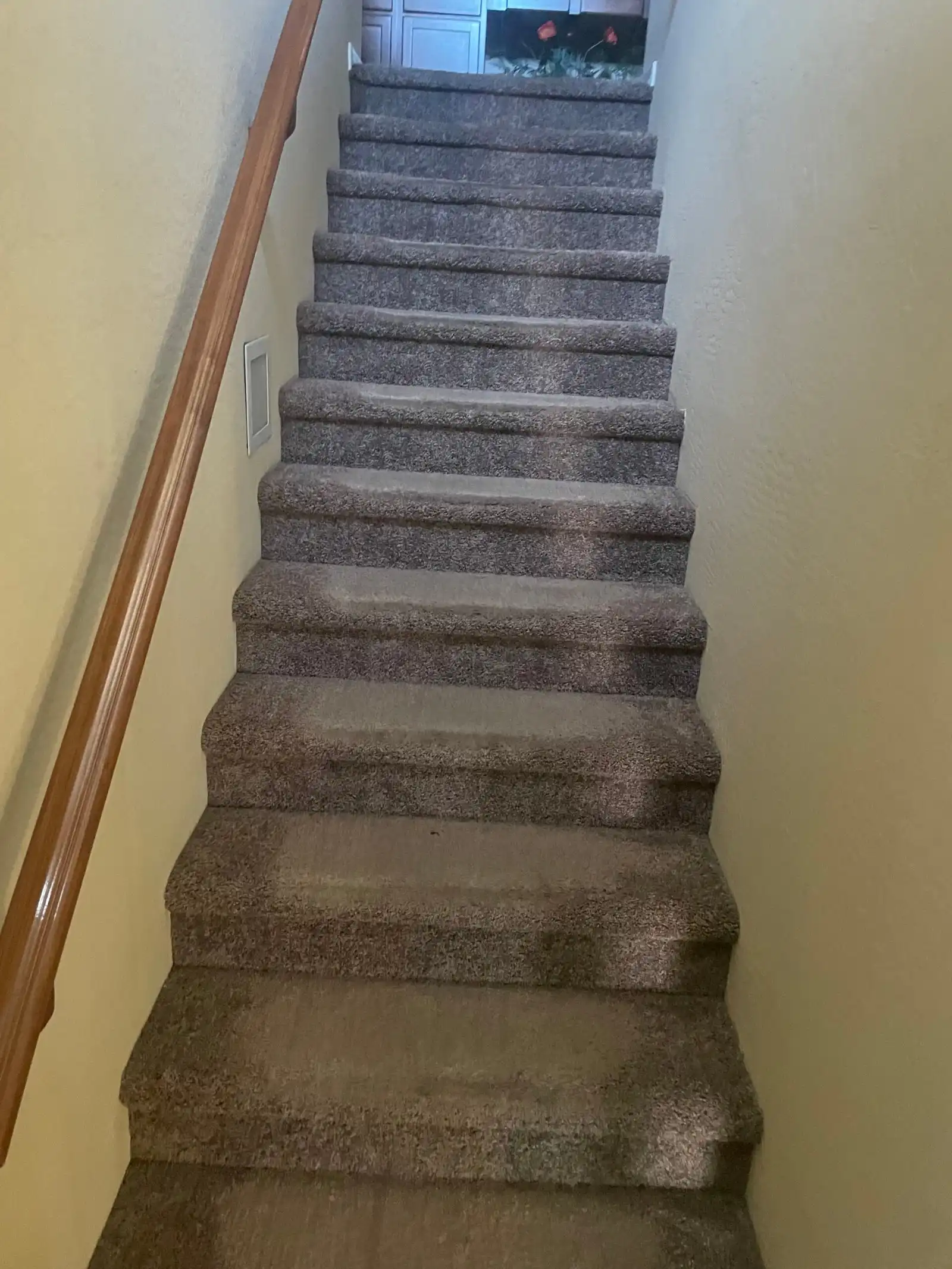
The Visual Contrast Mechanism and Why It Matters for Stair Safety
Safe stair navigation - particularly on descent - relies on the ability to visually distinguish each step edge. The tread edge is the visual boundary that tells the eye and brain where one step ends and the next begins. When staircase lighting is good and the carpet is clean, this boundary is clear.
When tread edges darken significantly, the visual contrast between the tread surface and the step edge zone changes in a way that reduces edge definition. The darkened edge band blends toward the color of the riser shadow, reducing the contrast that makes each step boundary clear. Rather than a clean visual separation, the eye sees a gradual darkening that makes the boundary ambiguous.
This ambiguity matters more in lower light conditions - evening stair use with only ambient room lighting, a staircase that doesn't receive good natural or artificial light, or early morning navigation before full lighting is activated. For residents whose vision makes contrast sensitivity more effortful, the reduction in tread edge contrast increases the visual work required to navigate the staircase safely.
For visitors to Sun City homes - adult children, grandchildren visiting for holidays, anyone unfamiliar with the staircase - the absence of clearly defined tread edges removes a visual reference that confident stair navigation normally relies on.
What's in the Tread Edge Soil Deposit
Shoe sole rubber and outdoor soil are the primary components. Carbon black from shoe soles deposits into carpet fiber at the tread edge with every step. Outdoor particulate brought in on shoe soles concentrates at the tread edge through the same mechanical concentration mechanism. Fine mineral dust, trace soil from outdoor surfaces, and general particulate all accumulate in higher concentration at the tread edge than on the tread surface behind it.
In Sun City homes where residents use the stairs barefoot or in socks, the tread edge soil composition shifts toward skin oil and natural foot sole material rather than shoe rubber - a somewhat different soil chemistry that responds to different pre-treatment emphasis.
For Sun City homes where guests use the staircase during family visits, the tread edge accumulates the additional soil load of unfamiliar contact chemistry. Grandchildren running on carpeted stairs deposit significantly more soil per contact than careful adult stair use.
Assessing Tread Edge Darkening: How Bad Is It?
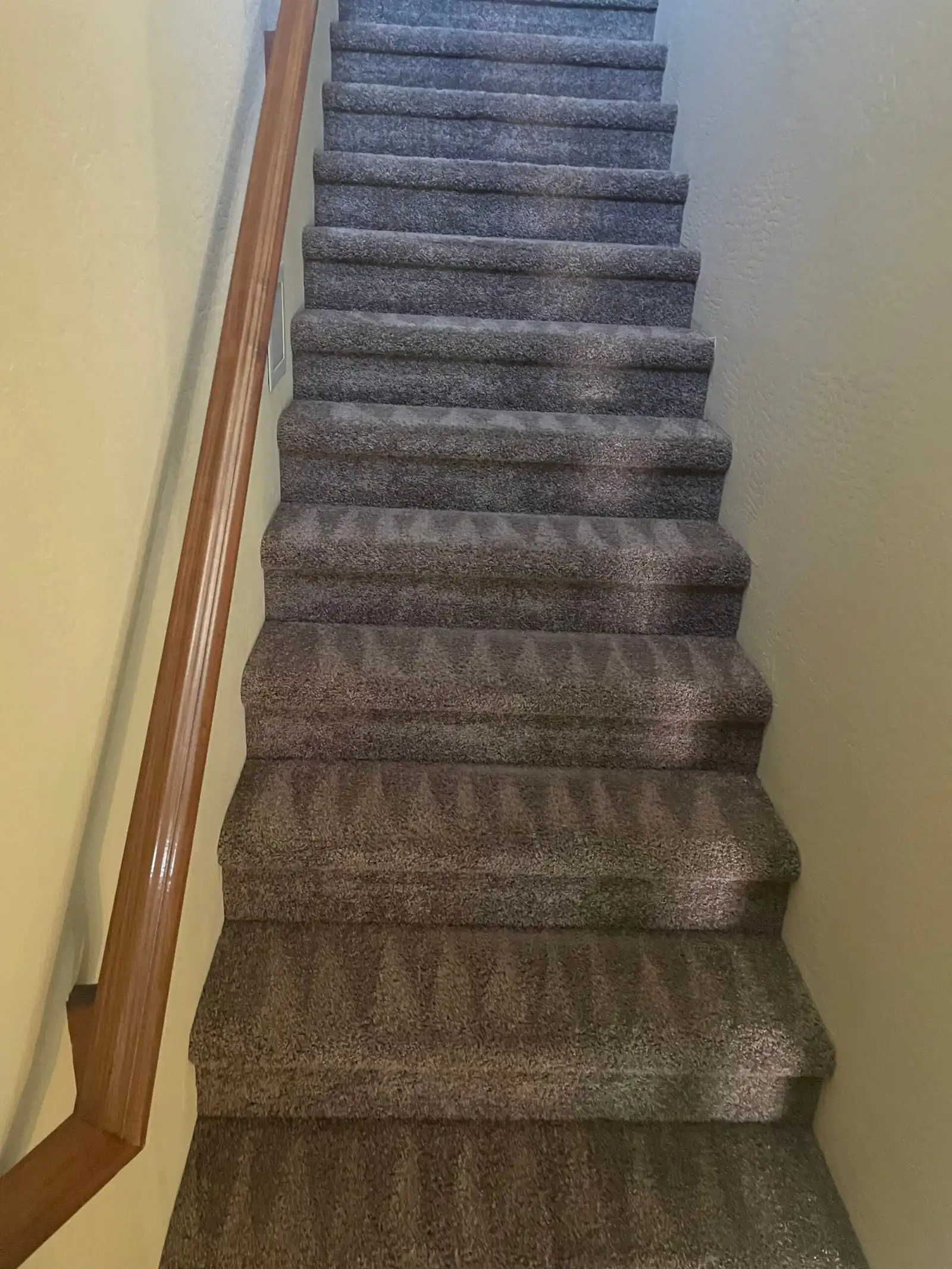
Early-stage tread edge darkening - one to two years of normal use without professional cleaning - shows as a slightly darker band noticeable close-up but not obvious from the bottom of the staircase. The fiber is still structurally intact. Professional cleaning at this stage produces dramatic results - the ideal cleaning window.
Moderate tread edge darkening - two to four years - shows as a clearly visible dark band apparent from the base of the staircase. Professional cleaning produces good results with meaningful lightening and visual contrast restoration, though somewhat less complete than at the early stage.
Advanced tread edge darkening - four or more years - shows as near-black bands with visible fiber compression and possible fiber wear. Professional cleaning produces genuine improvement and restores meaningful visual contrast, but some residual darkening may remain at the most severely accumulated tread edges.
Fiber wear at tread edges - where the pile fibers have been physically worn down by concentrated mechanical stress - is distinct from soil darkening and is not addressable by cleaning. Distinguishing fiber wear from soil darkening during assessment is important because the two conditions look similar from a distance but have different implications.
The Staircase Cleaning Process
Stair-specific tool attachments allow proper working contact with the tread surface and the critical tread edge zone. Getting the cleaning tool into proper contact with the tread edge - where the soil concentration is highest - is the key technique difference between stair cleaning that restores tread edge contrast and cleaning that leaves the darkest zone largely unaddressed.
Pre-treatment at tread edges is applied with concentration at the darkest band first, allowing longer dwell time at the highest-soil zone. The tread edge pre-treatment dwell time is typically longer than the tread surface dwell time because the deposit depth and bonding is greater.
Agitation at the tread edge requires working into the fiber at the specific angle of the tread-to-riser junction. The soil has been driven into the fiber by foot contact at that specific angle - cleaning agitation that matches that geometry reaches the soil more effectively.
Extraction at the tread edge requires proper tool positioning to get suction contact with the tread edge zone. Inadequate extraction leaves chemistry and released soil that re-soils quickly.
Riser carpet cleaning is included in a thorough stair cleaning - the vertical riser faces collect fine dust and airborne particulate, and cleaning the risers ensures the complete visual presentation of the staircase is addressed.
Stair Safety Beyond Carpet Cleaning
Restored tread edge contrast is a meaningful safety contribution. What carpet cleaning restores: the visual contrast between tread surface and tread edge, the definition of each step boundary as a clear visual reference point, and the surface condition of the carpet pile at tread edges.
What carpet cleaning doesn't address: handrails, railing integrity, tread depth and riser height, lighting adequacy, and non-slip nosing strips if present. If a Sun City staircase has safety concerns beyond carpet condition, those are structural issues that fall outside what carpet cleaning can help with.
For Sun City homeowners considering non-slip stair tread additions, professional cleaning of the underlying carpet before adding treads ensures the treads are placed on clean substrate and provides the best surface condition for any adhesive or grip mechanism.
Maintenance and Cleaning Frequency for Sun City Staircases
Regular vacuuming of stair carpet - weekly if the stairs are in regular use - removes surface soil before it can be mechanically driven into the fiber at tread edges. A stair attachment that allows the vacuum head to reach the tread edge zone specifically is worth having.
Professional cleaning annually for stairs in regular use maintains tread edge contrast in the early-stage range where cleaning results are most complete. For stairs that see less regular use, an 18-month interval is appropriate. For stairs receiving additional soil from guest visits, a post-visit cleaning assessment is worth considering.
In Sun City West and original Sun City homes where the staircase carpet may be original or significantly aged, the honest assessment at each cleaning includes noting whether tread edge wear has progressed to the point where the carpet is approaching the end of its functional life.
Serving All Four Sun City Communities
Serving Sun City, Sun City West, Sun City Grand, and Sun City Festival including communities near RH Johnson Recreation Center, Hillcrest Golf Club, Briarwood Country Club, Heritage, Sun City Manor, Sun City West neighborhoods, Corte Bella, and throughout the West Valley active adult communities.
Learn more about our carpet cleaning services, or explore other cleaning services we offer in Sun City.

 (602) 429-9602