How Soil Buildup Changes the Way a Rug Sits on a Hard Floor
A clean area rug and a heavily soiled area rug behave differently on a hard floor, and the difference isn't just cosmetic. Soil accumulation changes the physical properties of the rug in ways that directly affect stability.
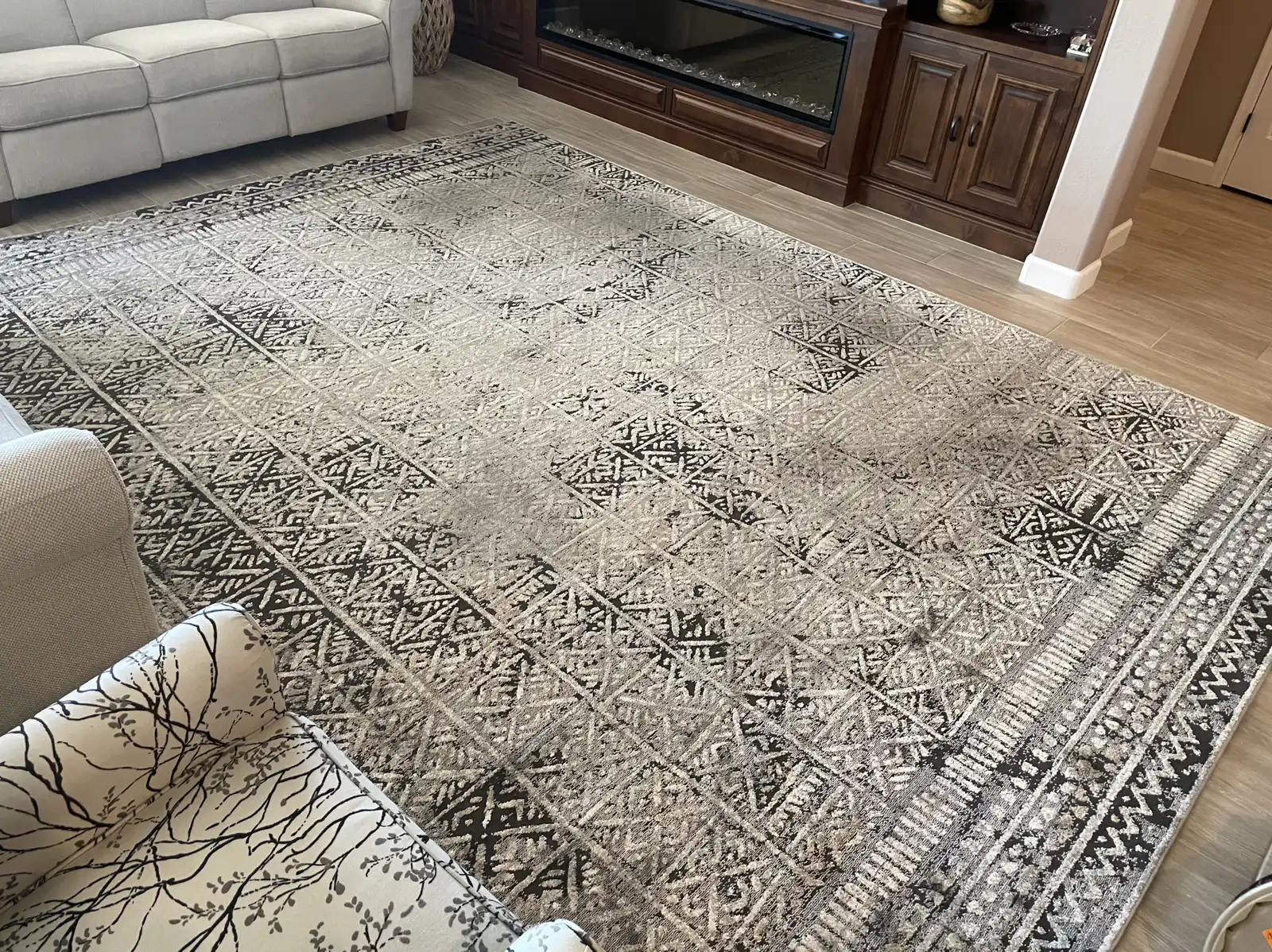
Weight distribution changes as soil loads into the rug foundation. A rug that has absorbed years of fine desert particulate, skin oils, and household dust becomes denser and less flexible than it was when new. This sounds like it would make the rug more stable, but the effect is more complicated. A stiffer rug doesn't conform to minor floor irregularities the way a flexible rug does, which creates edge-lifting behavior - the rug lies flat in the center but the edges and corners curl slightly upward because the body of the rug has stiffened and the edges haven't compressed into contact with the floor. Curled edges are one of the primary trip hazard mechanisms in area rugs.
The bottom surface texture changes with soil accumulation. The backing of an area rug has a texture that creates friction against the floor and against the pad. When soil works its way through the rug and accumulates at the backing, it fills in the surface texture and reduces the friction coefficient. The backing becomes smoother. A smoother backing slides more easily on tile.
Moisture-related stiffening affects rugs in Sun City homes specifically. When rugs absorb the occasional moisture event - a spill that wasn't fully dried, humidity variation during monsoon season, or the slow transfer of moisture from concrete slab through tile in older homes - and then dry out in Sun City's low-humidity air, soil particles bond together and to fiber surfaces in a way that creates localized stiffness. This uneven stiffness across the rug body produces inconsistent contact with the floor - some zones grip, others don't - which makes the rug's behavior under foot pressure harder to predict.
Clean rugs maintain their designed flexibility. The pile has loft. The backing maintains its surface texture. The weight distribution is even. These properties are what make a well-maintained rug behave predictably underfoot.
The Pad Underneath: The Part of the System Nobody Checks
The rug pad is the most overlooked component in the rug-on-tile safety system, and in Sun City homes it's often the component in the worst condition relative to what it should be.
Most rug pads are installed once and never replaced. A pad that was put under a rug when the home was furnished - potentially 15 or 20 years ago in Sun City West or original Sun City - has been quietly degrading ever since. The degradation isn't visible because the rug is on top of it. But when you lift the rug, you find a pad that's either crumbled into fragments of dry foam, compressed into a thin hard layer with no cushioning or grip function left, or in the case of rubber-backed pads, dried out and become brittle.
Each of these degradation modes affects stability differently. Crumbled foam pad creates an uneven surface under the rug - the rug is sitting on mounds and voids in the pad material, which produces inconsistent floor contact and edge-lifting behavior. A compressed flat pad that has lost its thickness has also lost the grip properties that were built into its surface when it was manufactured - the pad is now essentially a smooth film between the rug and the floor. A brittle rubber pad has lost elasticity, which means it no longer conforms to the tile surface and provides only intermittent contact rather than continuous grip.
In Sun City Grand communities like Desert Springs and Mountain View, and in the newer Festival homes off Sun Valley Parkway, pads may be in better condition because the homes are newer. In Sun City West homes near Hillcrest Golf Club and Trail Ridge Golf Course on N 151st Ave, and in original Sun City homes in Heritage and Sun City Manor, the pads are often ten to twenty years old and well past their functional lifespan.
The tile surface condition also matters. Tile floors in Sun City homes accumulate a fine soil film from foot traffic, cleaning product residue, and the fine particulate that settles on every surface in a Phoenix home. This soil film reduces the friction between the tile and whatever is on top of it - pad or rug backing. When I clean area rugs in Sun City homes, I always look at the tile underneath and recommend cleaning that surface too if it has a visible film. A clean rug on a degraded pad on a soiled tile floor isn't significantly safer than before I cleaned the rug.
What a Proper Rug Cleaning Does for Stability and Safety
When I clean an area rug in a Sun City home, the stability benefits of the cleaning are as significant as the appearance benefits - sometimes more so, depending on the household.
Restoring pile flexibility is the first functional benefit. Removing the deep soil load from a rug that has stiffened with accumulation brings back the flexibility of the fiber structure. A flexible rug conforms to the floor surface and the pad underneath, maintaining consistent contact across the whole rug rather than bridging over uneven zones. Edge curling reduces when the rug body regains its flexibility.
Restoring backing surface texture is the second. The extraction process during professional cleaning removes the soil film that has accumulated at the rug backing and filled in the surface texture. The backing's original grip texture becomes functional again rather than smoothed over with soil. This directly improves the friction between the rug and the pad or floor surface.
Drying completely and evenly is the third, and it's a step that's often done poorly when rugs are cleaned in place with steam or wet methods. A rug that's cleaned with too much moisture and doesn't dry fully will develop localized stiffening as it dries unevenly in Sun City's dry air. Controlled low-moisture cleaning followed by thorough extraction and grooming produces a rug that dries evenly and maintains consistent flexibility across its surface.
Identifying pad and floor condition comes with every rug cleaning I do in Sun City. Lifting the rug to clean it gives me direct visibility to the pad condition and the tile surface. I'll tell you if the pad needs replacement, show you the condition, and give you a straightforward recommendation. A pad replacement is inexpensive compared to the cost of a fall, and it's a decision that's easy to make when you can see the actual pad condition rather than guessing.
Rug Placement Patterns in Sun City Homes
Area rug placement in Sun City homes follows consistent patterns that reflect how residents actually use their space, and each placement location has a different combination of use intensity and slip risk.
Bedroom rugs beside the bed are among the highest-priority placement locations from a safety standpoint. This is the rug that gets stepped on when getting up during the night - often the first steps of the day taken on imperfect footing, sometimes in low light, sometimes without balance aids that would be used during the day. A sliding or curled bedroom rug in a Sun City West or Sun City Grand home is a specific nighttime fall risk. These rugs tend to have more moderate soil loading because bedroom traffic is lighter, but they receive repeated edge-contact loading from the same bed-entry point that can cause localized compression and edge lifting over time.
Living room and sitting area rugs anchor furniture groupings and define the primary socializing space. In Sun City homes with golf course views - particularly in communities like Corte Bella by Deer Valley Golf Course and the homes along the golf frontage in Sun City Grand - these are often the nicest rugs in the home, and they carry both decorative and safety significance. Living room rugs typically have the heaviest soil load from daily foot traffic and receive the most benefit from regular cleaning.
Entry and transition rugs at doorways between tile zones - and at the transitions from garage to interior in Sun City Festival and Grand homes - experience the heaviest soil loading because they receive tracked-in particulate from outside. These rugs also experience the most mechanical stress from repeated foot-edge loading at the threshold, which accelerates edge curling and backing wear. They need the most frequent attention.
Kitchen and dining area rugs under tables and at work zones get food soil, water exposure, and chair leg mechanical stress. The chair leg pressure on the rug edges is a specific cause of edge compression and curling that's different from foot traffic wear.
How Often Sun City Area Rugs Should Be Cleaned
Because the soil accumulation rate in Sun City homes is different from family homes - lighter daily use, but consistent accumulation from fine desert particulate and HVAC circulation - the cleaning schedule is also somewhat different from what I'd recommend in Surprise or Avondale.
Entry and transition rugs should be cleaned most frequently - annually or every 18 months - because they receive the heaviest soil loading and the most mechanical stress. These are the rugs where soil accumulation most quickly affects the backing condition and slip behavior.
Living room and sitting area rugs can typically go 18 to 24 months between professional cleanings in a Sun City home with two residents and no pets. The fine particulate accumulation is real but slower than in a family home, and the appearance and stability benefits of cleaning remain meaningful at the 18-month mark.
Bedroom rugs beside the bed, given their safety significance, are worth cleaning on the same schedule as living room rugs even if they look cleaner - the soil load at the backing and the pad condition underneath matter more than the visual surface for this placement.
Pad inspection should happen at every rug cleaning. Sun City homeowners often don't know how old their pads are or what condition they're in because the pad is never visible. I check every pad when I lift the rug for cleaning and give a direct assessment of whether it's still functional.
For Sun City homes where area rugs are the primary soft surface throughout the entire home - which is the majority of Sun City West homes in neighborhoods like Lizard Acres along N RH Johnson Blvd and the established homes near Our Lady of Lourdes Church by Beardsley Park - maintaining the rug collection is the primary soft-surface maintenance task rather than carpet cleaning, and it deserves a deliberate schedule rather than cleaning reactively when rugs look dirty.
Pad Recommendations and What to Look For
Not all rug pads perform equally on tile, and the pad selection matters as much as the rug itself for stability on hard floors.
For tile floors specifically, the most effective pads are those with a textured or waffle-pattern surface on both sides - a surface that grips the tile below and the rug backing above. These pads maintain grip through compression better than flat foam pads and remain functional longer. They're also easier to clean because their surface texture allows the accumulation of grit to fall away rather than embedding in a flat surface.
Rubber-backed pads are popular but problematic in Sun City's climate over time. The dry heat and UV exposure in Arizona accelerates rubber degradation. A rubber pad that was installed ten years ago in a Sun City West home near Stardust Golf Course has been through a decade of heat cycling that has removed most of its elasticity. Dry, brittle rubber provides much less grip than the same pad in new condition.
Pad thickness matters for comfort and cushioning but should not be excessive on tile. A very thick pad creates an unstable base - the rug rocks slightly on impact rather than lying flat, which is the opposite of the stability you want. For Sun City homes, a pad in the 1/4 to 3/8 inch thickness range is appropriate for most rugs. Thinner for lower-pile rugs, slightly thicker for high-pile or heavier rugs.
When I identify a pad that needs replacement during a rug cleaning, I can advise on appropriate pad type for your specific rug and tile combination. The replacement itself is a simple step that you can do independently - the right pad at the right size is available at any home improvement store for a modest cost. The value is in knowing the pad needs replacement and knowing what to get.
Serving All Four Sun City Communities
Serving Sun City, Sun City West, Sun City Grand, and Sun City Festival including communities near RH Johnson Recreation Center, Hillcrest Golf Club, Briarwood Country Club, Trail Ridge Golf Course, Corte Bella, Deer Valley Golf Course, Desert Springs, Festival Foothills, Sun Valley Parkway, Lizard Acres, and areas near Beardsley Park and Stardust Golf Course.
Learn more about our area rug cleaning, or explore other cleaning services we offer in Sun City.

 (602) 429-9602