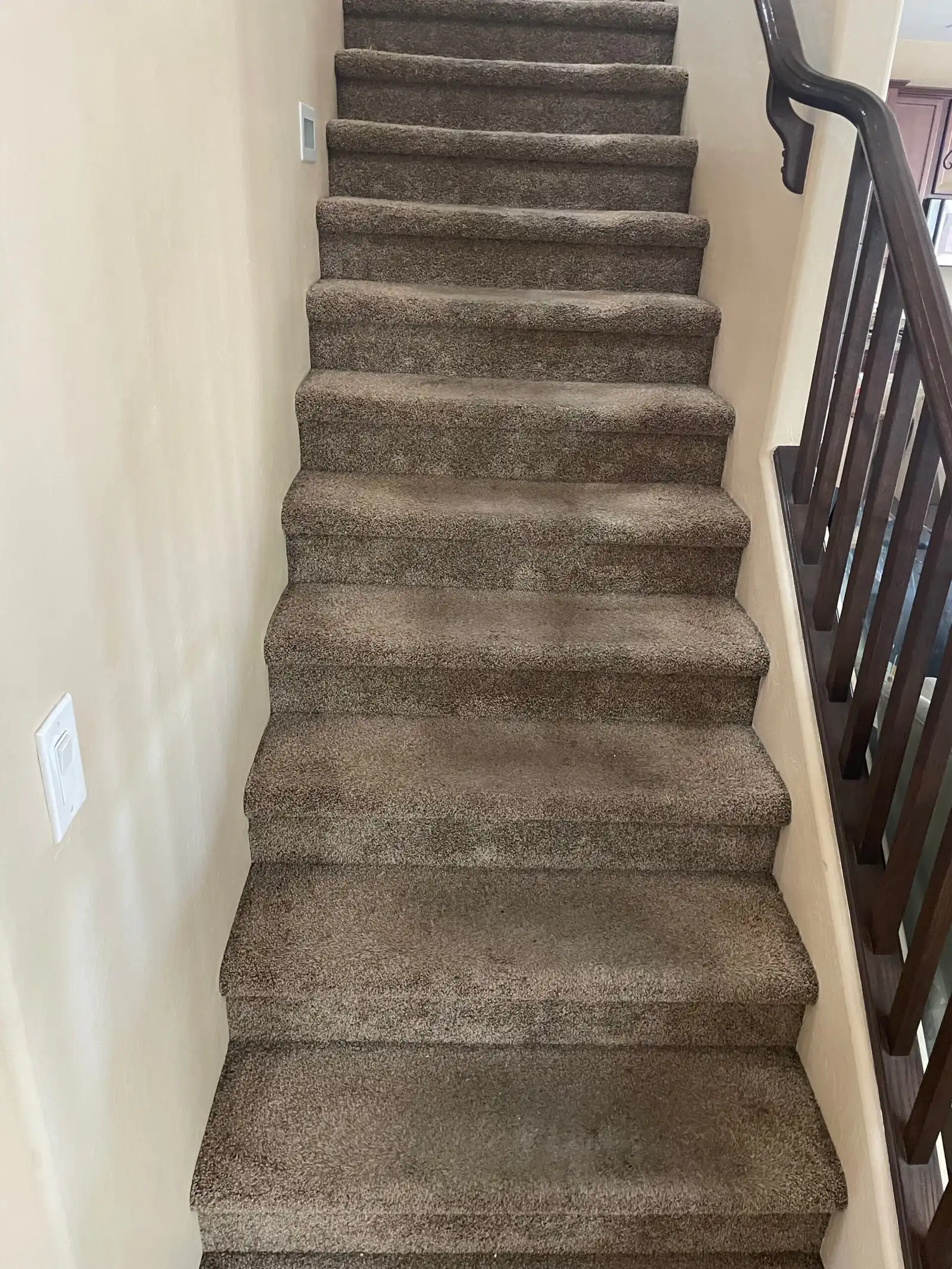
The Structural Situation at a Stair Nosing
The stair nosing is the most mechanically stressed point in any stair carpet installation. Every step up the stairs applies a bending force to the carpet at the nosing as the foot rolls from the tread surface over the rounded edge. Over thousands of steps, this repeated bending stress affects the carpet backing at that specific point in a way that does not happen anywhere else in the installation.
Standard residential carpet has a primary backing, the woven polypropylene fabric that the pile tufts are anchored into, and a secondary backing, the latex foam or SB rubber layer laminated to the back of the primary backing that provides dimensional stability and grip. At the stair nosing, the carpet must bend approximately 90 degrees as it wraps from the horizontal tread surface over the rounded nose and down toward the riser. This bend puts tensile stress on the face fiber side of the carpet and compressive stress on the backing side simultaneously.
In a properly installed staircase with appropriate tack strip placement and adequate tension across the nosing, this bend is managed without damage to the backing. In installations where the tension is insufficient, where the carpet was not pulled tightly enough over the nose during installation and there is slight slack in the fabric at the bend, the repeated bending cycle under foot traffic eventually causes the secondary backing to separate from the primary backing at the nosing zone. This separation is delamination, and at the stair nosing it typically appears as a slight softening or crushing of the carpet at the bent edge rather than as a visible gap, because the delaminated layers are still in contact but have simply lost the laminate bond between them.
The consequence of backing delamination at the nosing is that the carpet pile in that zone loses its structural support from below. Instead of the pile being anchored in a backing that is itself anchored to the stair structure, the pile is now anchored in a primary backing that is floating slightly above the secondary backing in the delaminated zone. Foot pressure on that zone drives the pile down and compresses the separated backing in a way that the intact backing zones on either side of the delamination do not experience. The compressed pile in the delamination zone reflects light differently and appears darker than the surrounding intact pile even when the soil level in both zones is identical.
How to Diagnose Delamination vs. Soil at a Stair Nosing
The nosing condition check before cleaning involves a few specific tests that distinguish the structural component from the soil component before any cleaning chemistry is applied. Running these checks takes about five minutes across the full staircase and gives a clear picture of what the cleaning will and will not accomplish.
The pinch test is the first diagnostic. Take a small section of the carpet at the nosing between two fingers and pinch it gently while moving the two layers slightly. In a properly laminated carpet, the primary and secondary backings feel like a single solid layer. There is no movement between them and they do not slide relative to each other. In a delaminated zone, there is a slight independence between the pile-side primary backing and the latex secondary backing, as if the two layers have a tiny gap between them or a slight freedom to move. The difference is subtle but perceptible once you know what you are feeling for.
The press-and-release test shows the pile recovery behavior in the nosing zone. Press firmly on the pile at the nosing with your thumb and then release. On an intact backing, the pile springs back relatively promptly as the backing resists the pressure and pushes the pile upright. On a delaminated zone, the backing has less resistance and the pile recovers more slowly, sometimes staying slightly compressed for several seconds. Comparing the nosing zone recovery to the pile recovery in the middle of the same tread, where the backing is typically intact, shows whether the nosing response is different.
The raking light check at the nosing from a flashlight held at a low angle to the tread surface shows whether the darker appearance has the textural character of soil-embedded pile or the crushed-flat character of mechanically compressed pile over a delaminated backing. Soil-laden pile has a slightly rough or particle-textured appearance in raking light. Crushed delamination pile has a flatter, more directionally oriented lay without the particulate texture of soil.
For a Tartesso homeowner who contacted me after having their staircase cleaned twice by two different services with the same partial result both times, the nosing strips remained darker than the rest of the treads after each cleaning. The pinch test on the first visit showed clear delamination across four of the twelve nosing zones. Those four zones had a structural component to their darkening that the cleaning was never going to fully resolve. The other eight nosings were soil-only, cleaned up fully, and stayed clean. Setting that expectation before the cleaning rather than after made the result understandable and the homeowner was not left wondering whether the service had failed.
What Cleaning Accomplishes on Stair Nosings With This History
The cleaning approach for a staircase with nosing delamination in some zones and soil-only darkening in others is the same cleaning approach in terms of chemistry and process. The difference is in the expectation conversation before cleaning begins rather than in the cleaning method itself.
Every stair nosing zone accumulates real soil from foot traffic regardless of whether delamination is also present. The ball-of-foot contact at the nosing concentrates shoe sole oil, outdoor particulate, and the general foot traffic soil in exactly the same location where the backing may have delaminated. Cleaning removes that soil component from every nosing zone. The result after cleaning is always some improvement even in the delaminated zones because the soil that was compounding the dark appearance is extracted.
The difference in outcome shows up in how complete the resolution is. In a nosing zone with soil and no delamination, the cleaning result is full: the nosing lightens to match the rest of the tread after drying. In a nosing zone with both soil and delamination, the cleaning lightens the nosing significantly by removing the soil component, but a residual darker appearance remains because the crushed pile over the delaminated backing continues to reflect light differently from the intact pile on either side of it.
This is the honest expectation before the cleaning starts. When a homeowner knows before the cleaning begins that eight of their twelve nosings will clean up fully but four have a structural component that will improve but not fully resolve, the cleaning result is satisfying rather than disappointing. A meaningful overall improvement across the staircase is the accurate outcome for most Buckeye two-story staircases, even when a small number of nosing zones carry a structural condition.
The cleaning process for stair carpet follows the tread-by-tread approach that the stair geometry requires. Pre-treatment at each nosing zone with appropriate dwell time for the foot traffic soil that has concentrated there. Agitation working with the pile direction on the tread surface and careful attention to the nosing wrap where the pile changes direction. Extraction immediately after agitation, with particular care at the nosing zone where excess moisture is more of a concern than on a flat surface.
The Full Staircase Soil Profile Beyond the Nosing Zones
The nosing darkening is the most visible and most discussed stair carpet issue in new Buckeye construction, but the full staircase has its own soil accumulation profile beyond the nosing zones that the cleaning addresses comprehensively.
The tread face soil in a Verrado or Buckeye two-story home follows the ball-of-foot traffic pattern consistent with all carpeted staircase cleaning. Every step up the stairs concentrates foot contact at the forward portion of the tread where the ball of the foot makes primary contact. Shoe sole oil, outdoor particulate carried in on shoes from Buckeye's high-grit environment, and the general foot traffic soil of a household with children and dogs all concentrate in this zone. In a household where the stairs are used many times daily, which in a two-story home with bedrooms upstairs is virtually every household, the tread face darkening develops at a faster rate than carpeted floor areas with the same traffic frequency.
The riser face, the vertical panel below each tread, accumulates a different soil type. Toe kick contact during stair climbing deposits the front of shoe soles against the riser fabric. In a household where shoes are regularly worn on the stairs, the riser develops the characteristic toe-kick darkening pattern at the lower portion of the riser face. In a household that removes shoes at the entry, the riser soil is lighter, primarily ambient dust and the overspray from tread cleaning in previous cleaning sessions.
The landing zone at the top and bottom of the staircase is a transition point that accumulates soil from both directions: the stair traffic coming off the treads and the main floor or upper hallway traffic approaching from the adjacent carpet. In Buckeye homes with direct garage access to the main floor and the staircase visible from the entry, the bottom landing accumulates outdoor particulate brought in on shoes before the stair ascent. In Festival Foothills homes where the staircase is positioned near the back entry with yard and pool access, the bottom landing also picks up pool-season soil from wet feet and outdoor shoe contact.
HVAC return vents positioned near the staircase in some two-story Buckeye builds create an air pressure differential pattern that produces fine particulate drawn through the carpet at the riser zone as a filter medium. This produces vertical dark streaks on the riser face that are different in character from the horizontal toe-kick pattern and that respond differently to cleaning. When this pattern appears during the initial walkthrough, the cleaning approach accounts for it with dry extraction pre-treatment that targets the embedded particulate before wet chemistry goes down.
Protecting Stair Carpet Between Professional Cleanings
The most impactful habits for keeping stair carpet in good condition between professional cleanings:
- Vacuum stairs from top to bottom twice weekly with a handheld or hose attachment, making a slow tread-by-tread pass. Use a crevice tool at the nosing zone where particulate concentrates at the wrapped edge and a standard floor vacuum head does not make full contact.
- Shoe removal before using the stairs reduces the outdoor grit and sole oil that concentrates at the nosing and tread face. Stair carpet in a shoe-free household accumulates a lighter and more organic soil profile, and the grit abrasion against the yarn at the nosing is significantly reduced.
- For staircases with confirmed nosing delamination, a washable stair tread pad placed over the nosing zone reduces the repeated bending stress that is causing the delamination to progress and reduces further soil accumulation in the most visible zone.
- If nosing delamination is identified early, a carpet re-stretch by a qualified carpet installer addresses the underlying installation tension issue before the delamination progresses further. I refer homeowners to a qualified installer for this work when the condition warrants it.
Honest Expectations: What the Full Staircase Cleaning Accomplishes
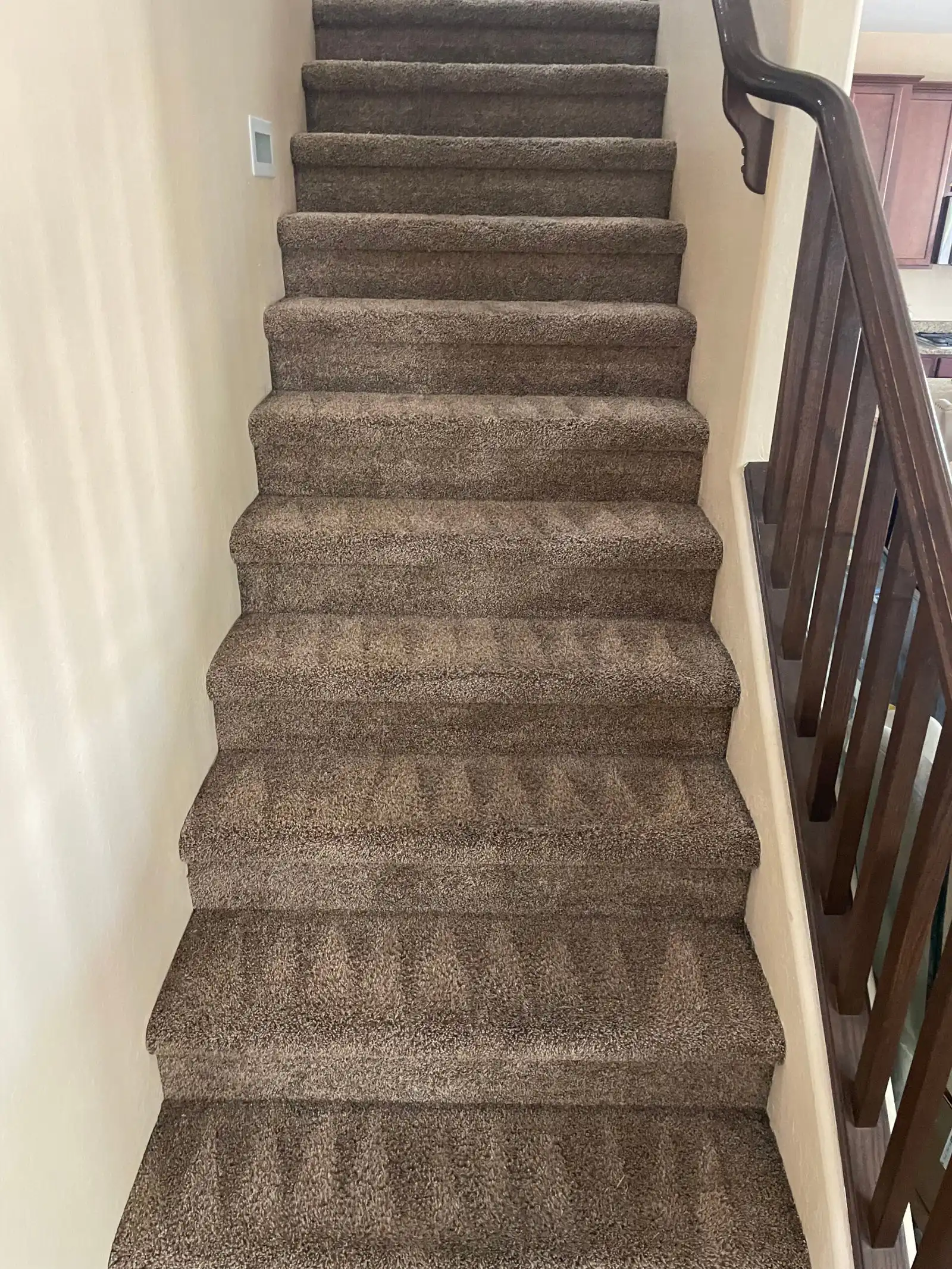
A properly approached staircase cleaning in a Buckeye two-story home produces a meaningful and visible improvement across the full staircase. The tread faces lighten significantly as the accumulated foot traffic soil is extracted. The riser faces address the toe-kick darkening and any filtration soil. The landing zones clean up from the transition soil they accumulate. The overall staircase looks notably better and the fabric reflects light more cleanly after drying.
The nosing zones specifically will improve in all cases because the soil component is addressed regardless of whether delamination is also present. In nosing zones with soil only, the improvement is complete and the cleaned nosing matches the rest of the tread. In nosing zones with delamination, the improvement is significant but the residual structural compression continues to make those specific zones appear slightly different from the intact zones after cleaning.
Permanent fiber damage from abrasion at the nosing is a condition that cleaning addresses the soil component of but does not reverse. In staircases where the nosing abrasion has been accumulating for several years without cleaning, the fiber at that zone may have a slightly different texture and light-reflective quality from abrasion history that is distinct from the delamination condition and also distinct from soil. The check before cleaning covers all three conditions: soil, delamination, and abrasion, and the pre-cleaning conversation identifies which zones have which conditions and what the cleaning will accomplish in each.
Replacement is the conversation for nosing zones where the structural delamination is severe enough that the pile has permanently compressed and the visual difference from the intact zones is significant. This is not a common outcome for new Verrado construction staircases in the first few years, but it is the honest endpoint of a delamination that has been progressing without intervention for a long time.
Learn more about our carpet cleaning, or explore other cleaning services we offer in Buckeye.

 (602) 429-9602