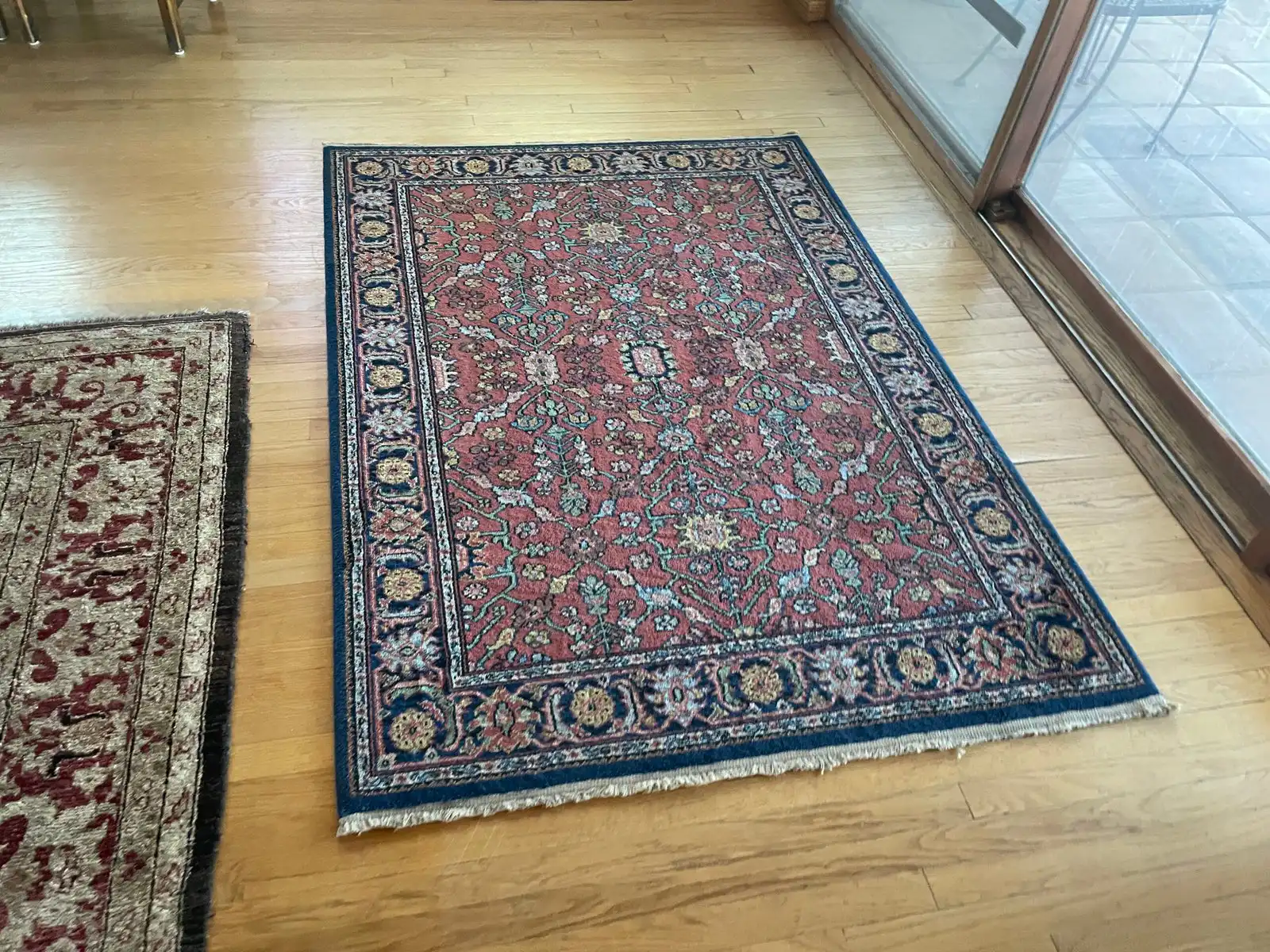
The Color Families That Carry the Highest Migration Risk
Not all colors in an oriental rug have equal migration risk. Understanding which color families carry higher risk explains why dye testing focuses on those zones first and why those areas get specific handling during the cleaning.
Saturated reds are historically the highest-risk color in oriental rugs. The most prized and traditional red dye in hand-knotted oriental rugs is madder, derived from the root of the Rubia tinctorum plant. Madder produces a range of reds from brick red through burgundy depending on the mordant used and the dyebath conditions. Madder-dyed fiber is generally reasonably stable under proper pH conditions, but madder dye that was applied with inadequate mordanting, or that was dyed in a bath that was not fully exhausted before the fiber was removed, can retain excess dye that is not permanently bonded to the fiber and that becomes mobile under wet conditions. This excess unbonded dye is what runs.
Modern synthetic red dyes, particularly those in the azo dye family common in lower-cost machine-made oriental-style rugs, can have their own migration characteristics that differ from natural dye behavior. Some azo dyes are more soluble in water at certain pH ranges and become progressively more mobile under conditions that would not significantly affect a well-set acid dye. The specific behavior depends on the dye molecule and the conditions of the original dyeing, which is not information available from looking at the rug.
Blues carry a different migration profile. Traditional indigo, the source of deep blues in hand-knotted oriental rugs from many production regions, is not bonded to wool fiber through the same ionic bond as acid dyes. Indigo is a vat dye that adheres to the fiber through mechanical entrapment in the fiber structure rather than through chemical bonding. This means it is released more readily under agitation and excess moisture than a chemically bonded dye would be. Indigo-dyed zones in oriental rugs are the areas most commonly associated with blue bleeding, where excessive agitation or moisture liberates the mechanically trapped dye molecules and allows them to move.
Browns and blacks in older oriental rugs carry a different risk for a completely different reason. Historical brown and black dyes in hand-knotted rugs were often achieved using iron-based mordants that are highly corrosive to wool fiber over time. The same iron compounds that produce the deep brown and black tones slowly break down the keratin protein chains in the fiber, causing the brown and black areas of older rugs to show pile loss and fiber fragility that is not present in adjacent color zones. In rugs with this iron-mordant degradation, cleaning with excess moisture or agitation can accelerate the fiber breakdown in those zones.
The Pre-Cleaning Dye Stability Test in Practice
The dye stability test is not complicated but it has to be done correctly to be meaningful. A single test in one corner of the rug tells you what the dye does in that one location under those conditions. Oriental rugs with multiple colors and multiple dye types need testing at multiple locations to give a complete picture of what the full rug will do when cleaning moisture touches it.
The basic test involves applying a small amount of water or dilute cleaning solution to the pile in a specific color zone and then pressing a clean white cloth firmly against the area and holding it for fifteen to thirty seconds. The white cloth picks up any dye that is mobile under those conditions and shows it clearly against the white background. The amount of color on the cloth tells me how much dye migration risk that zone carries at that moisture level and chemistry.
Testing happens at a minimum in the highest-saturation color zones, which in most oriental rugs means the primary field color, the dominant border color, and any accent colors that appear in small concentrated areas where migration into adjacent lighter zones would be most visible. For rugs with both natural and synthetic dye zones I test each separately because the behavior under wet conditions can differ across the same rug.
If a test shows meaningful color transfer onto the white cloth, there are two options. The first is to adjust the cleaning approach to use even less moisture and pH-appropriate chemistry at the most conservative end of the safe range, cleaning more carefully and accepting a slightly less thorough extraction result in exchange for protecting the dye. The second, for zones with high migration risk, is to treat that specific area dry or with minimal moisture while cleaning the surrounding less-risky areas normally. The decision depends on the severity of the transfer in the test and the overall cleaning goal for the rug.
I picked up a hand-knotted Afghan rug from a homeowner in the Sundance community near Watson Road last year. It was a beautiful piece with a deep burgundy field and an ivory border, which is exactly the high-contrast combination where migration from field to border would be most visually devastating. Pre-cleaning dye testing at the field color showed meaningful transfer on the white cloth at standard moisture levels. I adjusted the approach — lower moisture application overall and a specific dry treatment zone along the field-border transition — and the cleaning proceeded without any migration. What the homeowner saw was the rug coming back cleaner with no color change, which is exactly the outcome the testing was designed to produce.
Why Low-Moisture Cleaning Is Technically Necessary, Not Just Faster
Of all the variables that affect dye migration risk during oriental rug cleaning, moisture volume is the one with the most direct and controllable relationship to outcome. More moisture in the rug means more carrier fluid for capillary action and more potential for mobile dye to travel. Less moisture means less carrier fluid and a shorter potential migration distance for any dye that does become partially mobile under cleaning conditions.
This is the technical argument for low-moisture VLM cleaning on oriental rugs that goes beyond the convenience of faster dry times. When the total moisture in the rug at any point during the cleaning is kept low — enough to activate the cleaning chemistry and facilitate extraction without saturating the pile — the physical conditions for capillary migration are significantly reduced. A rug that has been cleaned with controlled low-moisture application and extracted immediately after agitation has a narrow window for capillary action to move any mobile dye before the moisture is gone.
Hot water extraction and steam cleaning apply significantly more moisture to the fiber than VLM does. The extended drying period for a hot-water-extracted rug is a multi-hour window during which dissolved dye in the pile is carried by capillary action through the slowly-drying fiber. In a rug with any migration risk identified in pre-cleaning testing, this extended wet window is exactly what needs to be avoided.
The extraction timing also matters. In the VLM process, the extraction step follows agitation closely, removing the cleaning solution and any dissolved material from the fiber before it has time to migrate through capillary action. For rugs that show any dye transfer in pre-cleaning testing, I work in small sections rather than treating the full rug and then extracting. Apply to a section, agitate gently, extract immediately, then move to the next section. This keeps the wet zone small and the moisture window short at any given point of the rug, which is the most conservative practical approach to dye migration risk management in an on-location setting.
The Buckeye Environmental Factors That Affect Oriental Rugs Specifically
Beyond the dye chemistry, two Buckeye-specific environmental conditions affect how oriental rugs should be cleaned here:
- Hard water mineral deposits: the hard West Valley water supply affects Buckeye homes. Calcium deposits on oriental rug pile from wet-foot contact or from cleaning done with hard tap water that was not fully extracted can alter the surface characteristics of the fiber and affect how the dye responds to cleaning moisture. Rugs in Festival Foothills and other Buckeye neighborhoods with wet-foot traffic zones near pool access get tested in those areas specifically.
- Desert grit in the foundation: a hand-knotted rug in a Verrado home near active construction for two or more years has accumulated fine abrasive grit in the foundation threads. This grit does not interact with dye chemistry directly, but it makes the dry extraction step before any moisture goes down particularly important. Removing the grit dry before the wet cleaning reduces the volume of particulate available to be carried by moisture through the foundation during the cleaning.
Oriental Rugs in Buckeye and Verrado Homes: Where They Come From and What That Means
The oriental rugs I clean in Buckeye come from a range of sources that affect what dye chemistry is likely present.
The larger established properties in the Sundance community and the Verrado Golf Club corridor tend to have older or more traveled pieces — rugs brought back from international travel, purchased from specialty importers, or inherited from family members. These are the rugs most likely to have natural or early synthetic dyes with the migration risks described on this page, and the pre-cleaning dye testing is most important for exactly these pieces.
Newer Verrado homes in the active build-out phases, and the younger-family demographic throughout communities like Tartesso, more commonly have machine-made oriental-style rugs from major retailers and online sources. These rugs almost universally use modern synthetic dyes that are more predictably stable. The pre-cleaning testing still happens for these pieces — I do not make assumptions based on how a rug looks — but the testing typically shows lower migration risk and the cleaning proceeds with less modification to the standard approach.
Regardless of where the rug came from, the grit environment in Buckeye adds a factor that does not exist at the same level in more established suburbs. A hand-knotted rug in a Festival Foothills or Watson Estates home near active construction for a year or more has accumulated fine abrasive grit in the foundation threads that the pre-cleaning dry extraction step is specifically designed to address before moisture goes down.
Honest Expectations: What Proper Testing and Cleaning Accomplishes
Pre-cleaning dye testing and a properly calibrated low-moisture cleaning process produces a result where the rug looks noticeably better — cleaner pile, more vibrant color, better-defined texture — without color migration or fiber damage from the cleaning process itself. For a rug in good structural condition with manageable dye stability, this is a satisfying outcome that the piece deserves.
The limitation is that testing identifies risk and allows the cleaning approach to be adjusted, but it does not eliminate all risk in every situation. A rug with severe dye instability in a high-saturation color zone may not be safely cleanable with any process that introduces moisture to that zone. If pre-cleaning testing shows migration that cannot be practically controlled through approach modification, the honest conversation is about whether cleaning that specific zone is the right choice. In some cases the safest outcome is to clean the rest of the rug and leave the highest-risk zone dry-treated only, accepting that zone will be less thoroughly cleaned in exchange for not risking color loss.
Existing color migration from a previous cleaning by another party is not something the current cleaning reverses. If dye has already migrated from a field color into a border and dried there, that dye is bonded in its new location. Specialist dye correction by a textile restoration expert is the path for addressing existing migration. If testing reveals existing migration before the cleaning starts, I document it and note it so the homeowner is aware of the existing condition rather than attributing it to the current cleaning.
Dye degradation from UV exposure — a gradual lightening of the field or accent colors in areas that have received direct sun — is also not reversed by cleaning. Cleaning removes the soil that was compounding the washed-out appearance, and the color may look somewhat more vibrant after cleaning because the soil coating is gone, but the actual dye loss from UV is permanent. This is worth understanding before the cleaning so the color improvement is not expected to be greater than what soil removal can actually produce.
Protecting an Oriental Rug Between Professional Cleanings in Buckeye
Keep oriental rugs out of direct afternoon sun from west or south-facing windows. In Buckeye's high-UV environment, the cumulative UV dose that a rug receives from unprotected afternoon sun exposure in a single Arizona summer is significant. UV does not cause dye migration but it does cause dye degradation — the permanent lightening of exposed pile colors over time. UV-filtering window film on the glass that creates the exposure is the most practical and durable protection for any valuable rug in a sun-exposed Buckeye or Verrado room.
For spills on an oriental rug, act immediately and use cold water only as the first response. Cold water does not trigger the thermal acceleration of dye release that warm water does, and blotting gently with a clean white cloth pulls the spill out of the fiber before it has time to set. Never rub a spill on an oriental rug — rubbing spreads it laterally and drives it deeper into the pile. After blotting, allow the area to dry completely before vacuuming. Do not apply any consumer spot treatment product to an oriental rug without knowing the pH of that product, because alkaline spot cleaners carry the same dye migration risk as the alkaline cleaning chemistry covered throughout this page.
Rotate the rug every four to six months. Rotation distributes foot traffic across different sections of the pile, distributes UV exposure more evenly, and prevents concentrated pile wear and color change from developing in the zones nearest the windows. In a high-traffic Verrado family room where children and dogs use the rug daily, rotation also distributes the grit abrasion load across the full rug surface rather than allowing it to concentrate in the fixed traffic path.
Vacuum oriental rugs in the direction of the pile lay, not against it. Running a vacuum against the pile direction on a hand-knotted oriental rug can pull at the pile knots and stress the foundation threads at the pile base. Suction without a rotating brush bar is appropriate. For Buckeye homes near active construction or open land, weekly vacuuming in the direction of the pile keeps the surface layer of grit from working deeper into the foundation between professional cleanings.
Professional cleaning every 12 to 18 months for an oriental rug in regular use is appropriate. High-traffic family rooms with children and pets should lean toward 12 months. Rugs in lower-traffic formal areas can go to 18 months. The dye testing at each professional cleaning is not a one-time step — it happens every visit because cleaning chemistry, UV history, and moisture contact history since the last cleaning can all affect how the dye responds to the next cleaning. A rug that tested stable at the previous cleaning may behave differently at the next one if its conditions have changed in the interval.
Learn more about our area rug cleaning, or explore other cleaning services we offer in Buckeye.

 (602) 429-9602