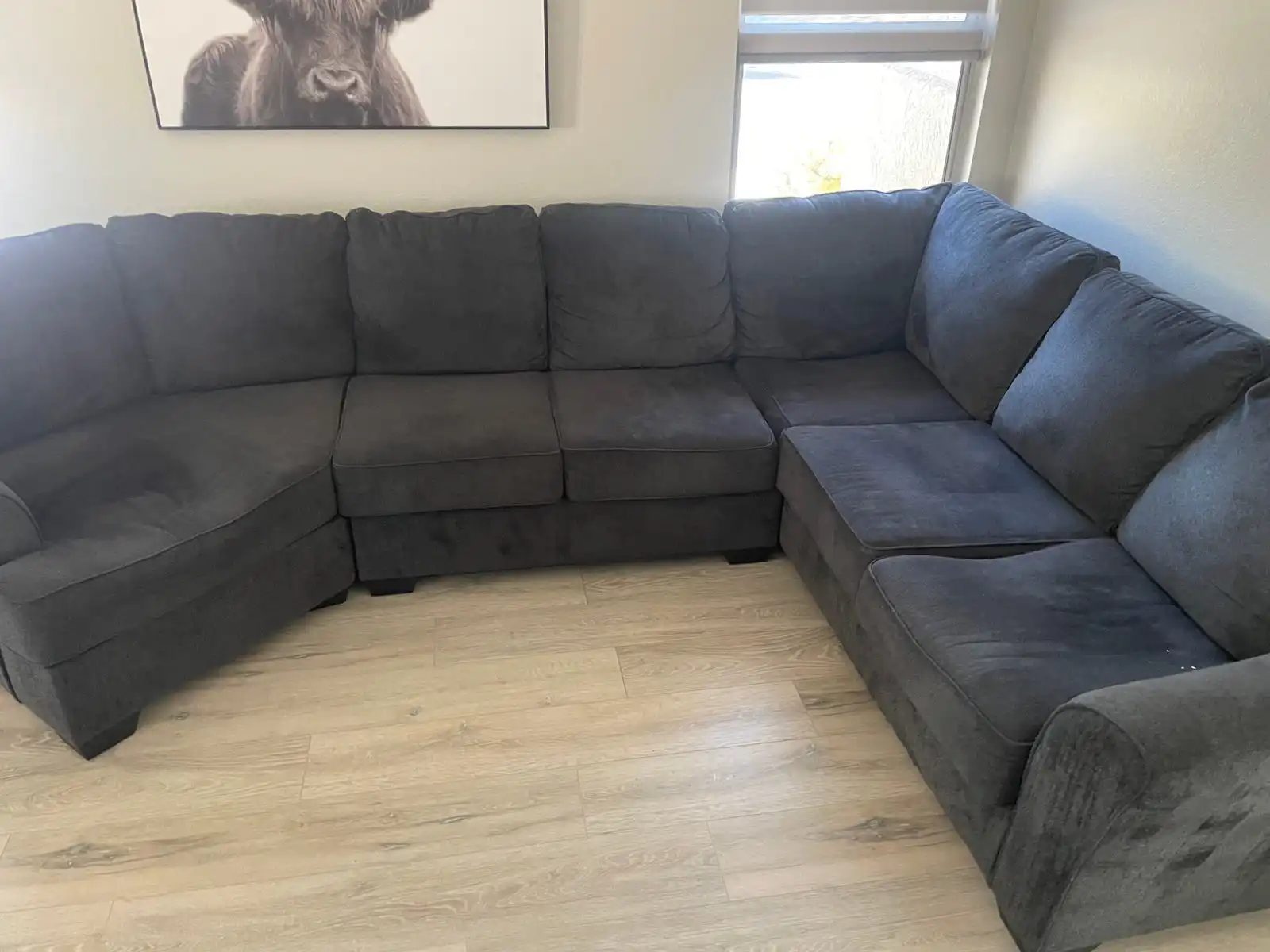
What Accumulates in the First Six Months — and Why It Is Already in the Mid-Pile
The first six months of a new modular sectional's life in an active Verrado family home establish the soil baseline that all subsequent cleaning works from. Most homeowners think of this period as the piece being new and clean, and in one sense they are right — the fabric appearance has not changed dramatically and there are no obvious stains. In another sense the piece has been accumulating soil continuously since the day it was placed.
Body oil from daily contact is the primary accumulation source in the first months. Sebaceous oil from scalp and skin contact deposits at the headrest zone and armrests with every hour of use. In the first six months this accumulation has not yet oxidized to the point where it visibly darkens the fabric, but it is present in the fiber. Fresh sebaceous oil responds readily to the citrus-based degreasing component. Six-month-old oil that has begun to oxidize requires more aggressive pre-treatment and longer dwell time. Twelve-month-old oil that has cross-linked through oxidation is the most challenging and the most likely to leave residual discoloration after cleaning.
Ambient particulate from Buckeye's environment settles into the pile from the first day. Desert dust, construction particulate from the active Verrado build-out, and fine grit from outdoor access all enter the home and settle on every horizontal fabric surface including the sectional cushion faces. In the first six months this accumulated particulate has worked from the surface into the mid-pile layers through normal HVAC air movement and the slight mechanical action of the cushion fabric shifting during use. It is not yet at the base of the pile but it is below what household vacuuming reaches effectively.
Pet contact in households with dogs adds dander, coat oil, and paw pad compounds to the early accumulation profile. The modular section that the dog gravitates to — usually the chaise or the corner module — develops a noticeably different texture and appearance from the rest of the piece faster than the other modules because the per-hour soil deposit rate from pet contact is higher than from human contact alone. This module differentiation, where one part of the sectional looks different from the rest, is one of the early signals that the piece is ready for its first professional cleaning.
What the Piece Looks Like at Six Months vs. Twelve Months
Understanding the specific changes that happen in each half of the first year helps explain why the timing of the first cleaning matters and why waiting beyond twelve months produces a meaningfully more difficult cleaning situation.
At six months, the changes are primarily textural rather than colorimetric. The pile in the primary seating zones is slightly less defined than at move-in — the fiber is not yet visibly darkened but the body oil in the mid-pile has slightly weighted the pile tips and reduced the crispness of the fabric texture. Under raking light the difference is visible as a slight reduction in the fabric's light-reflective clarity. In the dog module, the coat oil and dander accumulation has produced a slightly different feel — a slight stiffness in the direction of the dog's regular resting position. In the pool household, the sunscreen and pool water contact zones have a faintly different surface character, noticeable on close inspection but not obvious from across the room.
At twelve months, the colorimetric changes have joined the textural ones. The body oil in the primary contact zones has been oxidizing for up to a year and has begun to visibly darken the fabric at the headrests and armrests. The difference between the contact zones and the back panels and sides of the same modules — surfaces that have accumulated ambient particulate but not body oil — is becoming visible under normal room lighting. The seam channels between modules have accumulated a season of fine particulate fall-through and are slightly darker along the module joins. The dog module, if not cleaned, may show visible color change in the resting zone.
The critical point about the twelve-month stage is the oxidation state of the body oil. Fresh sebaceous oil is a relatively simple fatty acid compound that degreasing chemistry dissolves and lifts from the fiber efficiently. After twelve months of oxidation in the fiber, the oil has cross-linked into more complex polymer compounds that are less soluble in cleaning chemistry and require more aggressive pre-treatment and longer dwell time to address. This is not a hopeless situation — the cleaning still produces a good result at twelve months — but the result at six months, before the oxidation has advanced, would have been better for the same cleaning effort.
Why the Oil Oxidation Chemistry Makes Early Cleaning Better Than Late Cleaning
The argument for cleaning a new modular sectional within the first year — and ideally around the six to nine month mark rather than waiting for the full twelve — comes down to the oxidation chemistry of sebaceous oil in fabric fiber.
Sebaceous oil freshly deposited on fabric is primarily composed of triglycerides, wax esters, squalene, and free fatty acids. These compounds in their unoxidized state have a direct interaction with degreasing cleaning chemistry. The d-limonene solvent component dissolves the unoxidized oil and holds it in suspension for extraction. At this stage the cleaning is working on the chemistry the oil started with, which is the most accessible version of the problem.
As sebaceous oil sits in fabric fiber and is exposed to oxygen, UV light, and the warm-to-hot temperatures of a Buckeye summer home, the fatty acid components begin to oxidize. The triglyceride structure breaks down to release more free fatty acids, and the free fatty acids undergo further oxidation to produce aldehydes, ketones, and carboxylic acid compounds. These oxidized compounds begin to form cross-links with each other and with the fabric fiber structure — a process called polymerization that converts the liquid-like oil into an increasingly solid, increasingly resistant compound.
The polymerization process is progressive and its rate increases with temperature and UV exposure. A modular sectional in a Verrado home receiving afternoon sun from west-facing windows during a Buckeye summer accelerates the oxidation cycle compared to a piece in a shaded north-facing room. By twelve months in a sun-exposed room, the oxidized oil in the primary contact zones may have cross-linked significantly enough to require the extended pre-treatment dwell times used for long-accumulated organic soil. This is not a reason to be alarmed about a twelve-month-old piece. It is a reason to understand that the cleaning done at nine months is easier, faster, and produces a better result than the equivalent cleaning at fifteen months, which is in turn easier than waiting for the piece to reach the two-year accumulated state.
When to Schedule the First Cleaning for Your Buckeye Modular Sectional
The right timing depends on the household profile. Use this to find your window:
- Non-pool household, no pets: nine to twelve months from move-in is the target range. The nine-month mark catches the body oil before significant polymerization.
- Pool household: October or November after the first full pool season. This addresses both the standard body oil accumulation and the full pool season compound in a single visit.
- Household with a dog: watch for module differentiation as the signal. If the pet module looks visibly different from the others by month seven or eight, schedule the cleaning rather than waiting for a specific month target.
- West-facing afternoon sun exposure: move the target earlier by two to three months, since UV and heat accelerate the oxidation cycle.
- Already past twelve months: schedule now rather than waiting further. The cleaning still produces a meaningful result at twelve to eighteen months, and each additional month of polymerization makes the next cleaning more intensive.
What the First Professional Cleaning Looks Like
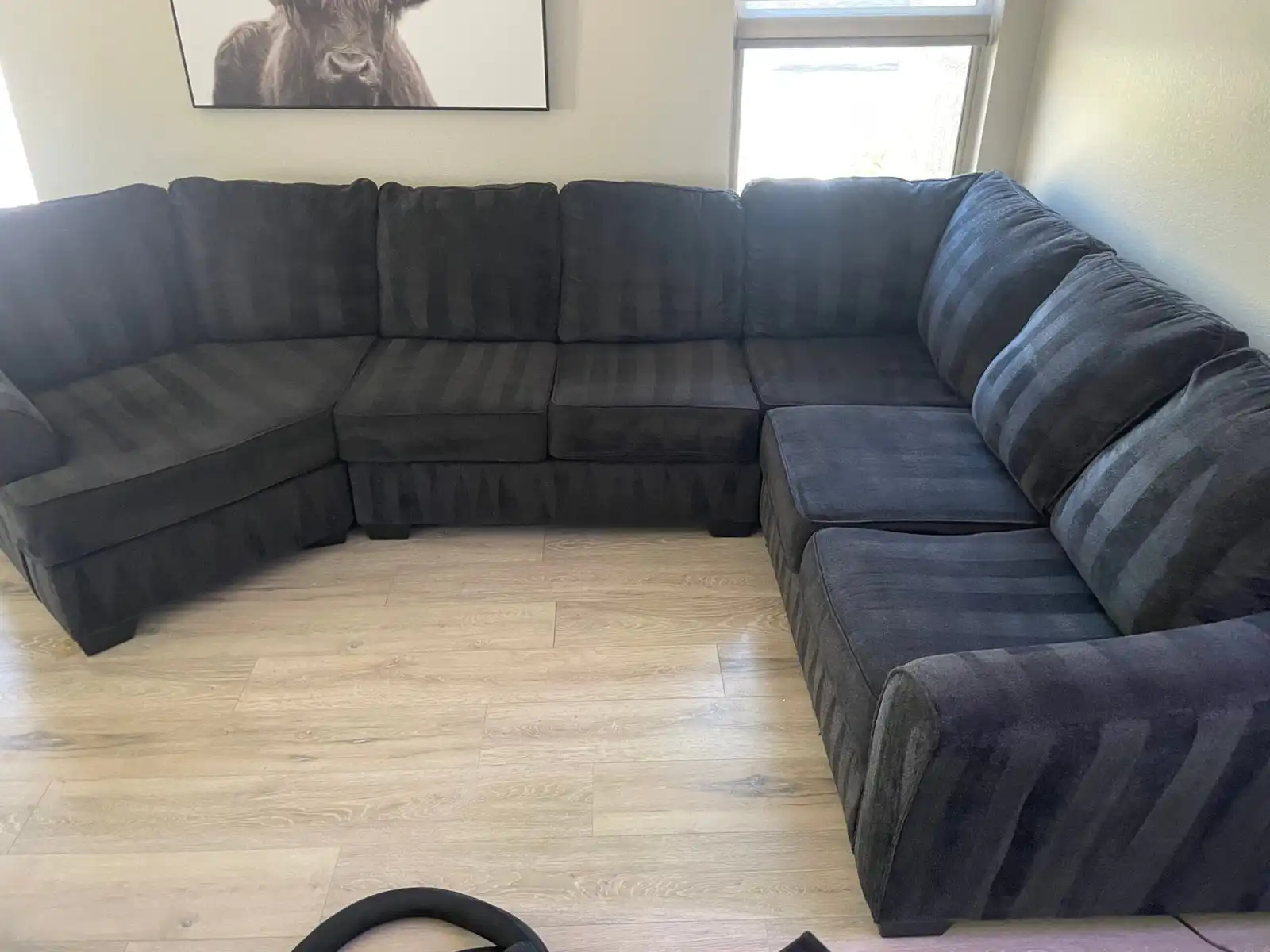
The first professional cleaning of a new modular sectional in a Buckeye home starts with an assessment that maps where the soil has concentrated in the first year of use. A raking light scan of all cushion faces before cleaning shows the distribution of body oil and particulate accumulation. Modules in the primary seating positions show the clearest fabric texture change from the oil in the mid-pile. Modules in secondary positions that see less consistent contact show less change. The module the dog uses shows its own specific pattern. The chaise, if present, shows the full-body contact oil pattern from extended reclining use. This zone map determines where the cleaning effort is concentrated.
Pre-treatment chemistry in the primary seating zones addresses the oxidized body oil before the full-piece cleaning begins. At the six to nine month mark, a standard dwell time of three to five minutes is usually sufficient because the oil has not yet polymerized significantly. At the twelve month mark, five to ten minute dwell times in the primary contact zones are more appropriate to allow the chemistry to work through the partially cross-linked oil before agitation. The dwell time reflects the oxidation state of the soil, which the raking light assessment and the feel of the fabric provide before I start.
Module seam zones get specific attention during the cleaning. The seam channels between modules accumulate fine particulate fall-through from the cushion gaps during daily use. A crevice tool extraction at the seam channels before the main cleaning removes the concentrated particulate in those zones so it does not get redistributed during the wet cleaning step. In a first-year piece this material is generally loose enough to extract effectively with dry suction before any moisture is introduced.
The full-piece cleaning covers every module surface including the back cushions, side panels, and deck fabric beneath the seat cushions. In a first-year piece the deck fabric has accumulated less fall-through than a piece with several years of use, but it is not clean. Addressing it in the first cleaning establishes a clean baseline for the deck zone that subsequent annual cleanings maintain rather than having to work through progressive deck accumulation. The piece is dry and back in use within an hour in most cases given Buckeye's low humidity and the VLM low-moisture approach.
The Pool Season Factor for New Verrado Modular Sectionals
For a Verrado household with a pool, the timing of the first professional cleaning for a new modular sectional should account for whether the first pool season has already occurred. The pool household sectional soil — sunscreen UV filter compounds, calcium from pool water, and wet swimwear contact residue — is additive to the standard first-year body oil and particulate accumulation. If the first cleaning happens before pool season begins, it establishes a clean baseline before the pool soil starts accumulating. If it happens after pool season, it addresses both the standard first-year accumulation and the full pool season compound simultaneously.
Post-pool-season timing in October or November is generally the better cleaning window for pool households because it addresses the complete first-year accumulation in one visit rather than cleaning before pool season and then immediately beginning a second accumulation cycle. For new Verrado homes near the Heritage Swim Park area where access to community pool facilities or a private backyard pool makes pool-adjacent living part of the household routine, this timing consideration is particularly relevant. A modular sectional in the main living area of a pool-active Verrado household that is cleaned in October after its first full year gets the standard first-year cleaning and the post-pool-season compound cleaning in a single visit — the most efficient approach for that household profile.
If the piece shows concerning soil development before October — the dog module looks notably different from the rest, or the primary seating zones are visibly darkening by July or August — scheduling a cleaning mid-year rather than waiting for the October window is the right call. Early intervention on soil that is visibly advancing faster than expected is better than waiting for the planned interval if the soil is clearly getting ahead of the cleaning schedule.
Honest Expectations and What Comes After the First Cleaning
A first professional cleaning of a new modular sectional at the six to twelve month mark in an active Verrado household produces a significant result. The body oil in the contact zones is at an oxidation stage where it responds well to pre-treatment and extraction. The ambient particulate in the mid-pile has not yet compacted to the pile base depth where it requires more aggressive agitation to address. The pool season compound, if present, is at its first-season accumulation level where the treatment produces full results. The piece returns to close to its factory condition in the primary soil zones.
The most important outcome of the first cleaning is establishing the clean baseline for all subsequent maintenance cleanings. A modular sectional that receives its first professional cleaning at six to twelve months and then continues on an annual cleaning schedule stays at a condition level where each cleaning is maintaining a good result. A piece that misses the first-year window and is not professionally cleaned until two or three years of accumulation have built arrives at its first cleaning with partially polymerized oil, compacted pile-base particulate, and potentially multiple pool seasons of compound soil — all of which require more intensive cleaning and produce a less complete result than the same cleaning done at twelve months.
There is no permanent damage to the fabric from waiting past twelve months in most cases — it is a question of how complete the first cleaning result can be, not whether the piece is salvageable. But the practical difference between cleaning at nine months and cleaning at twenty-four months is visible in the result, and most homeowners who experience that difference in their own piece understand immediately why the earlier interval produces better outcomes. For performance fabric or stain-resistant treated fabric — which is common in quality modular sectionals in the Verrado market — the same first-year timeline applies. Performance fabric treatments resist liquid spill penetration on initial contact but do not prevent the gradual body oil adhesion and particulate accumulation this page covers.
Getting the Most from a New Modular Sectional's First Year and Beyond
Vacuum the cushion faces weekly from the first week of use. In Buckeye's ambient particulate environment, the surface layer of desert and construction dust that settles on the sectional each week can be removed effectively before it works into the mid-pile layers if vacuuming happens consistently. A weekly vacuum with a proper suction attachment, slow enough to actually pull material from the pile rather than skimming the surface, keeps the loose surface particulate from becoming the compacted mid-pile material that makes the next professional cleaning work harder. This one habit is more valuable in the first year than at any subsequent point because the pile is factory-fresh and the fiber is most responsive to surface particulate removal.
For the dog module specifically, vacuuming two to three times per week keeps the coat oil and dander from building to the level where they visibly differentiate that module from the rest of the piece within the first year. Module differentiation from pet contact is the most visible early sign that a cleaning is due, and more frequent vacuuming in the pet contact module extends the interval before that differentiation becomes apparent.
Address any spill within the first minute with a clean dry cloth blotting rather than rubbing. On a new piece where the fabric finish is intact, surface liquid is more accessible than it will be in a piece with established soil in the pile. Do not use any consumer cleaning spray on the new fabric unless you know the pH and are certain it is appropriate for the fabric type. Using the wrong chemistry on new fabric in the first year creates residue that compounds the natural soil accumulation and makes the first professional cleaning more complex.
Keep the pool entry routine consistent from the first pool season. A washable cover on the cushions during pool season, or a consistent change-before-sitting routine, is easier to establish in the first pool season than to introduce after the habit of sitting on the sectional in wet swimwear has been established. Starting that first season with the right habit keeps the first-year pool compound soil from reaching the level that requires the extended treatment at the first cleaning. Schedule the first professional cleaning between six and twelve months of occupancy, with October or November as the target for pool households and nine months as the target for non-pool households.
Learn more about our upholstery cleaning, or explore other cleaning services we offer in Buckeye.

 (602) 429-9602