Why the Treatment Sequence Matters as Much as the Chemistry
Most stains on a family room loveseat in a Buckeye home with young children are compound stains that contain more than one of the three chemistry categories simultaneously. A chocolate stain has fat, protein, and tannin. A pizza stain has fat, protein, and tomato tannin. A fruit-and-cheese snack event produces multiple simultaneous deposits in overlapping zones. When the treatment approach applies a single chemistry to a compound stain, it addresses one category and can inadvertently create conditions that make another category harder to remove.
The most damaging sequence error is applying alkaline degreasing chemistry before addressing the tannin component. Alkaline chemistry on tannin staining accelerates the oxidation reaction that makes tannin more permanently bonded to the fiber. If you apply a standard alkaline upholstery cleaner to a juice stain because you want to degrease the adjacent chip grease, the alkaline chemistry that clears the grease simultaneously darkens and sets the tannin stain that was overlapping with it. The stain that could have been fully removed is now significantly more difficult.
The second damaging sequence error is applying heat or steam before the protein component is addressed with enzyme chemistry. Steam cleaning a loveseat with dairy or food protein staining without first using enzyme pre-treatment exposes the staining to the denaturation temperature. The protein bonds permanently to the fiber during the steam application. The surface looks temporarily cleaner because the steam lifted loose surface material, and then the set protein staining becomes apparent as the fabric dries.
The correct treatment sequence for compound food staining works from the most chemically sensitive component to the least. Tannin staining is addressed first with appropriate mild chemistry before any alkaline or heat-generating process is used. Protein staining is addressed second with enzyme pre-treatment and cold chemistry before any warm application. Fat staining is addressed third with the solvent-compatible component once the tannin and protein steps are complete. The full organic cleaning of the piece follows after the targeted pre-treatments have had their dwell time and been extracted.
What the Compound Staining History of a Family Room Loveseat Looks Like
A loveseat that has been in a family room in a Buckeye or Verrado home with young children for two or three years has typically accumulated far more compound staining than the surface appearance suggests. Some events were blotted immediately and look clean. Some were addressed with consumer spray cleaners that removed the visible surface material while leaving chemistry and residue in the fiber. Some were not noticed until they had dried and been sat on multiple times, pressing the staining further into the pile.
The consumer spray cleaner residue situation is particularly relevant to the accumulated stain history. When a parent grabs a bottle of upholstery spray and treats a juice spill, the product removes some of the surface tannin but leaves surfactant residue in the fiber. The treated area looks better for a few days and then darkens again as new soil and airborne particulate adhere to the sticky surfactant residue. Another treatment follows, leaving more residue. After two or three years of this cycle in a high-staining-event household, the fabric in the seating zones and armrests has a layered soil history of original staining, partial cleaning, residue accumulation, and fresh staining on top of the residue. This is the compound that a professional cleaning has to work through.
The armrests on a loveseat in a children's household develop their own specific soil profile. Children lean on armrests the way adults do, depositing skin oil and hand contact soil, but they also use armrests as food resting surfaces and as the place where a juice cup or a sticky hand gets placed during screen time. The armrest fabric typically has a combination of body oil, food tannin, sugar residue, and fat from snack contact that is different in composition from the seating zone soil and different from adult-household armrest soil.
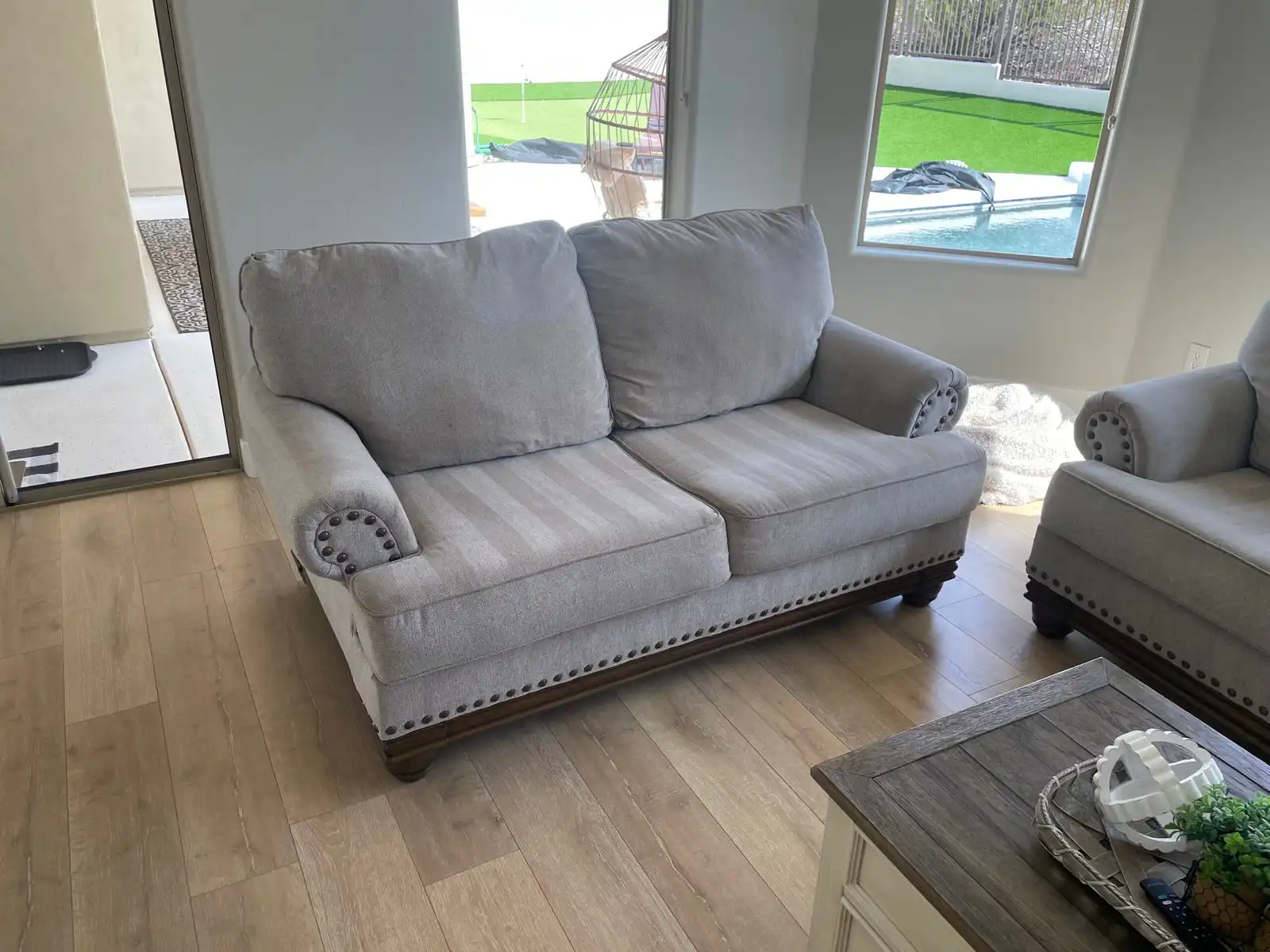
I cleaned a loveseat for a family near the Tartesso Sports Park area in Buckeye whose three kids had been using the piece as the primary family room seating for about two and a half years. The homeowner described it as needing a cleaning and thought the visible spots were the main issue. Under UV light before cleaning, the staining history across the full loveseat was much more extensive than what was visible in normal lighting. The tannin oxidation, the protein deposits, and the consumer cleaner residue layers all showed up in the UV scan and mapped out which zones needed which pre-treatment before the main cleaning. The result after the full sequential treatment was significantly better than the homeowner expected given how discouraged she had become about the piece.
What the UV Light Inspection Reveals Before Cleaning Starts
The fifteen-minute UV inspection before any chemistry is selected maps the staining history that normal lighting does not show:
- Dried protein deposits fluoresce differently from tannin staining, identifying which zones need enzyme pre-treatment versus tannin chemistry
- Consumer cleaner residue shows as flat zones that absorb UV rather than reflecting it, marking where multiple spray applications have built up
- Tannin oxidation shows its degree of advancement, indicating whether mild chemistry will fully reverse it or whether some permanent bonding has occurred
- Fat deposits in the seating zones and armrests show their lateral spread, which is often wider than the visible surface stain suggests
- The UV map determines the pre-treatment sequence and the zones where extended dwell time is needed before the main cleaning pass
This assessment is included in the standard rate. The cleaning conversation starts from what the UV inspection shows, not from what the homeowner guesses is in the fabric.
The Professional Cleaning Process for a Family Room Loveseat
The cleaning process for a compound-stained family room loveseat in a Buckeye home starts with the UV light inspection that maps the staining history before any chemistry is selected. The fifteen-minute assessment gives a clear map of which zones need which pre-treatment and in what order.
Tannin staining identified in the UV scan gets the first pre-treatment application before anything alkaline touches the piece. The mild acid chemistry appropriate for tannin oxidation reversal is applied to those specific zones with enough dwell time for the chemistry to work into the oxidized tannin compound. Gentle agitation works the chemistry through the fiber without spreading the stain laterally. Extraction removes the chemistry and the dissolved tannin compound before the next step begins.
Protein staining zones get enzyme pre-treatment as the second step. The enzyme chemistry is applied cold, not warm, to avoid triggering denaturation in protein staining that has not yet been heat-set. The enzyme dwell time is longer than for the tannin step because the biological catalyst action of the enzyme needs time to break down the protein compound at the molecular level. Extraction after the enzyme dwell removes the broken-down protein.
Fat and oil zones get the solvent-compatible component as the third targeted step, applied after the tannin and protein chemistry has been extracted so there is no cross-contamination between the chemistry sequences. Extended dwell in the fat zones allows the d-limonene component to dissolve the lipophilic compounds from the fiber.
The full-piece cleaning follows all three targeted pre-treatments, applying the encapsulation chemistry across the entire surface of the loveseat; cushion faces, armrests, back panels, and sides, to address the ambient body soil and the fine particulate accumulation that is present across the piece beyond the specific staining zones. The post-cleaning check compares the treated staining zones to the surrounding fabric in normal and raking light to assess the result. In most cases the compound staining in a family room loveseat in a Buckeye home responds well to the sequential approach and the treated zones are not visibly different from the surrounding clean fabric.
What DIY Consumer Products Do and Why They Often Make Things Worse
Consumer upholstery spot cleaners are a single-chemistry product applied to a multi-chemistry problem. They are formulated to address the most common household soil type (oily body contact soil) with an alkaline surfactant system. That chemistry works for the soil it was designed for. It creates problems when it is applied to tannin staining, protein staining, or compound staining that includes tannin as a component.
The most common and most damaging consumer cleaning mistake on a family room loveseat is reaching for whatever cleaning spray is under the sink when a stain happens. Alkaline upholstery spray on a fresh juice spill sets the tannin component within the first application. The visible fruit color lightens because the surface material was lifted, which looks like the stain was addressed, and the underlying oxidized tannin compound that was accelerated by the alkaline chemistry becomes the darker, more permanent residue that eventually shows up when the surface material fades.
Steam cleaning units marketed for upholstery are particularly risky on a family room piece with dairy or food protein history because the steam temperature is well above the protein denaturation threshold. A homeowner who steam cleans their loveseat to address general soil and odor may inadvertently set every protein stain on the piece during that cleaning, making those zones permanently harder to address in any subsequent cleaning.
Rubbing a stain rather than blotting it is the physical equivalent of the wrong chemistry problem. Rubbing spreads the stain laterally across a larger area of fiber and drives it deeper into the pile from the surface. Blotting with a clean dry cloth, pressing straight down and lifting, removes liquid from the surface without spreading it. For every type of stain a child produces on upholstery fabric, blotting rather than rubbing is the correct immediate physical response regardless of what chemistry will be used subsequently. This conversation is about understanding why the piece looks the way it does when the professional cleaning starts, and why some of the residual staining may be more permanent than it appears because of how it was treated in the first minutes after it occurred.
Honest Expectations: What the Sequential Treatment Accomplishes
The sequential pre-treatment approach addresses compound food staining at the chemistry level rather than just at the surface level, and for most staining that has not been permanently set by heat or long-term oxidation the results are very good. Fresh to moderately aged tannin staining that has not been treated with alkaline chemistry clears well. Protein staining that has not been heat-set responds fully to enzyme pre-treatment. Fat staining that has not been oxidizing for years responds well to the solvent component.
The realistic limitations are the staining that has been permanently altered. Protein staining that was heat-set by hot water treatment or steam cleaning has denatured and is bonded to the fiber at the molecular level. Enzyme chemistry improves the appearance of set protein staining but may not fully clear zones that received significant heat exposure. Tannin staining that was treated with alkaline chemistry immediately after the spill has undergone accelerated oxidation and the resulting compound is more tenaciously bonded than staining that was left alone and addressed professionally. These zones improve but may not fully clear to the surrounding fabric color.
Food coloring from juice drinks and flavored beverages is its own category. Artificial food dyes are specifically designed to be color-stable and resistant to fading. In upholstery fabric, food coloring behaves more like a fabric dye than a food stain. Professional enzyme and oxidizing treatment partially addresses food coloring in many cases. In severe or long-standing cases, some residual color may remain after the cleaning. The UV light assessment before the cleaning tells me which zones have which staining conditions, and the pre-cleaning conversation tells you what the treatment is likely to accomplish for each specific zone on your piece. No surprises after the cleaning is done.
Managing a Family Room Loveseat With Young Children Between Professional Cleanings
Immediate response is the single most valuable thing a parent can do for loveseat staining. Blot, do not rub, with a clean dry cloth within the first thirty seconds of any food or beverage contact. Cold water only if the stain needs liquid treatment; not warm, not hot, not the nearest cleaning spray. Cold water blotting of a fresh juice or food stain removes the majority of the soluble surface material before the oxidation and bonding processes that make stains permanent begin. This one habit reduces the severity of staining that the next professional cleaning has to address more than any other maintenance practice.
If a consumer spot product is used, check the pH before applying it to tannin staining. Products marketed for tough food stains or set-in stains are typically alkaline because alkaline chemistry is aggressive at removing grease and organic body soil. That same aggressiveness accelerates tannin oxidation. For fruit, juice, and tomato staining on upholstery, a product labeled as enzyme-based or pH-neutral is a safer choice than a general alkaline spot spray. Enzyme products are widely available at grocery stores and pet supply stores and are safe for tannin staining in the way that alkaline sprays are not.
Washable slipcovers or seat covers for the loveseat in active children's use reduce the rate at which staining reaches the upholstery fabric. A fitted washable cover laundered weekly intercepts most of the snack and beverage contact before it reaches the fabric. The loveseat underneath the cover accumulates far less compound staining than it would with direct contact, which means the professional cleaning interval can be extended and the result of each cleaning is better because the accumulation layer is thinner.
In Buckeye's high-UV environment, keeping the loveseat out of direct afternoon sun from west-facing windows slows the tannin oxidation process on any staining already in the fabric. UV and heat both accelerate tannin cross-linking and fat oxidation. A piece in direct afternoon sun in a Verrado or Tartesso home with west-facing windows is seeing conditions that actively worsen any existing staining between cleaning visits. Positioning the piece away from that direct light, or using UV-filtering window treatments during peak sun hours, meaningfully slows the staining chemistry between professional cleanings. Professional cleaning every 10 to 12 months is appropriate for a family room loveseat with young children in active daily use.
Learn more about our upholstery cleaning, or explore other cleaning services we offer in Buckeye.

 (602) 429-9602