What Actually Causes Wool to Shrink
The felting mechanism requires three conditions acting simultaneously: moisture, heat, and mechanical agitation. Remove any one and felting cannot occur. Moisture causes wool scales to partially lift and open - creating more surface for interlocking. Heat amplifies this effect and reduces the energy required for scales to interlock, which is why hot water extraction is specifically risky for wool. Mechanical agitation provides the physical force that drives opened scales into interlocking contact.
The practical safety rules: cool to lukewarm water, not hot. Controlled moisture without saturation. Gentle directional agitation rather than aggressive scrubbing. Flat drying at ambient temperature without tumble heat. These aren't restrictions that compromise cleaning - they're the correct conditions for wool fiber chemistry that produce excellent results safely.
Other Wool Vulnerabilities Beyond Shrinkage
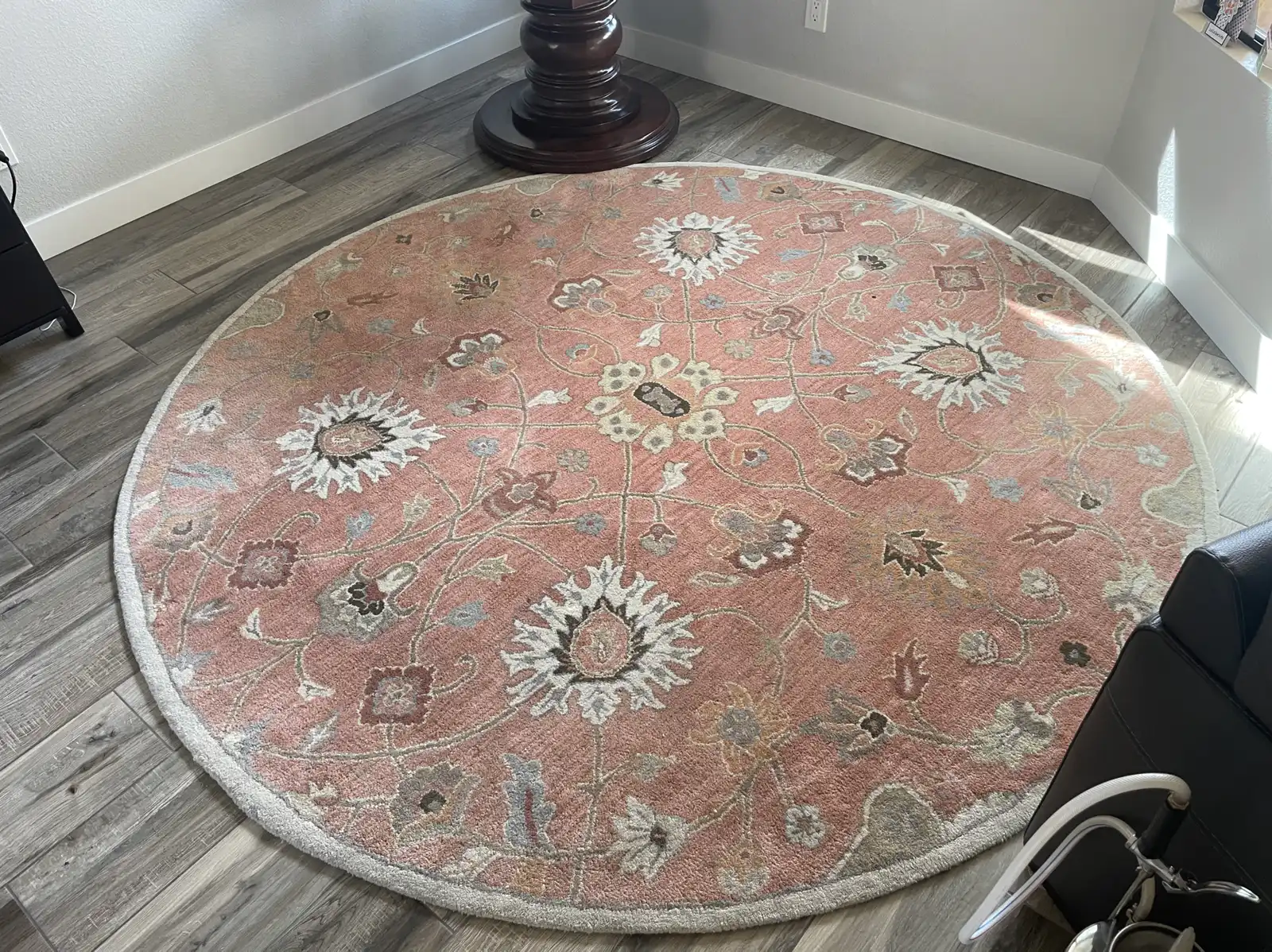
Backing distortion is sometimes confused with shrinkage. When a wool rug's jute or cotton foundation absorbs excess moisture and shrinks during drying, the rug buckles or ripples rather than lying flat. This is foundation distortion, not pile felting, but the result looks similar. Low-moisture cleaning prevents both. Browning occurs when over-wetting wicks moisture through the pile to a jute foundation, where natural compounds oxidize and wick back as yellowish-brown discoloration. Homes throughout Arizona Brisas and Thompson Ranch with hand-knotted rugs on jute foundations benefit from the conservative moisture management that prevents this.
Evaluating a Cleaner's Wool Rug Capability
The question that reveals the most: what water temperature do you use for wool rugs? A cleaner who answers "hot water extraction" or "steam cleaning" without qualification likely doesn't differentiate between wool and synthetic approaches. Ask about agitation method - aggressive scrubbing describes felting conditions. Ask about drying - high heat on moistened fiber completes the felting triad. Ask about dye testing - it indicates overall wool awareness.
In El Mirage's market where price sensitivity sometimes drives decisions, the cheapest quote may represent standard synthetic approaches applied to wool. The cost difference between a cheap cleaning that damages a wool rug and a properly priced cleaning that doesn't is insignificant compared to replacing a rug that was shrunk by incorrect technique.
The Safe Cleaning Process for El Mirage Wool Rugs
When I clean a wool rug in an El Mirage home - whether in Pueblo El Mirage, a rental in Buenavida, or a home in the Thompson Ranch neighborhood - the process is adapted to wool's fiber chemistry throughout. Pre-cleaning assessment includes dye stability testing and construction evaluation. Dry pre-extraction removes El Mirage's fine mineral and combustion particulate before wet chemistry is introduced.
Pre-treatment uses cool water at controlled moisture levels with pH-neutral to mildly acidic chemistry appropriate for wool's keratin structure. Agitation is gentle and directional - working with the pile rather than against it. Extraction is thorough but managed, removing chemistry completely without saturating the foundation. Flat drying at ambient temperature with good airflow - El Mirage's dry desert air is actually an advantage here, producing complete drying in a reasonable timeframe. Post-cleaning pile grooming restores uniform appearance.
Caring for Wool Rugs Between Professional Cleanings
Suction-only vacuuming without a motorized brush roll, weekly, removes loose particulate before it adheres through humidity cycling. For spills, cool water and immediate blotting only - never hot water, never aggressive scrubbing, never commercial spray cleaners. The hot-water-plus-agitation combination from an energetic DIY attempt is exactly the felting condition to avoid. Rotate the rug every six months to distribute traffic wear and El Mirage's directional particulate loading from Luke AFB operations.
Professional cleaning every 12 months maintains wool rugs in El Mirage at the condition that preserves fiber quality throughout Rancho El Mirage, Dysart Cactus, El Mirage Downtown, and surrounding neighborhoods. The abrasion risk from accumulated mineral particulate makes the 12-month interval appropriate for wool rugs in active use.
Cool-Water Process Is Standard, Not an Upgrade
Every wool rug cleaning appointment in El Mirage uses cool-water, low-moisture technique with gentle agitation and flat ambient drying as the standard process. Dye stability testing is included at every appointment. These aren't premium add-ons - they're the correct way to clean wool fiber, and they're how every El Mirage wool rug cleaning is done.
Learn more about our area rug cleaning services, or explore other cleaning services we offer in El Mirage.
 (602) 429-9602