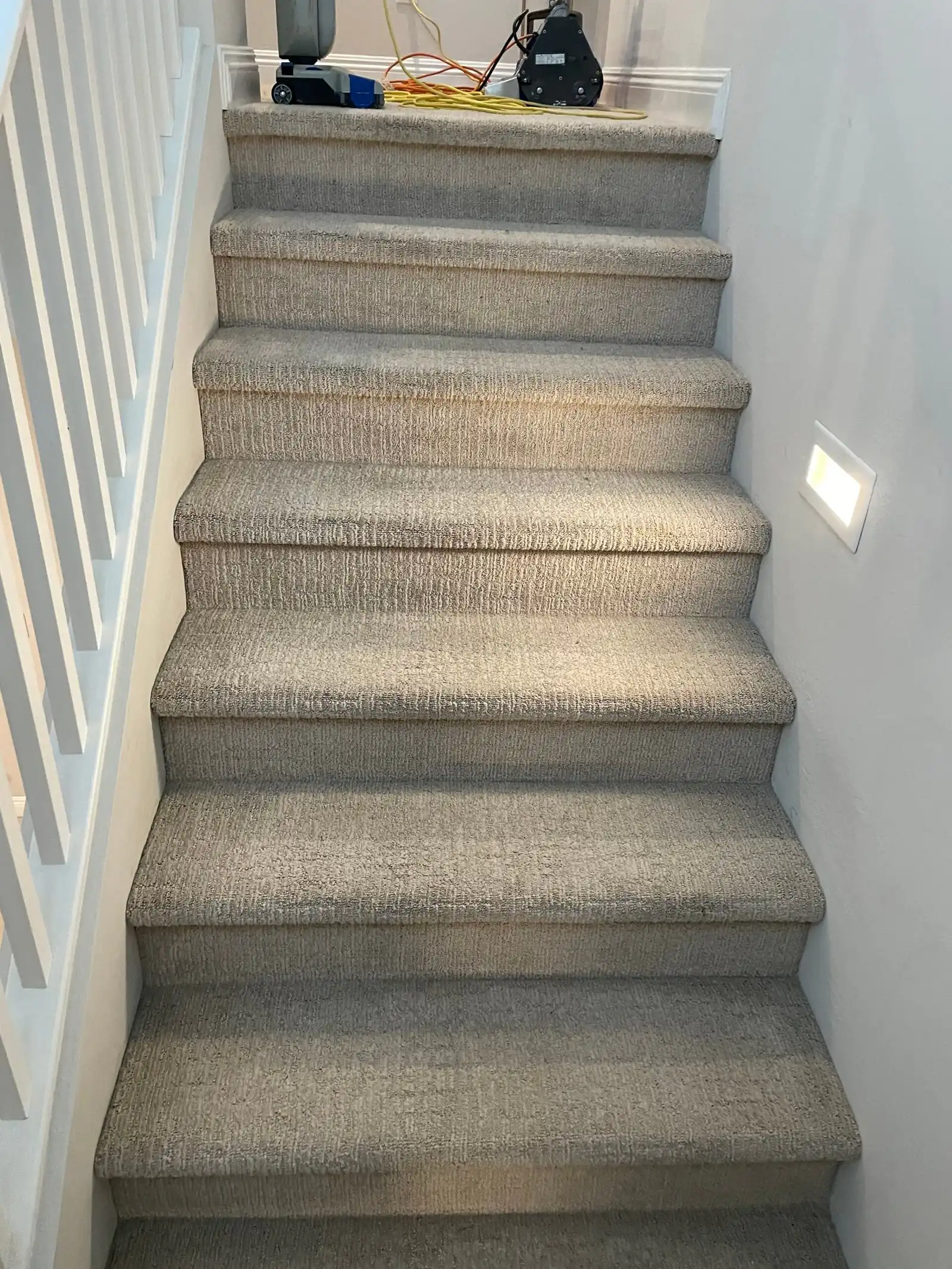
Why Risers Accumulate More Static Dust Than Treads
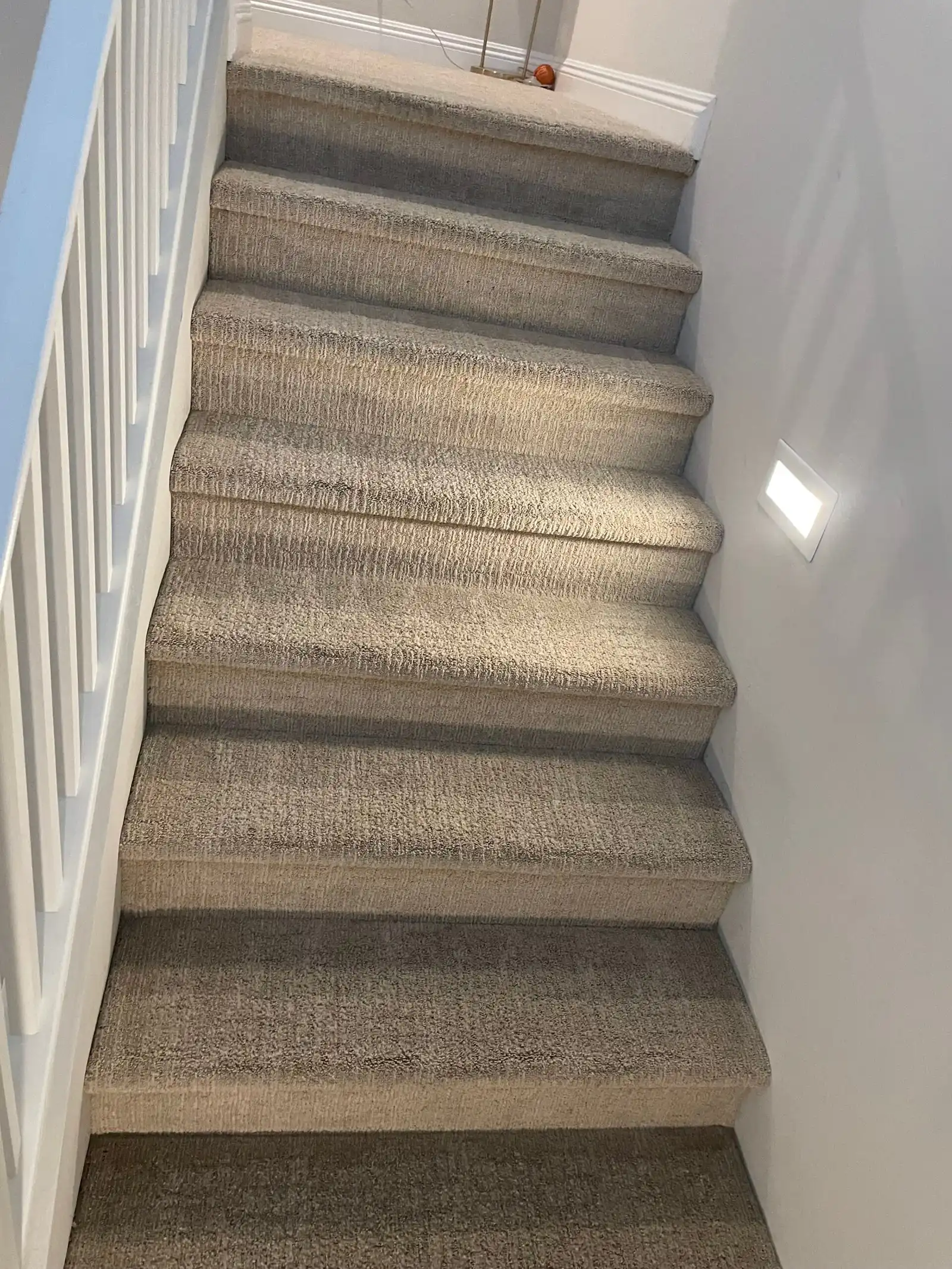
Foot traffic soil would concentrate on treads. If risers are visibly dirtier than treads, airborne particle attraction is the dominant mechanism. Vertical surfaces have unobstructed exposure to the stairwell air column with no horizontal surface to intercept particles. Treads get mechanical disturbance from every footstep that partially shakes loose attracted particles. Risers get none.
The tread-riser junction - the back corner of each step - creates a convergence zone where both charged surfaces are in close proximity and airflow slows, depositing more particles than on either open face. This is typically the heaviest accumulation zone.
💡 What Your Stairs Are Actually Attracting
Surprise staircase carpet pulls a specific mix from the air: fine construction dust from Prasada corridor and Surprise Farms development, desert soil particulate from nearby undeveloped land, standard household dust, and during pool season, fine aerosols from pool chemical treatment. The construction and desert components are extremely fine-grained - high surface area relative to mass - exactly the particle type electrostatic attraction captures most effectively.
The Dry Climate Static Cycle
Low humidity leaves no moisture to dissipate charge. Charged fibers attract airborne dust from Surprise's particulate-rich air. Attracted dust adds mass but the fiber stays charged. Vacuuming removes the top layer but doesn't discharge the fiber. Within days, a fresh layer is attracted. The cycle runs continuously because the conditions driving it - low humidity, construction dust, constant AC - don't change.
From May through September, sealed-house conditions intensify it. Windows closed, AC recirculating indoor air, and fine dust tracked through entries redistributed in the closed air volume. The staircase sits in the main path of air movement between floors.
How I Clean Statically Charged Staircase Carpet
First, dry-pass extraction on risers before wet treatment. Removing the loose outer layer prevents moisture from turning dry dust into embedded paste.
Second, controlled moisture application to risers specifically. Moisture discharges static charge and carries chemistry into fibers to break the bond between attracted particles and fiber surfaces.
Third, tread-riser junction corner work with dedicated tools. These convergence zones have the heaviest combined accumulation.
Fourth, VLM cleaning on treads. Tread soil is a combination of foot traffic and electrostatic attraction - different character from riser accumulation, calibrated accordingly.
Fifth, complete extraction from both surfaces. Residue on a statically charged surface creates new charge surfaces and a sticky layer that re-attracts dust faster. Complete extraction is non-negotiable.
Sixth, grooming while slightly damp. Setting fiber direction while fibers are temporarily discharged gives the cleanest result as they dry and recharge.
Reducing Static Buildup Between Cleanings
- Run a humidifier near the staircase base during the driest months. Even raising local humidity from 12% to 20-25% meaningfully slows charge buildup.
- Anti-static carpet spray temporarily introduces a conductive surface layer that dissipates charge. Effects last days to a couple weeks before reapplication.
- Slow, deliberate vacuum strokes - especially on risers - give suction more time to overcome electrostatic hold. Fast passes skim the surface.
- HEPA filtration in your vacuum captures fine desert and construction dust that standard filters re-release back into the air during vacuuming.
For families in Marley Park and Surprise Farms near active construction, the combination of humidity management and anti-static treatment makes a real difference between professional cleanings.
Learn more about our carpet cleaning process, or explore other cleaning services we offer in Surprise.

 (602) 429-9602