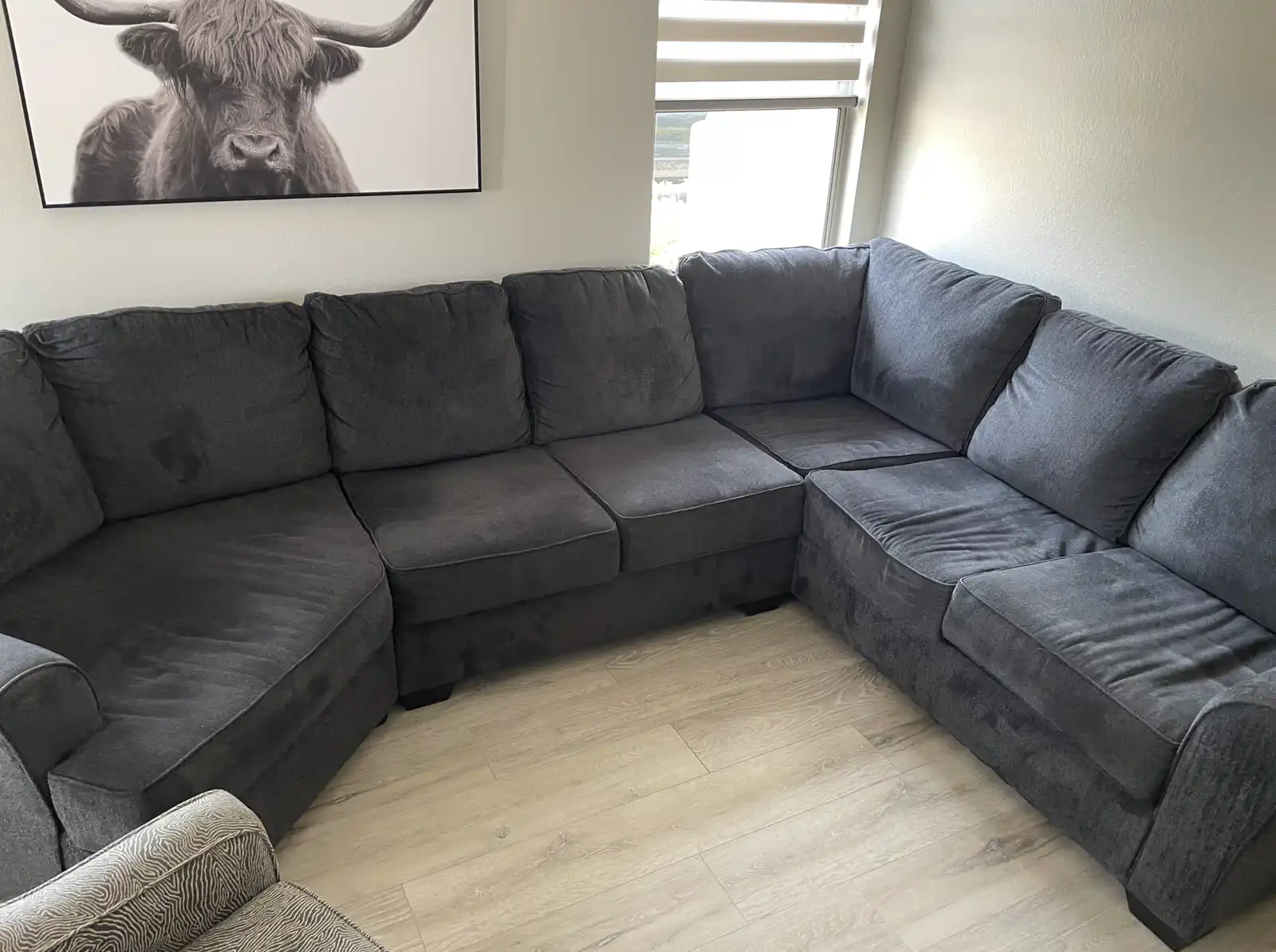
What Fiber Compression Actually Is and Why It Makes Fabric Look Darker
Fabric on upholstered furniture has pile - the upward orientation of individual fibers that gives it texture, depth, and softness. When fibers stand upright, they catch and reflect light evenly. When compressed repeatedly under body weight, they gradually lose ability to fully recover and end up angled or flattened.
Flattened fibers reflect light directionally rather than diffusely - like the difference between brush pile carpet and a polished floor. The low-angle reflection makes the surface appear darker, especially under overhead lighting. Additionally, compressed fabric holds soil more thoroughly because flattened fibers create a more solid surface for particles to rest on rather than falling through to the base.
The corner wedge of a well-used sectional in Surprise typically has both: compressed fibers that reflect light differently, and higher soil load from increased use. Both factors together create the visual gap between corner and rest of the sectional.
💡 Why One Worn Piece Makes the Whole Set Look Old
When a sofa is uniformly dirty, you adapt to it. When one piece looks dramatically different from the others, the contrast draws the eye constantly. In Surprise homes with open-concept floor plans where the sectional is visible from the kitchen and entry, a corner wedge that reads as belonging to a different couch is noticeable from across the room. This often triggers premature replacement decisions when cleaning would resolve the visual inconsistency.
Why Surprise Summers Make Corner Compression Worse
Corner wedges have less airflow than other pieces - enclosed on two sides by adjacent pieces. When outside temperatures hit 110-115° and the house runs AC continuously with windows sealed, the corner stays warmer than surrounding pieces from body heat with limited air circulation.
Warmer fabric means warmer fibers. Warm fibers compress more easily under body weight and stay compressed after load is removed. Body oils are also temperature-dependent - on a heated corner piece, oils penetrate the fiber structure more deeply than they would at lower temperatures. The oil works further into the pile before the fabric cools and the oil sets.
This is a Surprise-specific amplification. The same sectional in a climate with lower summer temperatures and better natural ventilation wouldn't show the same degree of accelerated corner compression.
How I Clean and Restore Corner Wedge Pieces
First, I assess the corner wedge separately. Are fibers compressed but intact, or has pile actually worn away? Compressed fibers can be partially recovered. Worn fibers can't. This determines realistic expectations.
Second, I apply pre-treatment with extended dwell time - 12-15 minutes for the solution to penetrate the compressed fiber layer and address oil compounds that have worked deeper into the pile.
Third, I use lifting agitation on compressed areas. Tools that agitate perpendicular to the surface as well as across it - lifting compressed fibers while cleaning solution is active rather than just cleaning on top of flattened pile.
Fourth, I extract with two passes on the corner. First pass removes suspended soil. Second pass with more suction addresses deeper-compressed zones.
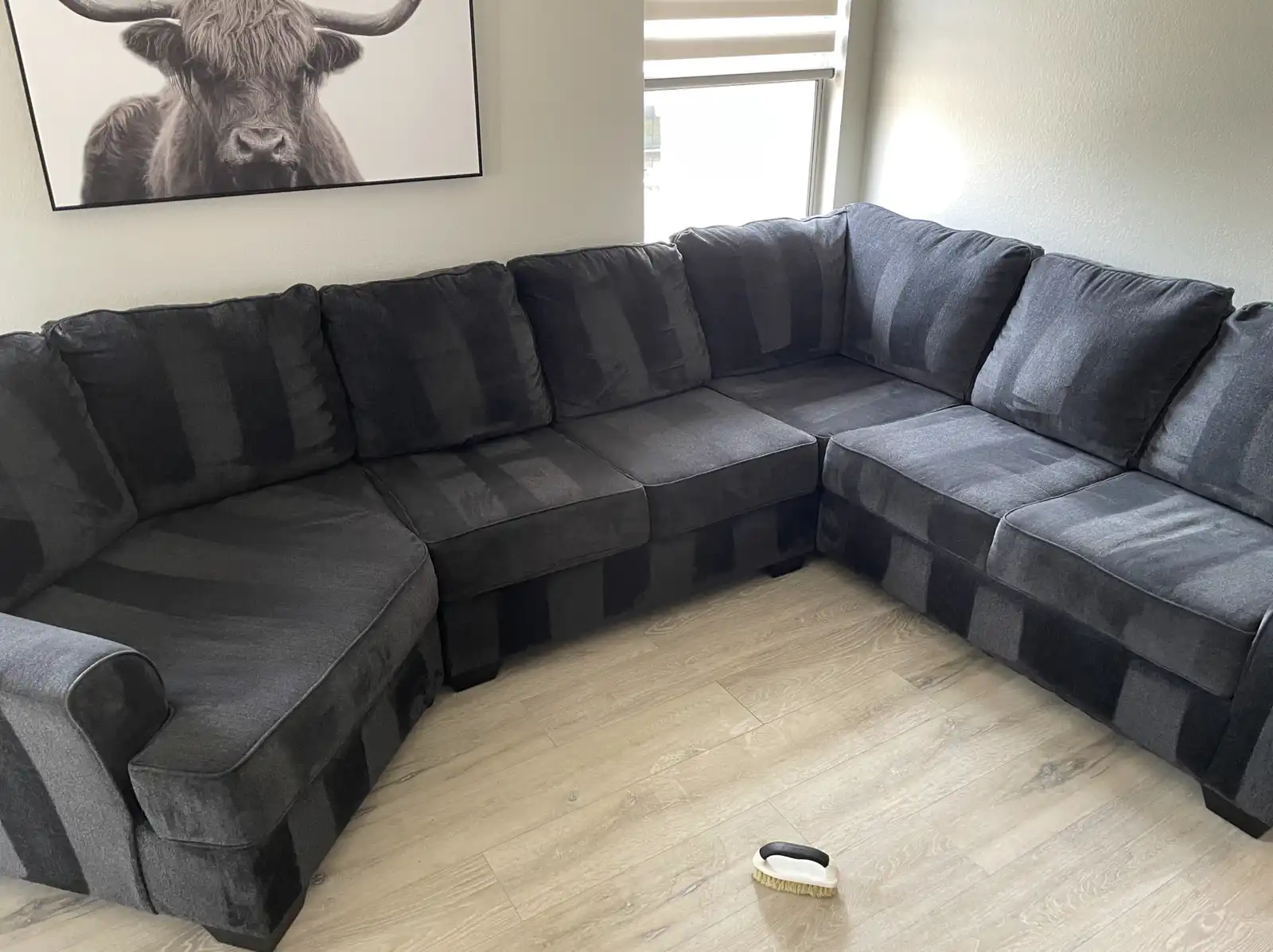
Fifth, I groom while still damp. Directional brushing guides compressed fibers back toward upright position as they dry - the compression recovery step.
Sixth, I match treatment across all pieces so the finished result reads as a consistent set rather than a clean corner next to dirty pieces.
Rotation Strategy for Modular Sectionals
The corner wedge is fixed by configuration - it has to occupy the corner. But armless middle chairs and end pieces can often be swapped. Rotating which end is on which side, or moving an armless chair from next to the corner to the other end, redistributes the use load more evenly.
Pieces closest to the corner get more use because people orient toward it. Rotating adjacent pieces every 6 months slows the rate at which they develop wear patterns. Combined with professional cleaning every 12-18 months, it keeps visual inconsistency from reaching the point where it looks dramatically mismatched.
When Compression Is Recoverable vs Permanent
Fabric that is compressed but has intact fibers responds to proper cleaning and grooming. The improvement is meaningful - sometimes dramatically so. But a corner piece that's been the primary seat for five years won't look exactly like an occasional-use middle chair.
What cleaning accomplishes: removes the soil darkening, partially lifts compressed fibers, and levels the playing field across all pieces. What it can't do: reverse complete pile loss, restore foam cushion height, or make a five-year-old corner look genuinely new.
I assess during the walkthrough and give you a straight answer on whether cleaning will meaningfully close the visual gap or whether wear has crossed a threshold where replacement makes more sense.
Learn more about our upholstery cleaning process, or explore other cleaning services we offer in Surprise.

 (602) 429-9602