Airflow Deposits Soil Where You Don't Expect It
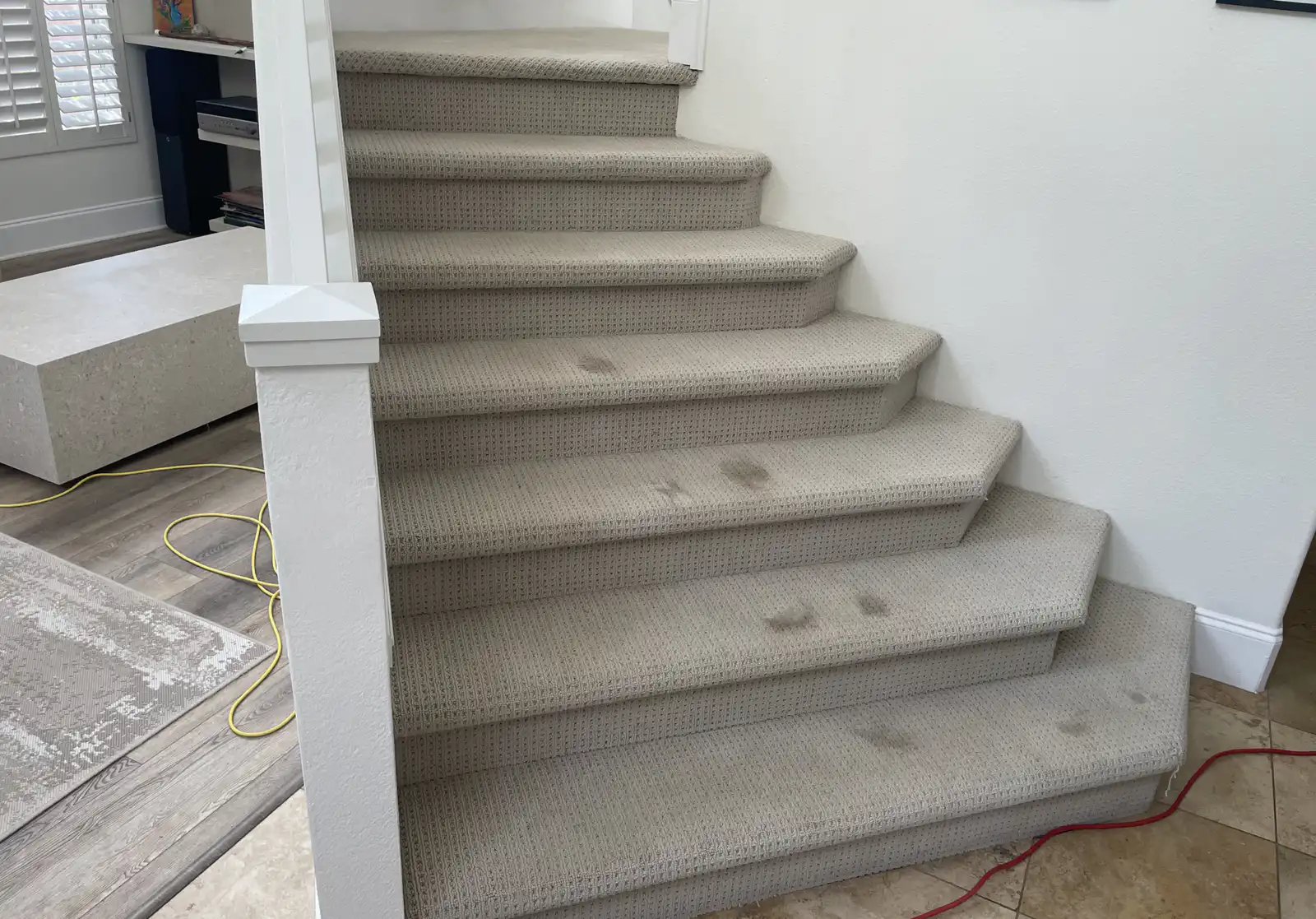
Everyone assumes the treads get dirty because people step on them. And yes, foot traffic does compress the fibers and grind in dirt. But the risers - the vertical parts - often look worse than the treads, and that doesn't make sense if you're only thinking about foot traffic.
The reason is airflow. Moving air carries particles, and when that air slows down or changes direction, it deposits those particles. Vertical carpet fibers on stair risers catch and hold airborne contamination in a way that horizontal tread fibers don't.
Think about it: when air flows past a vertical surface, the particles settle into the fibers and stay there. Gravity isn't pulling them out like it would on a horizontal surface. Vacuuming doesn't reach them because most vacuum heads are designed for horizontal surfaces, not vertical ones.
I see this constantly in Avondale homes - especially in Crystal Point, Harbor Shores, and the newer developments near Gateway Pavilions where two-story floorplans are common. The staircase risers look gray or brown from accumulated airflow soil, while the treads might look relatively clean.
The back corners of each tread also accumulate soil in a weird pattern. When you walk up stairs, your foot pushes air forward and down. That air carries dust and particles and deposits them right in the back corner where the tread meets the riser. Regular vacuuming never gets back there because most vacuum heads are too wide and the suction disperses before it can pull from that tight angle.
Western Desert Dust and Older HVAC Systems
Avondale is further west in the valley, which means we get more dust blowing in from the western desert areas. That dust has a different mineral composition than what you get in north Scottsdale - it has more iron oxide, which is why it has that reddish tint and why it stains lighter carpet more aggressively.
A lot of Avondale neighborhoods were built in the 90s and early 2000s - Historic Avondale, areas near Friendship Park, developments off Lower Buckeye Road. These homes often have original HVAC systems that are less efficient at filtering air than newer systems. Older systems move more dust through the home, which means more deposition on staircase carpet.
Proximity to agriculture also plays a role. Parts of Avondale are near farmland, which means certain times of year you've got pollen, dust from tilled fields, and other agricultural particles in the air that end up in homes. This is way different than Scottsdale or Paradise Valley where you're dealing with more manicured landscaping.
The layout of Avondale homes also matters. A lot of newer builds have open-concept floorplans with staircases connecting the levels. These open layouts create significant convection currents - warm air rises, cool air sinks, and the staircase becomes a channel for all that air movement. More air movement means more particle circulation.
Families with kids and pets add to the problem. More kids and pets means more traffic on stairs and more sources of airborne particles. I clean a lot of staircases in Diamond Ridge and Coldwater Ridge where there's evidence of kids sitting on the stairs to put shoes on or playing on the stairs. That concentrated wear in specific spots requires special attention.
Soil Acting Like Sandpaper on Your Carpet Fibers
That embedded soil acts like sandpaper on your carpet fibers. Every time someone walks on those stairs, they're grinding soil particles against the fibers. This breaks down the fiber structure and causes premature wear. I've seen staircases only 5 years old that looked 15 because they were never professionally cleaned. Odors are another issue - soil particles trap pet odors, cooking smells, body odor. Once soil buildup reaches a certain level, even professional cleaning can't fully restore the carpet. The fiber damage is permanent. Staircase carpet is like the oil in your car - ignore it and you'll cause damage that costs way more to fix than basic maintenance.
The Process for Vertical Fiber Extraction
When I clean a staircase in Avondale, the process is different from cleaning horizontal carpet because I'm dealing with vertical riser fibers that have trapped airborne soil.
First, I inspect to see what kind of soil we're dealing with. HVAC-related soil on risers looks and feels different from foot traffic soil on treads. It's usually a gray or brownish film that feels slightly sticky or waxy. That tells me I'm dealing with airborne contamination mixed with oils.
Second, I apply encapsulation pre-spray designed to break down oily airflow residue. For staircase risers with heavy HVAC-related soil, I use a more alkaline solution than I would on regular carpet because we're dealing with vaporized cooking oils, body oil aerosols, and particles that have bonded to the fibers over months of air circulation. The pre-spray needs dwell time - usually 5-10 minutes.
Third, I agitate the risers with a hand brush. The vertical surface needs mechanical agitation because extraction alone won't pull everything out. I'm physically working the pre-spray into the fiber structure to release that embedded airflow soil.
Fourth, I use the VLM (Very Low Moisture) cleaning process with the CRB machine on the treads and hand agitation on risers. The dual-action agitates and extracts at the same time, pulling all that dust, debris, and pre-spray solution out of the fibers.
Fifth, I address any spots or spills that need individual treatment. Staircases get weird spills - drinks that run down multiple steps, food dropped and ground in, pet accidents. Each stain gets the appropriate spot treatment.
Final step: grooming. I brush the carpet fibers on both treads and risers to make them stand up uniformly. This helps with drying and makes the carpet look better.
The whole staircase dries in under an hour because of the low-moisture method. And because I actually extracted the airflow soil from the risers instead of just surface-cleaning, the stairs stay cleaner longer.
When to Clean Based on HVAC Use and Traffic
For most Avondale families, staircase carpet should be professionally cleaned every 12-18 months. If you've got heavy traffic (kids running up and down constantly, pets using the stairs), every 12 months makes more sense.
If your HVAC system runs constantly and you haven't changed your filter regularly, you might need cleaning closer to the 12-month mark. The more air circulation, the more particle deposition on those risers.
Regular vacuuming helps between professional cleanings, but it's not enough. Vacuum both the treads and the risers at least weekly. Use your vacuum's upholstery attachment on the risers if you have one - it works better on vertical surfaces than a regular carpet head.
Change your HVAC filter every 1-3 months depending on usage. A clogged filter makes your system work harder and doesn't catch particles effectively, which means more dust ends up depositing on your staircase carpet.
Getting your stairs professionally cleaned before they look obviously dirty is always better than waiting until they're visibly gray. Early cleaning removes soil before it causes fiber damage. Late cleaning tries to repair damage that's already happened.
Why Regular Cleaning Is Cheaper Long-Term
Carpet replacement on stairs is expensive - way more expensive than people think. You can't just replace the stairs; you have to replace the whole run from bottom to top plus usually the landing. For an average Avondale two-story home, you're looking at probably 12-15 stairs plus a landing.
Carpet installation on stairs is specialized labor. It's not like laying carpet in a bedroom. You're cutting and wrapping each tread, stretching around corners, dealing with vertical risers. Most installers charge premium rates for stairs. You're probably looking at $1,500-$2,500 all in for replacement.
Compare that to maintenance: professional staircase cleaning runs $75-$150 depending on the company and how soiled the stairs are. Do that once a year, and even over 10 years you're spending way less than replacement.
By maintaining your carpet, you're potentially doubling the useful lifespan. I've cleaned stairs for customers who bought their home 15 years ago and still have the original carpet because they've maintained it properly. Meanwhile, I've also had customers who needed replacement after only 8 years because they never cleaned it and the wear and soil damage was beyond repair.
Learn more about our carpet cleaning process, or explore other cleaning services we offer in Avondale.

 (602) 429-9602