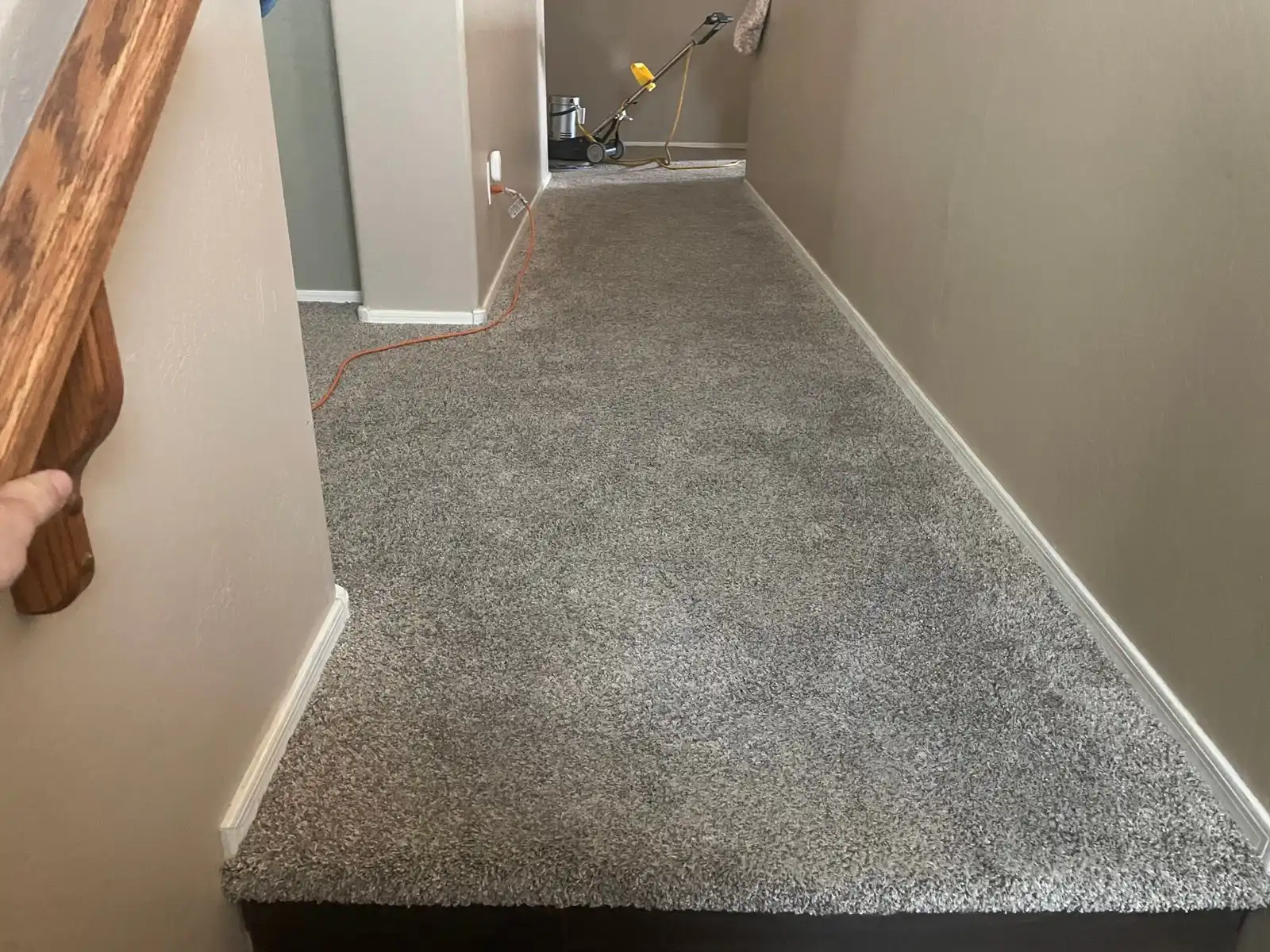
How Hallway Carpet Gets Compressed in Surprise Homes
Hallways are unique among carpeted spaces because traffic is almost entirely unidirectional. In a bedroom, people walk in from multiple directions. In a hallway, almost every footstep goes the same direction. The pile gets compressed toward one end, and the net result over thousands of footsteps is a directional collapse that points fibers along the traffic axis.
This directional collapse is more pronounced in Surprise than in cooler climates. From May through September, when indoor humidity is 10-15%, carpet fibers have less natural resilience. Dry fibers compressed under foot traffic stay compressed longer between footsteps. Over a Surprise summer, the directional collapse in a heavily used hallway advances faster than it would in a more moderate climate.
The two-story hallways common in Surprise builds are particularly affected. Upstairs hallways connecting three or four bedrooms get traffic from everyone in the household every morning and every night. That's concentrated linear traffic across a long carpeted corridor, repeated daily, in a climate that reduces fiber resilience.
💡 How Soil Loading Changes Light Absorption
Clean carpet fibers are slightly translucent at the tip - light enters the fiber, travels through it, and exits at the base. This is what gives clean carpet its depth and brightness. Soil-loaded fibers lose this translucency. Fine dust, skin cell residue, and body oils coat the fiber surface and block the light transmission. In a hallway, this soil loading is concentrated in the traffic path because every footstep compresses soil deeper into the pile.
The Far-End Effect in Long Surprise Hallways
Walk down a long hallway in a Surprise home and look at the far end. It almost always looks darker than the near end, even with a light fixture at the far end. Homeowners assume this is a lighting design problem. Usually it's a carpet problem.
If the carpet directly under the fixture is clean and upright, it reflects and redistributes light toward both ends. If it's compressed and soil-loaded, the area under the fixture absorbs light rather than distributing it. The far end gets only direct illumination without the benefit of carpet-redistributed light filling in dim zones.
I've heard homeowners in Mountain Vista Ranch and Surprise Farms describe their hallway as feeling like a tunnel - bright near the stairs, progressively darker toward the end. After cleaning and fiber restoration, the tunnel effect goes away because the carpet is distributing light down the length of the corridor instead of absorbing it.
How I Restore Hallway Reflectivity in Surprise
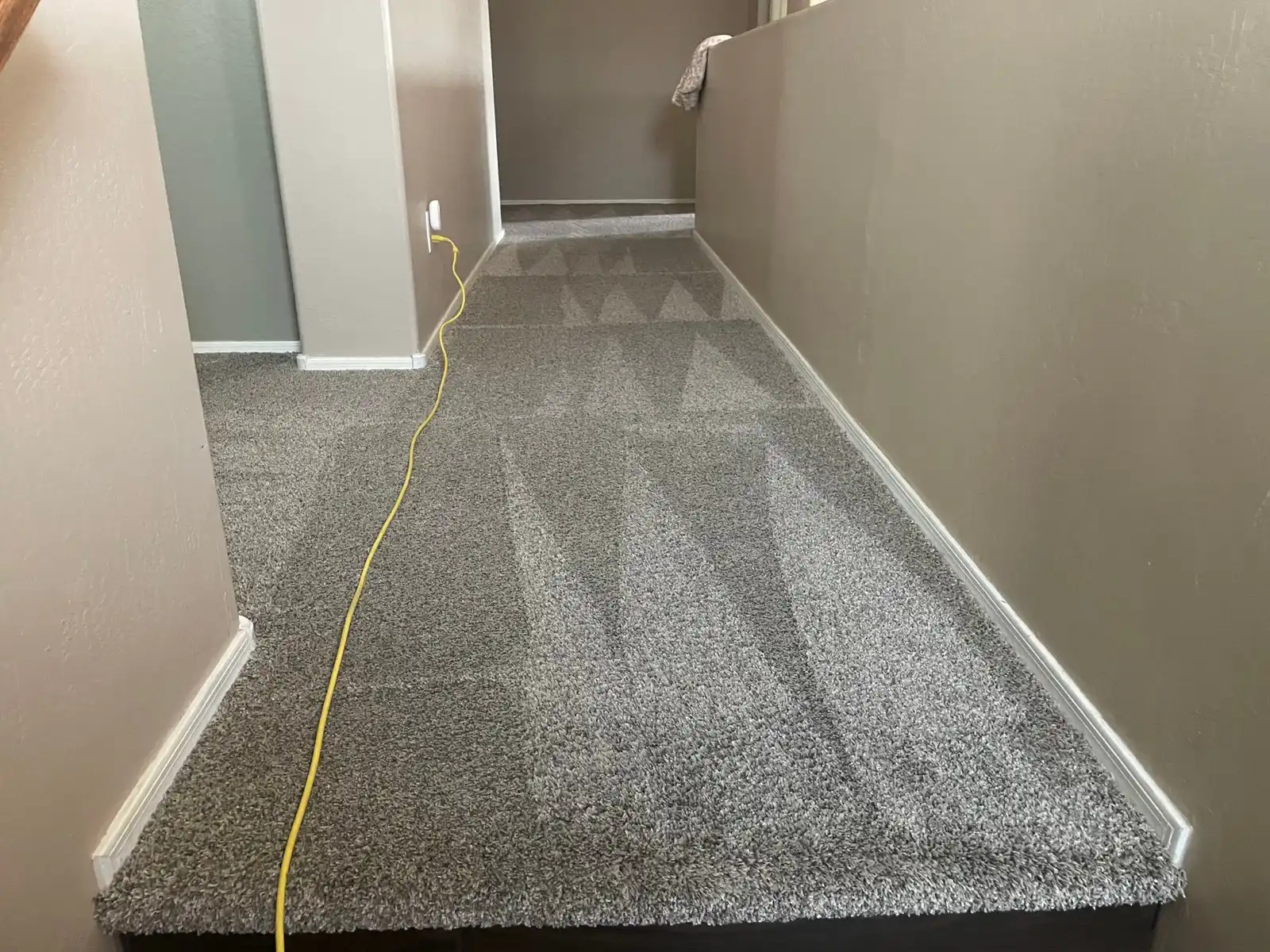
First, I assess pile condition under raking light - light from the side that reveals pile direction and compression. This shows the actual state of fiber geometry and determines how much grooming emphasis the job needs.
Second, I apply pre-treatment with good dwell time. Hallway soil in Surprise is fine mineral particulate and foot traffic composite - it needs time to penetrate to the pile base where the bulk of the soil load is.
Third, I clean against the traffic direction. This is critical and the step most methods skip. Cleaning against the collapsed direction uses cleaning action to work against the compressed pile angle and start lifting fibers before grooming.
Fourth, I extract thoroughly. Fine mineral particulate from Surprise's construction and desert environment needs to fully leave the fiber before grooming.
Fifth, I groom systematically from end to end while the carpet is still slightly damp - the window when fibers are most mobile. I work against the traffic direction, setting fibers upright across the full width.
Sixth, I check the result under raking light before finishing. If any sections still show pronounced collapse, I re-treat and re-groom.
The hallway dries in about 1 hour. The brightness difference is visible immediately and becomes even more apparent once fibers are fully dry and set in the upright position.
Maintenance Between Professional Cleanings
- Vacuum against the traffic direction at least once a week. Most people vacuum in the direction they're walking - which is the direction fibers are already collapsed. Vacuuming against traffic uses brush action to partially lift fibers between cleanings.
- Use a vacuum with a beater bar or rotating brush rather than suction-only. Mechanical lift from the brush roll agitates and partially recovers compression with each pass.
- Use a doormat inside the hallway entry. Reducing abrasive mineral particulate from entries slows fiber tip degradation that affects reflectivity over time.
- Professional cleaning annually keeps soil load from reaching levels that significantly affect fiber translucency, and grooming partially resets compression accumulation.
For homes in Marley Park and Ashton Ranch where upstairs hallways are long and heavily trafficked, annual cleaning before summer - in March or April - gives the best maintained brightness through the months of highest indoor use.
Learn more about our carpet cleaning process, or explore other cleaning services we offer in Surprise.

 (602) 429-9602